I have stood in the corner of the Sheraton Centre ballroom more times than I care to count, watching a well-meaning HR Director scan the room with a look of mild panic. They spent $5,000 on a live jazz trio that nobody is listening to, and another $3,000 on a photo booth that has been empty for forty-five minutes. The open bar is busy; the engagement is zero.
This is the nightmare scenario for any planner tasked with proving the value of their budget. When you are asked to justify the spend for your next Q1 kick-off or client appreciation night, "people seemed to have fun" is no longer an acceptable metric. You need engagement metrics. You need retention. You need people talking about the brand activation solutions you deployed long after the Uber ride home.
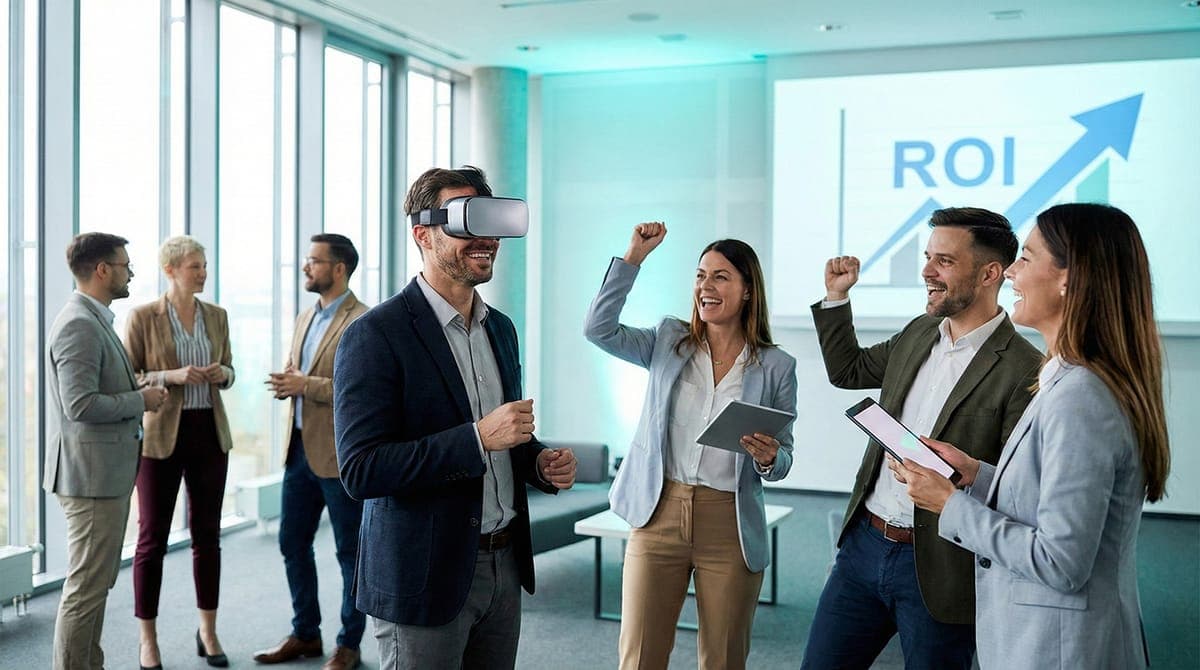
After running over 200 events across the GTA—from high-stakes trade shows at the Enercare Centre to intimate team-builders in Liberty Village lofts—I can tell you exactly why VR delivers the best ROI for corporate events in 2025. It is not because it is "futuristic." It is because it is the only entertainment channel that demands 100% of a guest's attention.
The Attention Economy: The Operator's Perspective
If you ask me where to put your entertainment budget this year, I won't tell you to hire a magician. I will tell you to deploy a managed Virtual Reality station. Here is the reality of the event floor: distraction is your enemy. People are glued to their phones, checking emails, or planning their exit.
When a guest puts on one of our Meta Quest 3 Business Edition headsets, two things happen immediately:
- Physical Isolation: They cannot check their phone. They cannot look over your shoulder for someone more important to talk to. They are physically incapable of being distracted.
- Active Participation: They are not watching entertainment; they are doing it.
We see an average session time of 3-7 minutes per guest. In the world of business event entertainment, five minutes of undivided, enthusiastic attention from a potential lead or a distracted employee is an eternity. That is where the ROI lives.
The Math: Calculating Cost Per Engaged Minute
Let’s get specific. I often help clients compare VR against other standard options using a metric I call "Cost Per Engaged Minute." This is the only metric that matters when your goal is brand impact or team bonding.
Here is the breakdown I use when we are sitting in a planning meeting for a launch at the Metro Toronto Convention Centre. Let's assume a hypothetical budget of $4,000 for a 4-hour event with 100 attendees.
| Metric | Photo Booth ($4k) | Live Band/DJ ($4k) | Managed VR (2 Stations - $4k) |
|---|---|---|---|
| Interaction Type | Passive (Stand & Smile) | Passive (Listen/Ignore) | Active (Move & Solve) |
| Dwell Time per Person | 45 seconds | 0 (Background noise) | 5 minutes active play + 5 mins spectating |
| Total Active Engagement | ~75 mins total for event | N/A | ~400 mins active + 1200 mins spectator |
| Spectator Value | Low (Waiting in line) | Variable | High (TV Casting creates a show) |
| Brand Recall | Logo on a photo strip (often tossed) | Zero | High (Associated with adrenaline/emotion) |
With the photo booth, you are paying for a printed souvenir. With VR, you are paying for an experience that anchors a memory. At VRPlayin, we cast the gameplay to a large screen TV (55" or larger). This turns a single-player experience into a group activity. At a recent brand activation solution we ran in Yorkville, the crowd watching the CEO try to navigate a virtual world was just as engaged as the CEO himself. That is 20 people entertained by one station.
Strategic Implementation: Matching Content to ROI Goals
One of the biggest mistakes I see planners make is assuming all VR is just "video games." If you are trying to impress a room full of 50-year-old stakeholders, you do not put them in a zombie shooter. We curate specific experiences to drive specific ROI outcomes.
1. The "Culture" ROI: Breaking Down Silos
Recommended Experience: Keep Talking and Nobody Explodes
Best For: Team bonding, Leadership training, Department mergers.
This is the ultimate communication test. One person wears the headset and sees a bomb covered in complex wires and puzzles. They cannot see the manual. The rest of the team has the manual (printed or on an iPad) but cannot see the bomb. They must talk to each other to defuse it before the timer hits zero.
I’ve seen junior associates screaming instructions to senior partners. I've seen quiet accountants take charge of a chaotic situation. The ROI here isn't just fun; it's genuine team cohesion that translates back to the office on Monday morning.
2. The "Lead Gen" ROI: The Trade Show Magnet
Recommended Experience: Richie's Plank Experience
Best For: Trade show booths, Product launches, High-traffic areas.
If you need to stop foot traffic at the Enercare Centre, this is the tool. Users take an elevator up 80 stories and walk out onto a narrow wooden plank. It triggers a primal fear response (safely). The reactions are visceral—people scream, laugh, and wobble.
Why does this drive ROI? Because it draws a crowd. A crowd draws more people. While 30 people are watching someone walk the plank, your sales team has a captive audience to scan badges and start conversations. We recently used this for a tech firm and increased their qualified lead capture by 300% compared to their previous year with just swag handouts.
3. The "Educational" ROI: Innovation & Science
Recommended Experience: Human Anatomy VR or Wander
Best For: Healthcare, Pharma, Educational Summits.
For our clients in the MaRS Discovery District, entertainment needs to be smart. Human Anatomy VR allows guests to shrink down and travel inside the human body. We recently supported a pharmaceutical product launch where sales reps used this to refresh their anatomical knowledge in a fun, competitive way. It wasn't just a game; it was product reinforcement.
The Throughput Equation: Logistics & Flow
The most common objection I hear from planners is: "But you can only put one person in at a time. Won't the line be too long?"
This is where hiring an experienced operator makes the difference. If you just rent headsets and put them on a table, yes, it will be a disaster. Here is how we manage flow to maximize ROI:
The "Short-Loop" Strategy
For high-volume events (like a holiday party with 300 guests), we strictly limit game selection to "arcade-style" loops that last 2-3 minutes. We do not run 30-minute story games. We run rhythm games or high-score challenges. This ensures we can cycle 15-20 people per station, per hour.
The Casting Effect
As mentioned, the TV screen is vital. By casting the view, the person "in line" isn't waiting; they are spectating. They are laughing at the player's mistakes and planning their own strategy. The "wait time" transforms into "entertainment time."
The Ticket System
For crowded events, we implement a digital queue system. Guests sign up, go grab a drink or network, and receive a text message when it's their turn. This prevents the "dead space" of standing in a physical line, keeping the event energy high and the bar revenue flowing.
Operational Reality: What We Bring to the Table
I know what you are thinking: "This sounds complicated to set up."
It isn't. Not for you. When we say we are a full-service operator, we mean we handle the sweat equity. We require a 6.5 x 6.5 foot (2m x 2m) space per standing station. That is it. We have set up in cramped break rooms in Mississauga and sprawling expo halls in Toronto.
The VRPlayin Standard Loadout:
- Hardware: Meta Quest 3 headsets with extended battery straps. Standard batteries die in 90 minutes. Ours run for 6 hours.
- Hygiene Protocol: This is non-negotiable. I have personally cleaned headsets at midnight after a 300-person gala. We use medical-grade silicone face covers that are swapped and sanitized with UV-C light and antibacterial wipes between every single user. In a post-COVID world, optics matter. Your guests need to see us cleaning it.
- Enterprise Connectivity: If your venue has spotty Wi-Fi (looking at you, certain convention center basements), we bring enterprise-grade 5G hotspots or configure the headsets for offline-only play to ensure zero lag.
If you are looking for our full VR game catalog, we can customize the loadout based on whether you have internet access or need a strictly offline setup.
Toronto Case Study: The Skeptical Financial Firm
Let’s look at a real-world example of ROI.
Last December, we were booked for a holiday party at a venue near King West. The client was a conservative financial services firm. The HR Director told me plainly, "If this doesn't work, it's my head. These guys don't play games."
We set up four stations with a mix of Walkabout Mini Golf (familiar, low friction) and Beat Saber (high energy).
The Trajectory:
- 7:00 PM: Guests arrive. Skepticism. People watching from a distance.
- 7:20 PM: One brave associate tries Mini Golf. The TV casting shows him missing a putt. His team laughs.
- 8:00 PM: A line forms. The CEO—who initially refused to participate—gets challenged by a VP to beat a score in Beat Saber.
- 9:30 PM: The event was scheduled to end. The client paid overtime to keep us there for another hour.
The ROI Data:
- Total Utilization: 96% of the runtime saw full headset occupancy.
- Throughput: 140 unique plays across 4 stations.
- Cost Per Interaction: Roughly $15 per deep, positive brand interaction. Compare that to a $150 per head dinner where people just talk to the person next to them.
- Retention: They booked us again for their summer picnic immediately.
Common Objections (And How We Handle Them)
"What about motion sickness?"
This is the #1 question. The answer lies in curation. We strictly avoid "artificial locomotion" (games where you slide around while standing still) for corporate crowds. We focus on room-scale or stationary experiences. Because of this strict filtering, fewer than 2% of our guests report any discomfort. Our facilitators are trained to spot the signs early—if someone looks wobbly, we switch them to a seated experience immediately.
"Is it just for gamers?"
Absolutely not. In fact, gamers are often our toughest critics because they have VR at home. The best reactions come from the 45-year-old accountant who has never held a controller. Games like Job Simulator or Wander require zero skill. You just reach out and grab things.
"Is it safe?"
We carry full liability insurance (available for review with two weeks' notice). We delineate play spaces physically with stanchions to ensure no one wanders into a waiter carrying a tray of champagne.
Final Verdict: Stop Guessing About Engagement
As we move into 2025, the corporate event landscape is getting competitive. Attendees are pickier. Budgets are tighter. You cannot afford to spend thousands on entertainment that serves as wallpaper.
VR delivers the best ROI for corporate events because it is immersive, memorable, and measurably engaging. Whether you need to break the ice at a team builder or capture leads at a trade show, the headset is the most powerful tool in the box.
For real estate VR experiences, the ROI is even clearer: if one person walks through a virtual pre-construction unit and signs a lease, the event has paid for itself ten times over.
If you are planning your 2025 calendar and want entertainment that actually moves the needle, let’s talk logistics. We can assess your venue, recommend a game list, and give you a clear quote with no hidden travel fees.
Stop Guessing About Engagement
Don't let your 2025 budget go to waste on passive entertainment. Let us build a custom VR activation that guarantees guest interaction.
GET A CUSTOM EVENT QUOTE