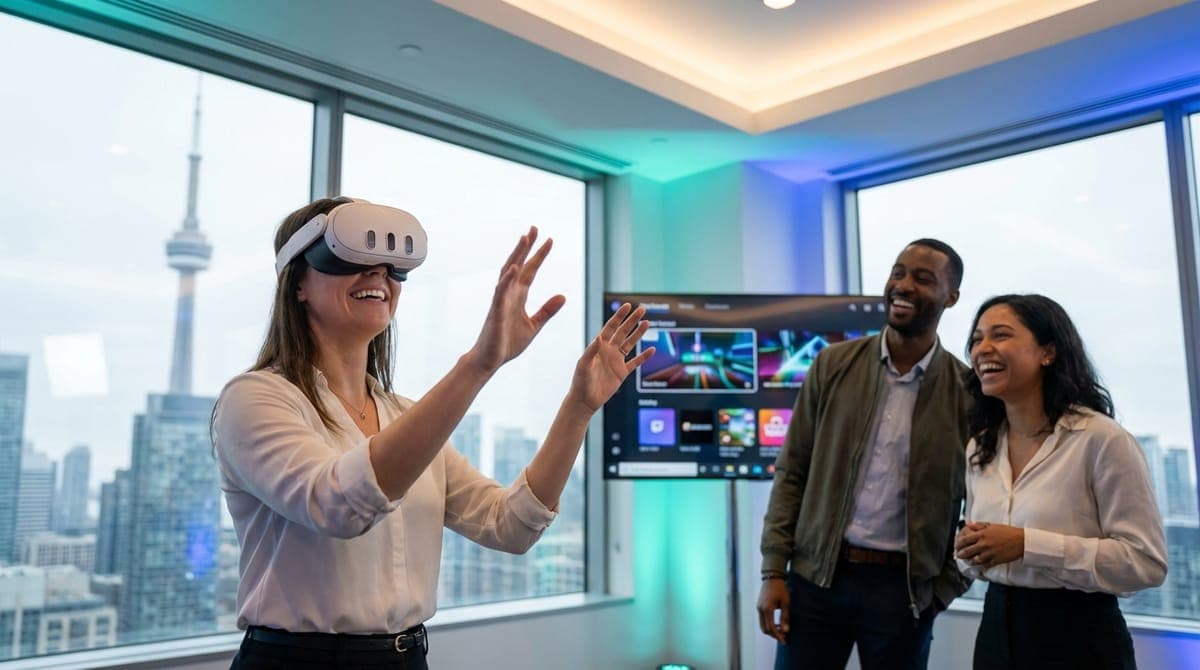
There is a specific debate I hear almost weekly from event planners finalizing their budgets for Q3 and Q4. The line item usually reads "Entertainment," and the choice comes down to two very different contenders. When analyzing vr photo booths guest engagement in Toronto, the decision isn't just about fun—it's about the psychological takeaway of your attendees.
The short answer? Photo booths offer a tangible souvenir that usually ends up on a fridge or in a desk drawer. Virtual Reality creates an active, shared emotional experience that guests talk about for months. While a photo booth captures a moment, VR creates the moment itself.
But "creating moments" is marketing fluff. You need operational realities. I have run over 200 events across the GTA, from the basement of the Rec Room to the grand ballrooms of the Fairmont Royal York. I have seen the quietest introverts become the life of the party, and I have seen the most cynical trade show attendees stop dead in their tracks.
If you are deciding between these two activations, you need to look at the metrics: dwell time, spectator value, operational footprint, and branding. Let's break down the data.
The Metric War: Passive vs. Active Engagement
We need to define what "engagement" actually means to you. Is it a headcount of who stopped by (throughput)? Or is it the duration and emotional quality of the interaction (depth)?
The Photo Booth Metric
A photo booth interaction typically lasts 45 to 60 seconds. It is passive. The machine does the work; you just stand there. The engagement curve is flat: you pose, flash, print, and leave. It is high throughput, but low impact.
The VR Metric
VR is active. It demands focus, movement, and reaction. Take Beat Saber, our most requested title. It is a medium-intensity rhythm game where you slash glowing blocks to the beat of the music. It sounds simple, but it triggers a "flow state" almost instantly.
At a recent activation in Liberty Village, we had a guest step in who claimed he "hated video games." He planned to play one song. He stayed for four. When he took the headset off, he was breathless, laughing, and immediately turned to his colleague saying, "You have to try this."
That is the difference. Nobody steps out of a photo booth and says, "My heart is racing, that was incredible." They say, "Does my hair look okay?" VR changes the physiology of your guests. It wakes them up.
Breaking the "Isolation" Myth
One of the biggest misconceptions about corporate social events is that VR is isolating. Planners worry that putting a headset on one person cuts them off from the group. In my experience, the opposite happens. We cast everything the player sees onto a large external TV screen. This turns a single-player game into a spectator sport.
We specifically use the Meta Quest 3 Business Edition because the casting capabilities are robust. At a law firm event in the Financial District, we set up a station for Walkabout Mini Golf. This is a low-intensity, highly social game. The physics are incredibly realistic—you can putt, chip, and spin the ball just like in real life, but you're doing it on a space station or a pirate ship.
Because the controls are so intuitive (point, grab, swing), the learning curve is non-existent. We saw partners coaching associates on their swing based on what they were seeing on the TV. It became a collaborative problem-solving exercise. You don't get that kind of organic mentorship standing in line for a photo printout.
Throughput Strategy: The "Acron" Method
If you are looking for effective corporate team building in Toronto for a group of 50 or 100, you might worry VR is too slow. "One person at a time? It'll take forever." This is a valid concern compared to a photo booth that can process groups of four every minute.
This is where game selection creates the win. We don't just run single-player experiences. We utilize asymmetric multiplayer games like Acron: Attack of the Squirrels!.
Here is how it works:
- One person is in the VR headset playing as a giant sentient tree protecting golden acorns.
- Up to eight other guests pull out their own smartphones, scan a QR code, and join the same game as squirrels trying to steal the acorns.
Suddenly, one VR station is entertaining nine people simultaneously. It turns a solo activity into a riotous team shouting match. We ran this at a venue near the Distillery District for a startup's quarterly social. The sheer volume of laughter—people yelling "Go left! He's looking the other way!"—drowned out the DJ. That is mobile vr team building at its finest.
The Branding Battle: Prints vs. Pixels
I will be the first to admit where photo booths have the edge: physical branding. A guest leaves with a strip of paper containing your logo. It goes on the fridge. That is valuable real estate.
However, VR branding is about association. You aren't giving them a piece of paper; you are associating your brand with the feeling of being a superhero or an astronaut. But we can also do visual branding.
At VRPlayin, we utilize:
- TV Surrounds: The 55-inch casting screens can be wrapped in branded housing or digital overlays.
- Leaderboards: For competitive events, we project a live leaderboard with the company logo. The competitive nature drives guests to look at that screen—and your logo—hundreds of times per night to check their rank.
- In-Game Customization: In certain enterprise applications, we can load custom 360-degree videos or environments that place the user strictly inside your brand narrative.
Logistics: Footprint, Power, and Lighting
As an operator, I know that the "best" entertainment is the one that fits the room. Here is the operational breakdown of VR vs. photo booths guest engagement in Toronto venues.
The Photo Booth
- Footprint: Small. 5x5 feet is usually enough.
- Lighting: Needs to be bright, or the booth provides its own strong flash.
- Power: Standard 15amp circuit.
The VR Station
- Footprint: We recommend 8x8 feet or 10x10 feet per station for safety. We need a "play space" where the guest can swing their arms without hitting a waiter.
- Lighting: VR tracking cameras hate direct sunlight and strobe lights. We work best in consistent, indoor lighting. If you are hosting a rave with heavy strobes at Rebel, we need to position the VR in a quieter breakout zone.
- Power: Standard 15amp circuit. We are self-contained.
If you are crammed into a tiny corner of a restaurant, a photo booth is the logistical winner. If you have the space to create a "zone," VR wins on impact.
The Hygiene Factor (Addressing the Elephant in the Room)
We address the "yuck factor" head-on. A common objection compared to photo booths is hygiene. "I don't want to wear something someone else sweated in."
I get it. I have personally cleaned over 40 headsets at midnight after a 300-person gala. That's why we use medical-grade silicone face covers that are non-porous. Unlike the foam used in home headsets (which absorbs sweat like a sponge), ours are wiped down with industrial-grade antibacterial wipes and UV-C sanitized between every single user.
It is cleaner than the bowling balls, karaoke mics, or photo booth props at other team building packages you might be considering. In 200+ events, hygiene has never been a friction point once guests see our uniformed staff executing the cleaning protocol.
Demographics: Who Actually Plays?
There is a fear that VR is only for the "tech guys" or the younger interns. The data from our Toronto events contradicts this.
- Gen Z / Millennials: They dive in immediately. They know the tech, they want to compete.
- Gen X / Boomers: They are often the most delighted. Why? Because they have lower expectations of technology. When a 60-year-old CEO puts on a headset and visits a hyper-realistic golf course, the "wow factor" is significantly higher than for a 20-year-old gamer.
We recently did an activation for a construction firm in Vaughan. The highest score on the leaderboard wasn't the IT guy; it was the 55-year-old foreman who played Richie's Plank Experience and handled the heights better than anyone else. VR is a great equalizer because it relies on natural human movement, not complex button combinations.
ROI Analysis: Paying for Impact
Let's talk budget. Photo booths are often seen as the cheaper option, but when you look at cost-per-minute of engagement, the math changes. If you hire a high-end photo setup with custom backdrops and props, you are paying for the physical output (the paper).
With VR, you are paying for the psychological impact. Our repeat booking rate sits at roughly 40%. Why? Because people remember how they felt.
We recently received feedback from a Marketing Director at a tech company who told us, "Our booth had a line around the corner the entire conference. VRPlayin made us the talk of the show." That line wasn't for a keychain; it was for an experience they couldn't get anywhere else on the trade show floor.
Making the Choice for Your Event
So, should you ditch the photo booth entirely? Not necessarily. If your primary KPI is social media impressions via a watermarked photo, a photo booth is a tactical tool. But if your goal is employee engagement activities that actually bridge the gap between departments or create a buzz that lasts until Monday morning, VR is the superior choice.
We handle everything—setup, the enterprise-grade WiFi networking (if needed), the hygiene, and the coaching. You just provide the 10x10 foot space. Whether it's a Bar Mitzvah in Forest Hill or a massive AGM at the Enercare Centre, the result is consistent: people lose their inhibitions and start having actual fun.
If you want to see exactly which games would fit your specific demographic—whether it's the high-energy slashing of Beat Saber or the collaborative chaos of Acron—check out our full VR game catalog to see the options.
The Verdict
Guests might keep the photo strip, but they remember the feeling of scoring a hole-in-one in zero gravity. In the battle of vr photo booths guest engagement in Toronto, VR wins on emotional impact every time. It converts passive attendees into active participants, and in the corporate world, that engagement is the only currency that matters.
Want Your Guests to actually Interact?
Stop forcing awkward small talk. Let us bring the icebreaker that gets your CEO and the interns laughing together.
VIEW TEAM BUILDING PACKAGES