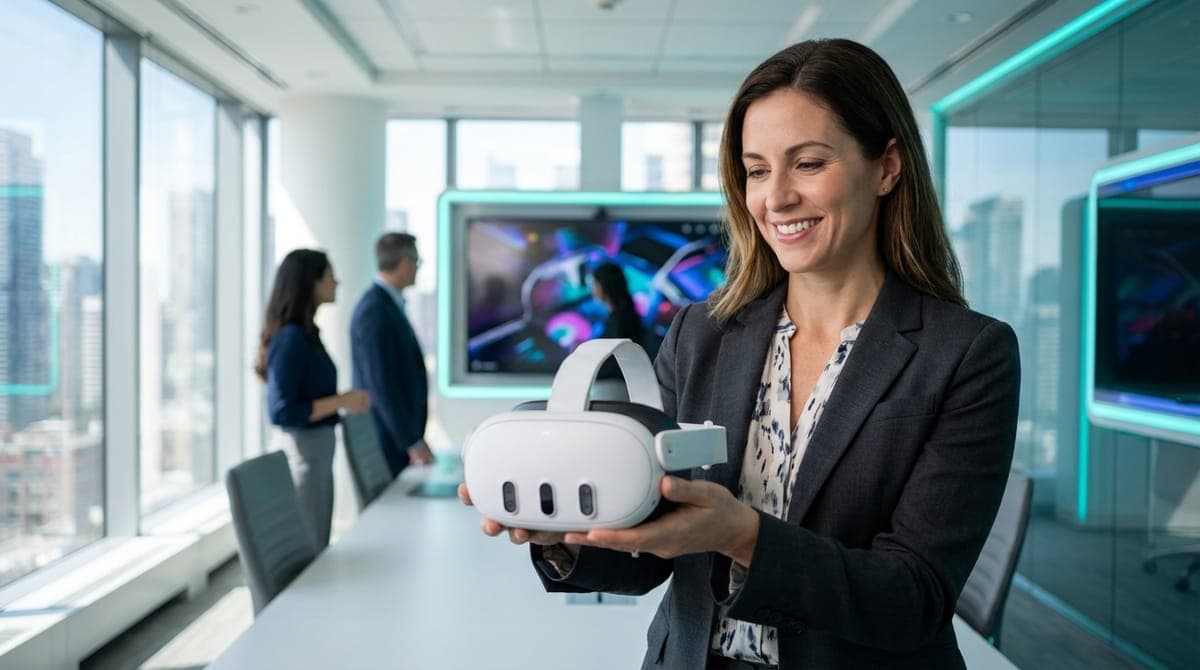
A robust VR hygiene protocol for corporate events in Toronto isn't a luxury; it is a liability shield. It requires a medical-grade approach including the mandatory use of non-porous silicone facial interfaces, 254nm UV-C sanitization, and strict "Clean/Dirty" bin logistics. At VRPlayin, we utilize a military-style sanitization process for our mobile VR activations that ensures every headset is clinically clean before it ever touches a guest's face.
At a high-stakes gala at The Carlu, nothing destroys a deal faster than a C-suite executive handing a damp, sweat-soaked headset to a potential client. That is the "ick" factor. In that split second, the investment in the experience is wasted. The focus shifts from innovation to pink eye.
I have run over 200 VR events across the GTA. I know that in the corporate world, hygiene is a trust requirement. If your team doesn't trust the gear, they won't play the game. Here is exactly how we solve the hygiene problem, down to the chemical level.
The "Sponge Problem": Why Foam Fails the Metro Toronto Convention Centre Test
When we deploy our full VR game catalog at a high-volume venue like the Metro Toronto Convention Centre, we deal with 300 to 500 unique users daily. The standard consumer facial interface on a VR headset (Meta Quest 2 or 3) is made of open-cell foam.
Foam is a sponge. It absorbs sweat, foundation, sunscreen, and facial oils. No amount of surface wiping can clean the interior of a sponge that has soaked up the perspiration of a stranger. If an event operator tells you they "sanitize" stock foam interfaces, they are functionally lying. You cannot sanitize a sponge without submerging it, which takes hours to dry.
The Silicone Solution
This is why our vr hygiene protocol for corporate events in Toronto starts with hardware modification. On every single one of our Meta Quest 3 Business Edition headsets, we rip out the stock foam and replace it with medical-grade silicone covers.
Silicone is non-porous. It is hydrophobic. It doesn't drink sweat; it beads it up. This allows us to perform a true surface sterilization between users. When a guest finishes their session, that silicone barrier is subjected to a rigorous wipe-down with 99% Isopropyl alcohol or hospital-grade CaviWipes that actually removes contaminants rather than pushing them deeper.
The "Paper Mask" Fallacy: Why We Don't Use Disposable Eye Masks
Many budget VR operators in the GTA attempt to solve the hygiene issue by using "ninja masks"—cheap, disposable paper eye masks that look like Zorro masks. You slip them over your ears before putting on the headset.
We refuse to use these for three specific operational reasons:
- Friction Failure: As soon as the user turns their head rapidly (essential in 360-degree gaming), the headset shifts, but the paper mask sticks to the sweat on their face. This blocks their vision, ruining the immersion.
- Wicking: Paper absorbs sweat and holds it against the skin, creating a damp poultice effect that feels grosser than the headset itself.
- The "Medical Patient" Optic: Putting a paper mask on a CEO makes them look like a patient in a sterile ward, not a tech-forward leader. It looks cheap, and it feels cheap.
We rely on cleaning the actual device, not adding a layer of paper trash between the user and the experience.
The Beat Saber Protocol: Managing Metabolic Heat
Hygiene protocols are easy when everyone is sitting still. But the best employee engagement activities get people moving. Take Beat Saber. You are slashing neon blocks. It is a workout. A player can generate significant metabolic heat in roughly 180 seconds.
I recall an event for a tech startup in King West where the CEO got into Beat Saber. She loved it, but she worked up a sweat. When she handed the headset back, the next person in line was her intern.
The power dynamic makes it awkward for the intern to say, "Ew, no thanks." It is our job to interrupt that dynamic. Our facilitator steps in immediately: "One moment for a refresh." They strip the silicone cover and spray the controllers. The intern sees the wet shine of the sanitizer evaporating (which takes exactly 10 to 15 seconds with 99% alcohol). By the time the headset is offered, it smells sterile.
Hardware Anatomy: A Component-Level Cleaning Guide
To truly understand our process, you have to look at the headset as four distinct contamination zones. We treat each differently.
1. The Facial Interface (High Risk)
Contaminants: Sweat, Makeup, Bacteria.
Protocol: Swap or Spray. For high-throughput speed, we spray 99% Isopropyl Alcohol directly onto the silicone. Why 99%? Because it evaporates almost instantly, leaving no residue. Lower concentrations (70%) contain more water, which takes too long to dry and can damage electronics if it drips.
2. The Lenses (Delicate)
Contaminants: Eyelash oils, fog, fingerprint smudges.
Protocol: ALCOHOL FREE. Alcohol strips the anti-glare coating on VR lenses. We use specialized photographer's lens pens and microfiber cloths dedicated solely to optics. A smudge on the lens causes light artifacting, which is the #1 cause of VR motion sickness. Clean lenses aren't just hygiene; they are nausea prevention.
3. The Controllers (The Forgotten Zone)
Contaminants: Hand oils, food residue (hors d'oeuvres), handshake bacteria.
Protocol: UV-C + Wipe. Hands are actually dirtier than faces. We use broad-spectrum disinfecting wipes on the plastic handles and often cycle them through a UV-C wand bath during downtime.
4. The Headstrap (The Sponge 2.0)
Contaminants: Hair products, sweat.
Protocol: This is the hardest part to clean on the fly. We mitigate this by using headsets with rigid plastic elite straps rather than soft cloth straps. Plastic can be wiped; cloth cannot. We avoid cloth-strap headsets for large-scale public events.
Operational Logistics: The "Clean/Dirty" Bin System
For larger groups utilizing corporate social events with asymmetric games like Acron: Attack of the Squirrels!, turnover is rapid. You cannot pause the party for 2 minutes to clean a headset.
We utilize a parallel processing workflow:
- Inventory Redundancy: We bring 150% of the required facial interfaces.
- The Bin System: On our technician table, there is a distinct "Red Bin" (Dirty) and "Green Bin" (Clean).
- The Hot Swap: When a player finishes, the interface is popped off and dropped in the Red Bin. A pre-sanitized interface from the Green Bin is snapped on immediately. The transition takes 8 seconds.
- Batch Cleaning: During gameplay, a second technician processes the Red Bin contents—spraying, wiping, and drying them before moving them back to the Green Bin.
This flow is essential for mobile vr team building. You can't have a 30-person group staring at a technician wiping a headset. Speed and safety must coexist.
The Science of UV-C: Beyond the Wipe
Chemicals are great, but light is faster. We utilize portable UV-C sanitization wands for our controllers and non-removable headset parts.
UV-C light (specifically at the 254nm wavelength) disrupts the DNA/RNA of bacteria and viruses, rendering them unable to replicate. It provides a "dry kill" method that is safe for electronics. We set up our UV stations visibly on lit tables. We want your guests to see the blue glow. It acts as a visual signal of safety, reducing anxiety and increasing participation rates.
Expert Insight: The Midnight Deep Clean
There is a reality to this business that clients never see. It’s 11:30 PM. The gala at the Fairmont Royal York is wrapping up. My team is in the loading dock doing the "deep reset."
Every piece of equipment—40 headsets, 80 controllers—gets a final decontamination before entering the Pelican cases. We do this so that when we open that case at 8:00 AM for a breakfast event in Mississauga, there is zero cross-contamination risk. It’s not glamorous, but it’s the only way to operate responsibly.
Motion Sickness: The Hygiene Connection
We must address the "motion sickness" objection, because hygiene plays a role. If a guest starts feeling warm (an early sign of motion sickness), they sweat more.
Our facilitators are trained to spot the "flush." If someone overheats, that headset is pulled from rotation immediately for a deep quarantine clean. We don't just wipe it; we remove it until it's fully reset. That is the difference between a gamer running an event and an event professional running a game.
Your Due Diligence Checklist
When planning your next function, whether a holiday party in Yorkville or a team summit in Oakville, interrogate your vendors. Don't ask "do you clean the headsets?" Ask these specific questions to filter out the amateurs:
- "Do you use stock foam or silicone interfaces?" (If they say foam, hang up.)
- "What is your turnover time for cleaning between users?"
- "Do you use a Clean/Dirty bin system for high volume?"
- "What concentration of alcohol do you use?" (Should be 90%+)
Your team's health is not the place to cut corners. Demand the silicone. Demand the science.
Mitigate Your Event Liability
Don't risk an HR nightmare with dirty equipment. Get the Toronto VR vendor that prioritizes hospital-grade hygiene protocols.
REQUEST A SAFETY-FIRST QUOTE