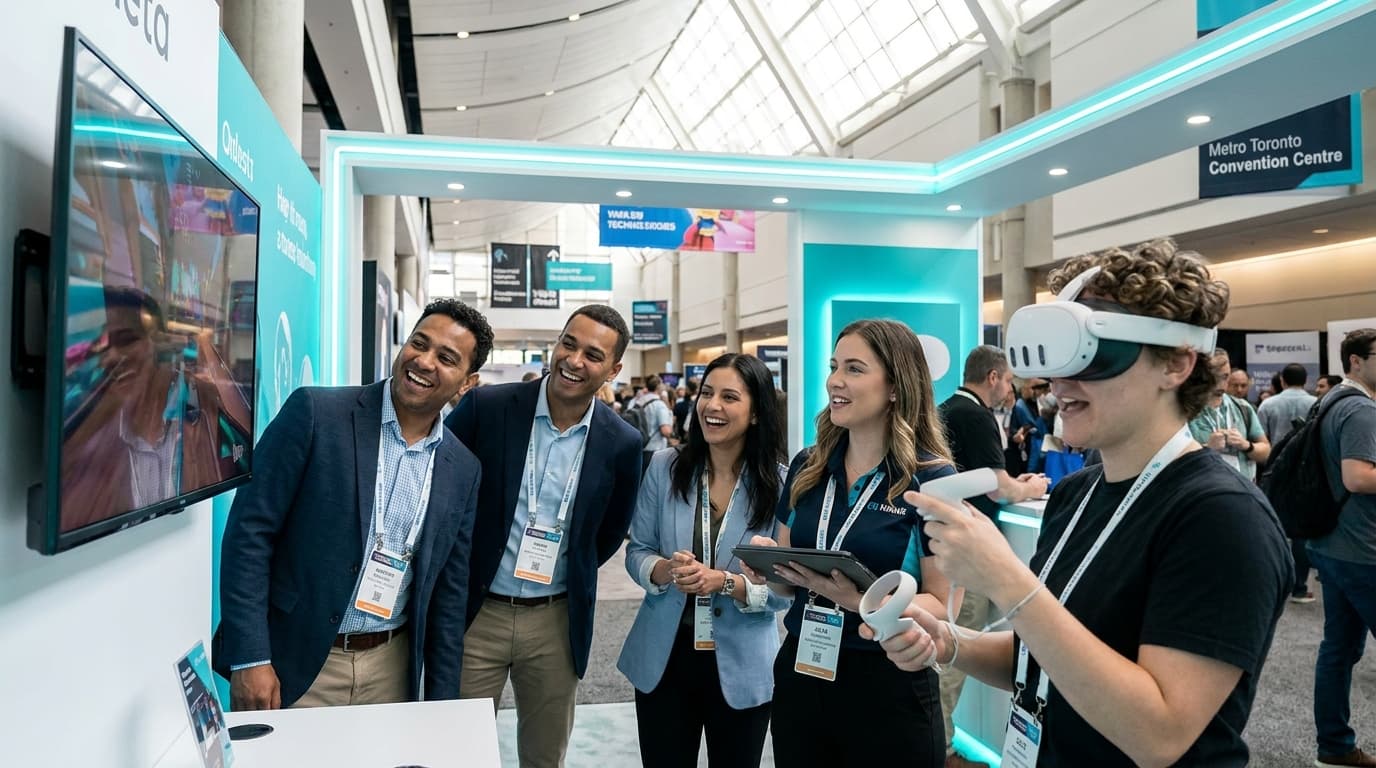
You have just booked a 20x20 island booth at the Metro Toronto Convention Centre. The invoice for the floor space alone makes your CFO wince, and now the pressure is on your marketing team to deliver qualified badge scans. Right now, you are likely debating trade show booth ideas vs escape room pop-ups to drive that essential foot traffic.
I have facilitated over 200 corporate VR activations across the GTA, from the Enercare Centre to Yorkville event spaces. I watch marketing directors agonize over this exact choice every season. The fundamental conflict is always the same: you want deep, memorable engagement, but you desperately need high throughput to justify the booth cost. Do you trap four prospects in a puzzle box for fifteen minutes, or do you run 40 leads an hour through a high-energy VR setup?
Let's drop the marketing fluff and break down exactly what works on a convention floor when your primary goal is capturing qualified leads.
Trade Show Booth Ideas vs Escape Room: The 200-Event Math
When evaluating trade show VR activations against portable escape rooms, the decision begins and ends with throughput. Throughput is the strict mathematical limit of how many humans can interact with your activation per hour. Your sales team cannot scan a badge if the prospect is stuck waiting in a 45-minute line, and they cannot qualify a lead who is locked inside a temporary plywood room.
A typical portable escape room accommodates four people per 15-minute session. Factor in the three minutes required to reset the room, explain the rules, and shuffle people in and out, and you are processing roughly 12 to 16 people per hour. For a massive trade show, that is a catastrophic bottleneck.
Let's run the Cost-Per-Acquisition (CPA) math. If your total booth investment (space, build, travel, staffing) is $30,000 for a two-day show, and your escape room maxes out at 150 participants over 16 hours, your baseline CPA just for engagement is $200 per lead. If half those leads are unqualified, your real CPA doubles.
Conversely, our mobile VR setups operate on a strict 2-to-5 minute session cycle. Take a game like Fruit Ninja 2. It is a single-player, medium-intensity experience built for quick sessions. Because it requires zero tutorial time, a prospect walks up, puts on the Meta Quest 3 Business Edition headset, plays for three minutes, and steps away breathless and laughing. With just two VR stations, you are comfortably cycling 40 to 60 prospects through your booth every single hour. At 500 prospects over that same two-day show, your engagement CPA plummets to $60.
Evaluating Footprint and the Nightmare of Drayage Fees
Floor space at a major Toronto convention venue is priced at an absolute premium. Every square foot dedicated to your attraction is a square foot taken away from product displays, meeting tables, and your sales representatives.
Portable escape rooms require a massive footprint. You are assembling literal drywall, wiring magnetic mag-locks, replacing broken cryptexes, and paying exorbitant union drayage fees (often $150+ per 100 lbs via GES or Freeman) just to move your heavy puzzle boxes from the loading dock to your booth. The logistics are heavy, inflexible, and highly prone to mid-show technical failure.
Stationary VR gameplay is brutally efficient with space. We require a minimum of 6.5 x 6.5 feet (2m x 2m) per standing station. Seated or purely stationary experiences can drop that requirement down to just 3 x 3 feet. We handle the 60-90 minute setup entirely ourselves, walking in with hard cases of Meta Quest 3 headsets and custom networking gear. There are no heavy walls to build, no union material-handling disputes, and teardown takes only 30-45 minutes after the event floor closes.
The Qualification Engine: Why Spectator TVs Beat Closed Doors
The most lucrative lead-generation happens on the aisle, not inside the headset. You cannot pitch SaaS software to someone swinging virtual swords.
We deploy 50-inch spectator TVs on truss stands that cast exactly what the player is seeing in real-time. When a VP of Sales is flailing away in VR, or walking a virtual plank 80 stories up in Richie's Plank Experience, a crowd forms in the aisle to watch the TV screen and laugh. Those spectators—standing still, smiling, and engaged—are your prime targets. Your SDRs can approach the crowd, scan their badges, and start qualifying conversations based on the shared experience happening on screen.
An escape room hides your engagement behind a wall, actively preventing a crowd from forming. VR puts your engagement on a massive screen facing the main aisle, turning your booth into a visual magnet. It forces the crowd to stop walking.
The Best of Both Worlds: Asynchronous VR Escape Rooms
If your marketing team is absolutely dead-set on the team-building aspect of an escape room, you do not have to sacrifice your floor space to get it. We bridge the gap using asynchronous VR puzzle games.
Consider Keep Talking and Nobody Explodes. One player wears the VR headset and sees a complex ticking time bomb. They cannot see the manual. The other three prospects stand outside VR holding printed bomb-defusal manuals (which we can brand with your company's logo). The VR player must describe the bomb to the outside players, who frantically search the manual and shout back instructions.
It delivers the exact same frantic communication and puzzle-solving dynamic as an escape room, but it takes up 10 square feet, cycles a team of four every 5 minutes, and draws a massive crowd of onlookers laughing at the chaos. This is how you optimize trade show booth ideas vs escape room concepts without compromising throughput.
Why Non-Gamers Dominate VR Leaderboards
A common objection I hear from corporate event planners is that VR is only for young tech enthusiasts or gamers. This is factually incorrect, and the data from our average demographic proves it.
Our most popular experiences require absolutely zero gaming skill. Take Beat Saber. You slash approaching blocks to the beat of high-energy music. I have seen nervous CEOs at Financial District boardrooms reluctantly put on the headset, only to refuse to give it back twenty minutes later because they wanted to beat their CFO's high score. We specifically curate for non-gamers. If a prospect can point, grab, and swing their arms, they can play. There are no complicated controller configurations to memorize, keeping your line moving fast.
The Risk Mitigation Matrix: Safety, Hygiene, and Crowd Flow
Having personally cleaned 40 headsets at midnight after a 300-person gala, I can tell you that hygiene and safety are the entire foundation of a successful activation. If you are comparing vendors for brand activation solutions, use this exact framework to evaluate their operational standards.
Medical-Grade Hygiene Protocols
We do not use shared foam face pads. Every Meta Quest 3 headset is fitted with medical-grade silicone face covers. We physically replace or rigorously sanitize these covers between every single user. We employ UV-C sanitization for all equipment, use antibacterial wipes on controllers between turns, and provide dedicated hand sanitizer stations. It is a relentless, visible cleaning process.
Safety and Space Management
Convention floors are chaotic. People are carrying bags, looking at their phones, and walking backward. Our facilitators physically stand between the VR player and the crowd, managing the 6.5 x 6.5 foot boundary. We use extended battery straps to keep the headsets fully wireless—meaning no tripping hazards on your expensive rented booth carpet.
Motion Sickness Reality Check
Forget the horror stories of roller-coaster VR apps from 2016. We curate zero-nausea experiences strictly designed for corporate events. We use stationary gameplay with no artificial locomotion. In 200+ completed events, fewer than 2% of our guests report any discomfort. Our trained technicians watch player body language closely and can instantly switch an experience if someone looks unsteady.
Canadian Case Study: Driving 400+ Qualified Scans
When you hire a vendor, you are trusting them with your brand's reputation on the show floor. We bring backup equipment to every single event, ensuring that if a controller drifts or a headset battery fails, our technicians swap it within 60 seconds for zero downtime.
As the VP of Marketing for a Toronto fintech SaaS noted after we deployed at Collision Conference:
"We processed 412 qualified badge scans in two days. The VR spectator screen did 80% of our SDRs' ice-breaking work for them. We never had an empty booth."
We maintain a 4.9-star Google rating and a 40% repeat booking rate because we operate like event professionals, not just gamers with hardware. We handle all the technical friction so your team can focus entirely on scanning badges and closing deals.
The Verdict: Choosing Your Booth Strategy
If you have an unlimited budget, unlimited floor space, and your only goal is to entertain four people at a time in total isolation, a portable escape room is a fine novelty. But if you are held accountable for lead generation, cost-per-acquisition, and maximizing the visual impact of your booth, the math heavily favors high-throughput VR.
You want a line of laughing prospects holding your branded swag. You want spectator TVs stopping foot traffic in the aisles. You want an attraction that cycles leads directly into the hands of your sales team every two minutes. That is what we deliver, and we have the full VR game catalog to customize the exact vibe you need for your target demographic.
Turn Your Booth Into the Busiest Spot on the Floor
Stop losing leads to the booth next door. Let our team handle the logistics, hardware, and crowd control while your sales reps focus on scanning badges and starting conversations. Check out our trade show specific packages to see how we maximize throughput and floor space.
SEE TRADE SHOW PACKAGES