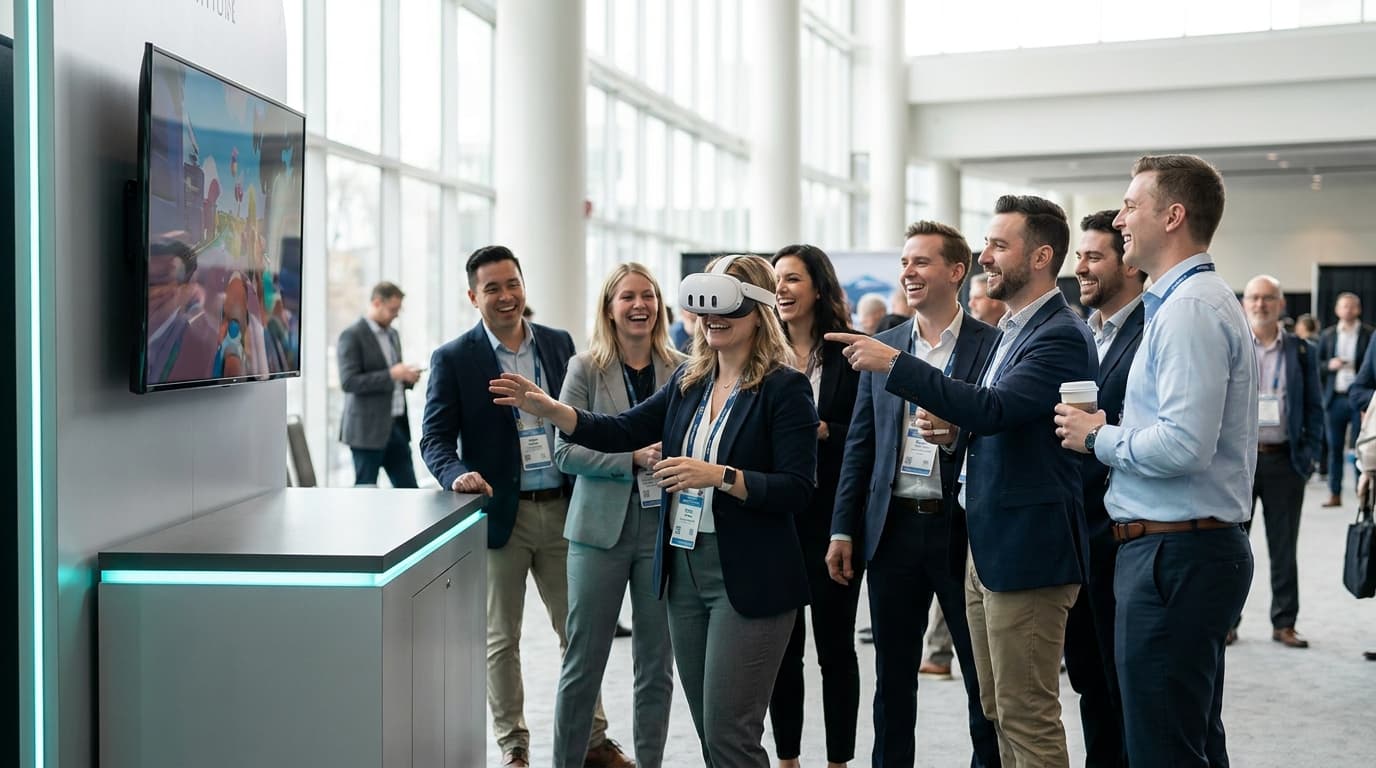
When you are searching for high-impact trade show booth ideas, the data consistently points away from passive giveaways and toward active, high-throughput interactive experiences. Mobile Virtual Reality accomplishes what a branded stress ball cannot: it stops aisle traffic, creates a magnetic spectator crowd via live TV casting, and holds your target prospects captive for the exact 3-5 minutes your sales team needs to qualify them.
Picture the south building of the Metro Toronto Convention Centre at 10:30 AM on a Tuesday. The floor is a sea of identical 10x10 and 20x20 pop-up booths. You have an SDR standing on the edge of your rented carpet, desperately trying to make eye contact with attendees who are actively avoiding their gaze. The attendees are doing the "trade show shuffle"—looking at their phones, clutching their lukewarm coffee, and dodging eye contact so they don't get roped into a thirty-minute software pitch.
Now picture the booth three aisles over. There is a line of eight people spilling out into the walkway. A crowd has formed around a 55-inch 4K monitor, laughing as they watch a VP of Logistics flail their arms trying to slice glowing blue and red blocks. The exhibitor's sales team isn't aggressively scanning badges; they are having relaxed, organic conversations with the people waiting in line. They are casually qualifying leads, dropping specific product questions into natural banter, and booking follow-up meetings before the prospect even puts the headset on.
That is the difference between hoping for foot traffic and engineering it. After executing over 200 events across the GTA—from massive multi-day setups at the Enercare Centre to high-touch VIP pop-ups in the Financial District—we have seen firsthand how the right interactive footprint changes the entire dynamic of a sales conversation.
Rethinking Trade Show Booth Ideas: The Math of Foot Traffic
Most exhibitors allocate 80% of their budget to backdrops and printed collateral, hoping sheer visual weight generates leads. After running over 200 corporate activations, I can tell you exactly why most booths fail: they are passive, static billboards in a room full of noise. Humans are hardwired to notice movement and emotion. When someone puts on a Meta Quest 3 Business Edition headset and reacts to a virtual environment, they immediately become an anchor for attention.
We utilize spectator TV casting at every event specifically for this reason. The person in the headset is experiencing the game, but the TV monitor is what catches the eye of the person walking fifty feet down the aisle. This creates a psychological permission structure for attendees to stop. They aren't stopping to talk to a salesperson; they are stopping to watch a spectacle.
The "Captive Audience" Throughput Formula
Let's break down the operational math of trade show VR activations. Our historical data shows an optimal average session per guest runs exactly 2.5 to 4 minutes. If you are running two VR stations in a 10x20 booth, that equates to a throughput of 30 to 48 players per hour. However, the value isn't just in the players; it's in the spectators.
For every active player, there is an average of 3 to 5 people waiting in line or watching the screen at any given moment. Those spectators are physically anchored to your space. They cannot leave because they want their turn. This gives your SDRs a guaranteed 4-minute, uninterrupted window to approach them, scan their badge, ask what brought them to the show, and determine if they fit your Ideal Customer Profile (ICP). Your floor team suddenly has a self-replenishing pool of 120+ captive prospects per hour to qualify.
Curation is King: The Best VR Games for Booth Traffic Generation
The biggest mistake exhibitors make when planning interactive booth experiences is selecting content based on what sounds cool rather than what processes a crowd efficiently. You do not want a complex, story-driven game like Half-Life: Alyx that takes ten minutes just to learn the controls. You need immediate, intuitive mechanics that anyone can grasp in five seconds.
We curate zero-nausea experiences exclusively. We mandate stationary gameplay with no artificial locomotion, which is why fewer than 2% of guests across our activations report discomfort. Here is the exact software we use to maximize throughput and engagement.
Beat Saber: The Ultimate Crowd Draw
This is the world's most popular VR game for a reason. You slash blocks to the beat of high-energy music. It is a 1-player, medium-intensity experience that serves as our single most effective magnet for energy. When a quiet analyst steps into the headset and suddenly starts destroying targets with perfect rhythm, the crowd erupts. It naturally caps out at 2-3 minutes per song, ensuring perfect line velocity. The 1080p live cast of the glowing neon blocks is highly visible from across a crowded exhibition hall.
Pistol Whip: The Adrenaline Anchor
For audiences that skew competitive, Pistol Whip is unparalleled. It is a 1-player, high-intensity cinematic rhythm shooter where guests dodge and shoot to vibrant synth-wave tracks. The physical movement required (ducking and dodging) makes it highly entertaining for the spectator crowd to watch. It visually communicates action instantly, pulling in attendees who are looking for a break from mundane software demos.
Richie's Plank Experience: The Spectator Magnet
If you want pure visceral reactions, this is it. Players step into a virtual elevator, go up 80 floors, and walk out on a wooden plank suspended over a city. It requires zero buttons—just walking. The session lasts 60 seconds, allowing for massive throughput. The real magic is the crowd reaction. Watching a grown executive hesitate to step onto a virtual plank draws crowds of 15-20 people purely to film the interaction on their iPhones, giving your brand immense secondary social media exposure.
Racket: NX: The Reaction Speed Qualifier
If you want to run a leaderboard, Racket: NX is the optimal choice. It functions as a futuristic racquetball game inside a giant glass dome. The scoring is objective, making it perfect for a "Highest Score Wins a Prize" daily contest. Attendees will literally return to your booth three times a day to check the whiteboard and see if their high score has been beaten, giving your team multiple touchpoints with the same prospect.
You can view our full VR game catalog to see how we match specific software mechanics to different corporate audience profiles.
The Operations Playbook: From Spectator to CRM Lead
Putting a headset in a booth does not magically generate revenue. A tight, well-rehearsed floor strategy and specific badge-scanning workflows generate revenue. This is the exact sequence we train our corporate clients to execute.
Step 1: The Visual Hook & Footprint Optimization
We require a minimum footprint of 6.5 x 6.5 feet (2m x 2m) per standing station to ensure a safe swing radius. We position the TV casting monitors flush against the aisle edge, facing outward toward the heaviest traffic flow. Our VRPlayin technical facilitators stand slightly behind the player, actively managing the hardware and ensuring physical safety. Your sales team stands at the perimeter, iPad or badge scanner in hand.
Step 2: The Soft Intercept
When an attendee stops to watch the TV screen, your rep approaches with a casual opener related to the game, not your software. "It looks easy until you put the headset on. Have you tried VR before?" This disarms the prospect. They are expecting a pitch; instead, they get a shared human experience.
Step 3: The Qualification Queue
As the attendee expresses interest, your rep manages the digital queue. "I can get you next in line. I just need to scan your badge to secure your spot." You have now captured the lead in your CRM. While they wait the 3 minutes for their turn, your rep asks the pivotal BANT (Budget, Authority, Need, Timeline) qualification questions: "What are you currently using for your inventory management? What brought your team to the show this year?"
Step 4: The Experience and Handoff
The attendee plays their round. They take off the headset laughing, experiencing a rush of endorphins—a psychologically proven state of high receptivity. Your rep hands them a cold branded bottle of water and executes the pivot: "Great score. Based on what you mentioned earlier about your inventory bottlenecks, I actually think our new module could save you about fifteen hours a week. Do you have five minutes to look at a quick demo on this laptop before you head to your next session?"
Overcoming Trade Show Technical Nightmares
If you rely on venue Wi-Fi for your trade show booth ideas, you will fail. Venues like the MTCC or the Enercare Centre are black holes for standard 2.4GHz Wi-Fi due to the sheer volume of mobile devices and overlapping router signals. If your VR headset cannot cast smoothly to your TV, you lose your spectator crowd, and your lead generation dies.
We bypass venue infrastructure entirely. We deploy dedicated enterprise-grade 5GHz routers hardwired directly to our casting receivers, establishing a localized, interference-free network strictly for screen mirroring. For massive tech conferences where even 5GHz spectrum is polluted, we utilize direct physical HDMI tethering with active USB-C optical cables to guarantee zero-latency 4K casting to your displays. We never put our clients at the mercy of convention center IT.
Expert Insight: Managing Hardware and Hygiene on the Floor
I have personally cleaned 40 headsets at midnight after a 300-person gala in a downtown Toronto hotel, ensuring they were ready for an 8:00 AM breakfast keynote. If you are going to execute interactive booth experiences, your hardware management and hygiene protocols must be bulletproof. A single dead battery or a visibly smudged lens kills momentum.
Our protocol is uncompromising. We use medical-grade silicone face covers that are wiped down with non-alcoholic antibacterial wipes between every single user. We employ UV-C sanitization for all controllers. We keep hand sanitizer stations integrated directly into the footprint.
Hardware endurance is another massive point of failure for amateur setups. A standard Meta Quest 3 battery lasts roughly 1.5 to 2 hours under heavy processing loads. A trade show floor is open for eight hours. We run customized extended battery rigs with magnetic hot-swapping power banks. Our technical facilitators swap depleted batteries in three seconds without ever powering down the headset. Furthermore, our technicians can swap a faulty controller with our on-site backup inventory within 45 seconds. When the Director of Operations from your biggest target account is in your booth, you do not have time for a system reboot.
Designing for Different Floor Plans
Integrating VR requires strict adherence to spatial strategy. Do not bury the VR experience at the back wall of your booth behind your demo stations; it must be positioned as a beacon.
- 10x10 Inline Booth: Tight, but workable. We run a single stationary setup angled slightly, with the TV monitor mounted on a tall floor stand directly on the aisle line to maximize visibility.
- 10x20 Corner Booth: We highly recommend placing two VR stations on the outermost corner, utilizing the natural intersection of two aisles to pull traffic from multiple directions simultaneously.
- 20x20 Island Peninsula: The ultimate playground. We deploy four stations facing outward in a diamond configuration, creating a massive 360-degree spectacle with customized leaderboard software displayed on a central truss monitor.
Sample Budget Breakdown: Planning Your Interactive Booth
Vague estimates lead to rejected marketing proposals. To implement these trade show engagement ideas successfully, you need clear financial line items. Below is a realistic baseline estimate for a typical two-day B2B trade show in the Greater Toronto Area (typically ranging from $3,500 to $6,500 CAD depending on scale).
Assumptions for this Estimate
- Event Duration: 2 exhibition days (e.g., 9 AM to 5 PM daily)
- Venue: Major GTA convention space
- Stations: 2 simultaneous standing VR stations
- Throughput Target: 150-200 qualified interactions per day
- Staffing: 2 dedicated VRPlayin technical facilitators
Line Item Breakdown
- Hardware & Software Licensing: Includes two Meta Quest 3 Business Edition headsets, commercial licensing for all curated games, magnetic hot-swap battery rigs, and identical backup hardware on-site.
- Casting & Display Infrastructure: Two 50+ inch casting monitors, heavy-duty mobile floor stands, zero-latency transmission gear, and dedicated offline enterprise routers.
- Technical Facilitation: Two trained VR staff members. They handle all guest onboarding, safety monitoring, hygiene management, and hardware maintenance, allowing your SDRs to focus 100% on pipeline generation.
- Logistics & Setup: 90 minutes of load-in/setup before the event start, and 45 minutes of teardown after. We handle all delivery, union dock coordination, and strike.
- Liability Insurance: Full coverage commercial liability insurance, with your venue and company listed as additionally insured certificates.
Maximizing the Post-Show Follow Up
The energy you create on the floor means nothing if the follow-up falls flat. The primary advantage of utilizing high-energy games like Racket: NX or Beat Saber is that they give your SDRs a highly personalized hook for their post-show outreach.
Instead of sending the standard, "It was great meeting you at Booth 412, would love to schedule a demo," your team can send: "Hey David, great meeting you at the show. I just checked the final Racket: NX leaderboard and you managed to hold onto 3rd place! I know we briefly discussed how your team is handling procurement delays—I have a few ideas on how we can streamline that. Are you open for a quick 15-minute call next Tuesday?"
That specific, experience-based personalization cuts through the noise of the fifty other generic vendor emails sitting in their inbox the Monday after the conference. It proves you paid attention to them as a human being, not just a badge scan.
Turning Attention into Pipeline
The landscape of event marketing has shifted. Attendees are highly protective of their time and deeply cynical about traditional sales pitches. If you want to penetrate that armor, you have to offer an experience that is genuinely valuable, entertaining, and visually magnetic.
By combining flawless technical execution, medical-grade hygiene standards, and a deeply integrated floor strategy, our brand activation solutions transform a patch of rented convention carpet into a high-velocity qualification engine. We handle the technology, the onboarding, and the crowd management. Your team handles the pipeline.
If you are planning your upcoming exhibition calendar and want to stop relying on fishbowls and pop-up banners to hit your lead targets, it is time to upgrade your floor presence. We execute these activations across Canada, bringing the exact same rigorous operational standards to every single floor.
Turn Your Next Trade Show Booth Into a Lead Magnet
Stop competing with fishbowls and passive giveaways. Our mobile VR trade show setups pull aisle traffic, hold attention with live TV casting, and give your sales team the captive audience they need to qualify real opportunities.
GET A CUSTOM QUOTE