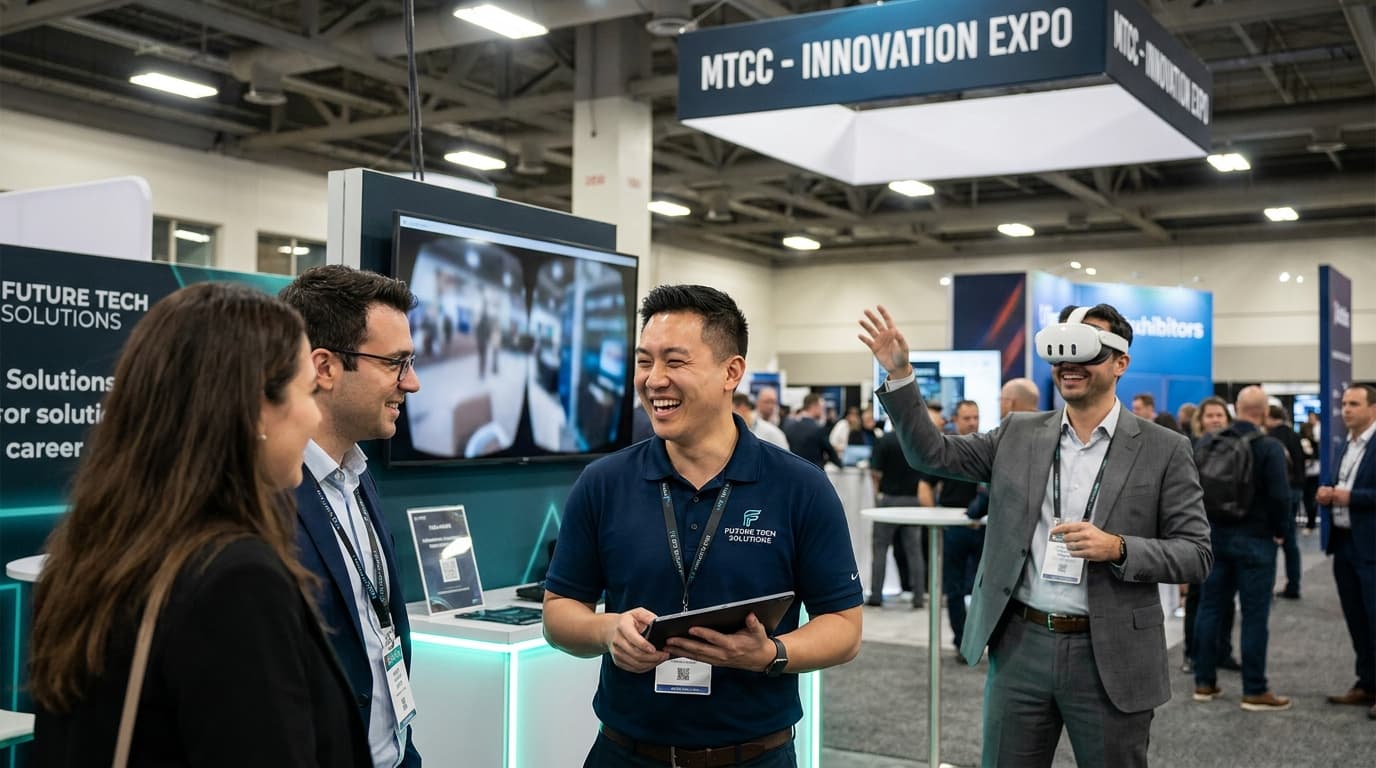
I have stood on the concrete floors of the Metro Toronto Convention Centre more times than I can count, watching exhibitors make the exact same mathematical error. They spend $30,000 on a prime 20x20 island booth, rent a massive physical game or a flashy gimmick, and then realize they have created a catastrophic bottleneck. The line snakes into the aisle, nearby exhibitors complain, and worst of all, attendees play the game and walk away without ever speaking to a sales rep.
If you are actively researching trade show booth ideas throughput, you are already asking the right question. A crowd is a vanity metric. What pays for the booth space is a predictable engine of qualified conversations.
After running 200+ VR events across the GTA, I evaluate booth entertainment entirely differently than most marketing directors. I do not care how loud an activation is. I care about the cycle time. I care about where the attendee looks while they wait. I care about the exact moment your Account Executive can scan a badge and ask a qualifying question without being intrusive.
You need a system that captures attention, cycles users predictably, and engineers natural moments for lead qualification. Let us break down the exact operational math of making that happen.
The Core Strategy: VR as a Lead Quality Engine
Most exhibitors treat entertainment as a trap to catch passing traffic. They hire a barista or rent a standard arcade cabinet. Those are fine brand activation solutions, but they fail at throughput optimization. A coffee line creates annoyed people checking their phones. A single arcade cabinet occupies two people while everyone else walks past.
Our strategy relies on a distinct hardware setup: Meta Quest 3 Business Edition headsets equipped with extended battery straps, wirelessly casting gameplay to large spectator TVs. This setup shifts the focus from the player to the audience.
To maximize this, the physical placement of your screens is critical. We mount our 50-inch 4K spectator TVs on 6-foot vertical truss stands, positioning the screen above the average attendee eye level. When a prospect is three aisles away, they cannot see the person in the headset, but they can clearly see the glowing TV screen broadcasting the first-person gameplay. It acts as a digital billboard. They walk toward the screen.
When a VP of Logistics is swinging a putter in virtual reality, they cannot talk to your sales team. They are wearing a headset. The value is not the person in the headset—it is the three people watching the TV screen, laughing at their boss trying to sink a virtual putt. That spectator TV is your lead generation engine. Your sales reps stand next to the screen, watch the gameplay with the onlookers, and use the shared experience as a natural icebreaker.
Do not let your reps just stand there in silence. We train client teams to use the gameplay to initiate discovery. When the prospect misses a virtual putt, your rep can say: 'Looks like your short game needs a little work—is your Q3 supply chain strategy rolling any smoother?' It sounds cheesy, but in the loud, high-energy environment of a convention center, it gets a laugh, lowers their guard, and transitions instantly into a business conversation.
Trade Show Booth Ideas Throughput: The Math by Station Count
Throughput is a strict mathematical formula. In our standard corporate setups, an average session runs 2 to 5 minutes. For high-volume trade show VR activations, we lock gameplay at exactly 3 minutes.
Here is the four-minute cycle we train our facilitators to execute:
- 0:00 - 0:30: Onboarding. The facilitator adjusts the headset, hands over the controllers, and explains the single button the user needs to press.
- 0:30 - 3:30: Gameplay. The user plays while your sales team chats with the spectators.
- 3:30 - 4:00: Offboarding and Hygiene. The user removes the headset. The facilitator wipes down the medical-grade silicone face cover with antibacterial wipes and prepares for the next guest.
At 4 minutes per complete cycle, a single VR station processes exactly 15 guests per hour. You can use this benchmark to scale your booth footprint.
1 Station Setup (10x10 Booth)
A single station requires a minimum footprint of 6.5 x 6.5 feet (2m x 2m) to allow safe swinging distance. In a standard 10x10 inline booth, this leaves enough room for a high-top table, the spectator TV, and two staff members.
Throughput: 15 active players per hour. Audience Multiplier: 45-60 spectators engaged per hour. This is the ideal setup for highly targeted, specialized industry shows where you want deep, 5-minute conversations with a smaller pool of VIP buyers.
2 Station Setup (10x20 Booth)
Two stations running side-by-side fundamentally change the dynamic. Now, you can run multiplayer sessions. Two attendees can play against each other, which inherently draws a larger crowd of their colleagues.
Throughput: 30 active players per hour. Audience Multiplier: 90-120 spectators engaged per hour. Space required is 13 x 6.5 feet, leaving ample room in a 10x20 space for a proper reception desk and lead-scanning station.
4 Station Setup (20x20 Island or Larger)
When you secure an island booth at the Enercare Centre or Toronto Congress Centre, four stations transform your footprint into a destination. We routinely see lines form around the corner for four-player cooperative games.
Throughput: 60 active players per hour. Audience Multiplier: 200+ spectators engaged per hour. At this scale, your bottleneck will not be the VR hardware—it will be your sales team's ability to scan badges fast enough.
Game Selection: Fast Turnover vs. Relationship Building
You cannot just load a random game and expect it to serve your business goals. You must match the software to your desired throughput and sales cycle.
High Throughput, High Energy: Racket: NX
If you are at a massive tech conference and need to process hundreds of people while generating maximum noise and energy, we load Racket: NX. It is futuristic racquetball played inside a giant glass dome where you hit glowing targets in 360 degrees. It requires zero gamer skills—you just swing the controller like a racket. It is a medium-intensity game that tests reaction speed. We set the timer for 3 minutes. The rapid movements attract attention from three aisles over.
High Spectator Engagement, Fast Cycle: Richie's Plank Experience
If your brand messaging revolves around 'taking risks,' 'elevating performance,' or 'overcoming fear,' we load Richie's Plank Experience. The premise is incredibly simple: the player rides a virtual elevator to the 80th floor, the doors open, and they are tasked with walking out on a narrow wooden plank extending over a sprawling digital city. The cycle takes exactly 2 minutes. The physical reaction—wobbly knees, gasps, and nervous laughter—makes passing attendees stop dead in their tracks. It boasts the highest audience multiplier of any VR title because human beings are hardwired to watch others react to perceived danger. This is perfect for high-traffic shows where you need to completely block the aisle with a massive, highly engaged crowd.
Low Throughput, Deep Conversations: Walkabout Mini Golf
If you are at a wealth management symposium at the Fairmont Royal York and your goal is to hold a prospect's attention for 10 minutes, we load Walkabout Mini Golf. It is the gold standard for social VR, featuring beautiful courses from pirate coves to space stations. It is a low-intensity, relaxed pace experience. Two prospects can play a quick three-hole stretch while your Account Executive talks to them about their Q3 portfolio strategy. The game facilitates conversation rather than interrupting it.
You can browse our full VR game catalog to see how we categorize experiences by intensity and required space, but we always consult with you to select the exact title that matches your throughput goals.
Post-Event KPI Dashboard: Benchmarking Interactive Booth Experiences
How do you know if the activation actually worked? After cleaning 40 headsets at midnight and packing down our gear, the first thing our corporate clients want to see is the data. You need a way to measure the impact of your interactive booth experiences against standard trade show ideas.
Here is a sample post-event KPI dashboard based on our averages across a typical 3-day (24 total floor hours) convention using a 2-station setup:
- Total VR Sessions Facilitated: 720 sessions (30 players/hour x 24 hours). This metric proves operational efficiency. If this number is lower than capacity, your booth placement or signage failed.
- Spectator Dwell Time: 4.5 minutes. We track how long onlookers stay to watch the casting TV. A 4.5-minute dwell time gives a rep ample opportunity to initiate a conversation.
- Badge Scans (Lead Capture): 850 scans. Notice this is higher than the player count. Because the spectator TV engages the crowd, reps capture leads from people who watch but never put on a headset.
- Sales Qualified Leads (SQLs): 120 SQLs. The ultimate metric. This represents attendees who watched the gameplay, spoke with a rep, matched the ideal customer profile, and agreed to a follow-up meeting.
How does this data securely bridge the gap from the exhibition hall to your Salesforce or HubSpot CRM? We strongly advise against manual sign-up sheets or business card fishbowls. Instead, we position a branded iPad on a secure floor stand directly next to the spectator TV. As the crowd gathers to watch the gameplay, your brand ambassadors can seamlessly work the perimeter, scanning attendee badges. You can also deploy a digital form offering a prize draw (e.g., 'Win the Meta Quest 3 You Just Played') in exchange for a badge scan. The spectacle of the VR game acts as the magnet; your CRM-linked badge scanner is the net.
A standard booth without an interactive anchor typically sees a 2-3% conversion rate from total foot traffic to SQL. A well-managed VR booth pushes that to 5-8% because the spectacle forces attendees to stop walking and stand still.
The Logistics of Running 200+ Events
I know exactly what goes wrong at trade shows, which is why we built VRPlayin as a fully managed service. We do not just ship you a box of headsets and wish you luck. That is a recipe for uncharged batteries, Wi-Fi failures, and an abandoned activation by 11:00 AM.
When you book us, we arrive 60 to 90 minutes before the event starts. We assess the floor plan, set up the boundaries to ensure absolute physical safety (requiring that exact 6.5 x 6.5 ft grid per station), and configure the casting TVs. We bring our own backup equipment to every event. If a headset fails or a controller battery dies, our trained technicians swap the hardware within two minutes. You experience zero downtime.
We also understand the constraints of convention center networks. While multiplayer experiences require internet, many of our high-throughput single-player titles run entirely offline. If your activation demands Wi-Fi, we confirm those requirements during the planning phase and can bring our own enterprise networking gear rather than relying on the venue's overloaded public network.
Handling the Inevitable Objections
Before you pitch this to your marketing committee, you need to be prepared for the two questions that always come up regarding mobile VR events in Canada.
"What about hygiene? Isn't sharing a headset gross?"
If you use stock foam face plates, yes. That is why we do not use them. We use medical-grade silicone face covers that are non-porous. Between every single user, our facilitators wipe down the headset and controllers with antibacterial wipes. We utilize UV-C sanitization wands on all equipment. We provide hand sanitizer stations right at the boundary line. All gear is thoroughly cleaned before, during, and after the event. In 200+ events, we have never had a hygiene complaint.
"Will this make our VIP prospects motion sick?"
This is a valid concern born from cheap, badly configured VR from five years ago. We curate zero-nausea experiences only for corporate events. We exclusively run stationary gameplay with no artificial locomotion (meaning the player does not "walk" using a joystick while standing still, which is the primary cause of nausea). In our history, fewer than 2% of guests report any discomfort. Furthermore, our facilitators are actively watching the players. If someone even slightly loses their balance or shows signs of dizziness, we step in, pause the experience, and switch them to something completely stationary.
The Final Word on Booth Traffic
Do not rent entertainment just to make your booth noisy. The goal is strategic, mathematical throughput that generates conversations.
"Our booth had a line around the corner the entire conference. VRPlayin made us the talk of the show." — Marketing Director, Tech Company
That line was not an accident. It was the result of exact pacing, the right game selection, and a spectator TV that turned one person's gameplay into a lead generation magnet for the entire sales team.
Your booth space is too expensive to leave your lead capture to chance.
Design Your Booth's Lead Engine
Stop guessing at your booth's capacity. Let us map out exactly how many stations you need to hit your lead targets using our mobile VR setups, spectator screens, and dedicated facilitators.
GET A CUSTOM QUOTE