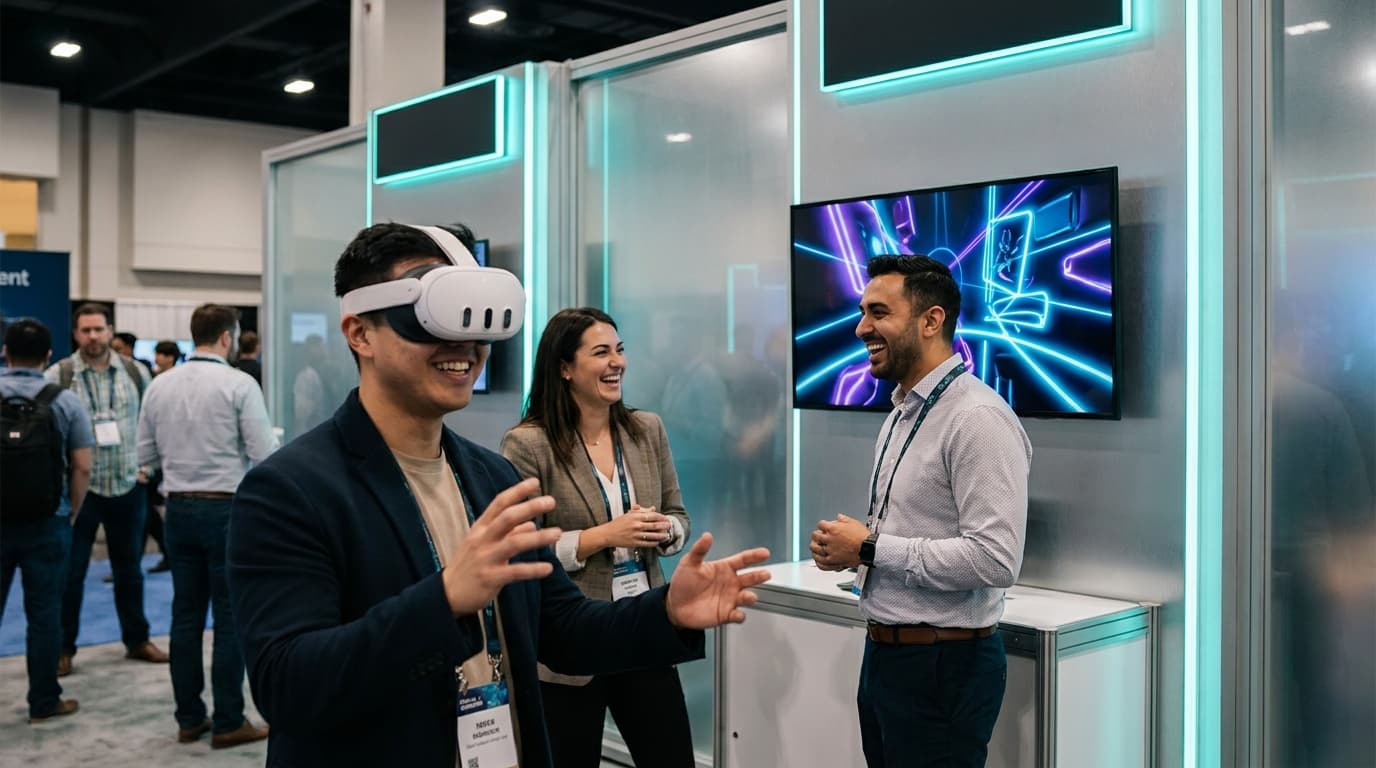
Understanding trade show booth ideas space requirements is the first step to knowing what is actually possible on the exhibit floor. The mathematical truth is simple: a standing mobile VR station requires a minimum 6.5 x 6.5 foot (2m x 2m) footprint to ensure safety and full range of motion. Seated or stationary experiences need just 3 x 3 feet. Understanding these dimensions prevents aisle crowding, keeps the Fire Marshal happy, and ensures your activation remains focused on capturing leads.
I have walked the floor at the Metro Toronto Convention Centre during peak tech season, and the most painful sight isn't a deserted exhibit. It is a standard 10x10 space where a marketing team brought a massive, over-engineered attraction that forces their own sales reps to stand in the aisle just to have a conversation. You spent thousands of dollars on that real estate. Your activation should pull people directly into your sales funnel, not physically push your team out of their own booth.
Navigating Trade Show Booth Ideas Space Requirements for a 10x10 Footprint
Space is the ultimate constraint that crushes poorly planned concepts. You cannot cram a sprawling physical game or a chaotic cash-grab wind tunnel into a standard 10x10 plot without alienating the attendees you are trying to attract.
Having executed over 200+ events across the GTA, I know the exact sweet spot for a standard 10x10 booth: one active VR station paired with one spectator TV, positioned opposite your lead capture counter. This configuration consumes roughly 42 square feet of your 100 square foot total. That leaves exactly enough room for two sales reps to have meaningful conversations with the next two people in line.
We physically map this out during the planning phase and establish digital Guardian boundaries in our Meta Quest 3 Business Edition headsets. If a player steps too close to the edge of the designated zone, the game instantly pauses and switches to a passthrough camera view, ensuring they never accidentally swing a controller into a passing attendee.
Scaling Up: Space Requirements for 10x20 and Custom Island Booths
When you upgrade to a 10x20 footprint at a larger venue like the Enercare Centre, the dynamics shift. You can comfortably scale to two standing VR stations, but doing so requires strict traffic flow management. If you simply place two 6.5 x 6.5 foot grids side-by-side, you create a 13-foot wall of flailing arms that attendees cannot pass. Instead, we stagger the VR play areas on opposite corners of the booth, angling the players slightly inward. This "V-formation" draws the crowd's eyes to the center of your footprint, where your branded backdrop and main sales podium sit.
For 20x20 island booths, the space requirements for trade show booth ideas become more about architecture than just square footage. With 400 square feet, we typically deploy three VR stations and a dedicated "cool down" lounge with high-top tables. This layout creates an internal ecosystem: attendees watch from the perimeter, play in the mid-zone, and move to the high-tops for a post-game sales qualification chat. It completely traps the lead within your branded environment for a full 10-15 minutes.
The Hidden Footprint: Power, Cables, and Wi-Fi Routing
A major oversight in floor planning is ignoring the invisible footprint of utilities. In venues governed by strict union rules, you cannot simply string extension cords across the carpet. Every wire must be taped down safely or run beneath a raised floor. When mapping out your 10x10 or 10x20 space, you must account for where the venue's electrical drop originates.
Our mobile VR setups are entirely wireless on the player side, utilizing extended battery straps that last hours. However, the spectator 4K TVs and our localized offline enterprise networking routers require dedicated power. By keeping our infrastructure lean—relying on a single 15-amp drop and generating our own closed-loop Wi-Fi network—we eliminate the need to rent exorbitant dedicated internet lines from the venue. This prevents a bulky AV rack from eating up another 9 square feet of your precious booth real estate.
Trade Show Engagement Ideas: Tying Gameplay to Qualified Conversations
Most trade show engagement ideas fail because they create an isolated, anti-social bubble. An attendee steps up, plays a game for three minutes, says "thanks," and walks away before your reps can even scan their badge. To generate ROI, your entertainment must bridge the gap between amusement and business.
We bridge this gap by weaponizing spectator TV casting. A B2B software company recently booked us for a financial summit on Bay Street. We set up Racket: NX—a futuristic racquetball game played inside a giant glass dome where you hit glowing targets in 360 degrees. It is a medium-intensity experience that tests reaction speed.
While the attendee was swinging away inside the headset, the sales rep stood next to their waiting colleagues, watching the live gameplay cast to a 50-inch 4K screen. The rep used the action on the screen as the ultimate icebreaker. "Look at him go—hey, speaking of hitting moving targets, how is your team tracking Q3 metrics?" The 2-5 minute session per guest creates a perfectly timed, captive audience for your pitch. We handle the hardware; your team handles the pipeline.
The Spectator Effect: Layout Strategies for Top Trade Shows Ideas
You do not just want a massive crowd; you want a manageable queue. The best trade shows ideas leverage the Fear of Missing Out (FOMO) strategically. By positioning the spectator TV facing outward near the aisle, you stop foot traffic. By placing the actual VR play area deeper inside the booth, you draw attendees past your branding and directly into the path of your sales team.
Handling a high-volume queue requires military precision regarding hygiene and hardware management. I have personally wiped down 40 headsets at midnight after a 300-person gala at the Fairmont Royal York, and I can tell you that rapid, medical-grade hygiene is a non-negotiable booth layout requirement. Your floor plan must account for a small sanitization station.
A 2x2 foot counter is plenty of space for us to operate. Between every single user, our trained technicians swap out medical-grade silicone face covers, apply UV-C sanitization, and wipe down the controllers. We do this in under 45 seconds. This seamless turnover ensures you can cycle 25-40 guests through a single headset over a standard conference session without bottlenecking your booth traffic.
"Our booth had a line around the corner the entire conference. VRPlayin made us the talk of the show." — Marketing Director, Tech Company
Sample Budget Breakdown for Mobile VR Events Canada
Corporate event planners often ask us about the hard costs of integrating trade show VR activations into their overall event spend. A successful deployment is not just renting a piece of plastic; it is a fully managed lead-generation machine. Below is a realistic sample budget breakdown for a one-day trade show activation.
Budget Assumptions: Single 8-hour exhibit day, one 10x10 booth downtown Toronto, 1 active VR station, 1 spectator display, and full on-site technical facilitation.
- VR Hardware & Infrastructure: 1 Meta Quest 3 Business Edition, extended battery straps for continuous play, and an offline enterprise networking router. Estimated cost: $400 - $600.
- Spectator Display Setup: 50-inch 4K TV mounted on a commercial floor stand with wireless casting receivers. Estimated cost: $250 - $400.
- On-Site Technical Facilitation: 1 dedicated VR Technician for 8 hours, including 60-90 minutes of early setup and 30-45 minutes of teardown. Estimated cost: $600 - $800.
- Hygiene & Consumables: Fresh medical-grade silicone covers, UV-C wand operation, and antibacterial supplies. Estimated cost: $75 - $150.
- Logistics: Local delivery, MTCC loading dock navigation, and downtown parking fees. Estimated cost: $150 - $250.
Estimated Total Investment: $1,475 - $2,200 CAD
Overcoming the Corporate Skeptics: Curating the Right Catalog
The quickest way to ruin your lead capture strategy is by requiring complex gaming skills to participate. The VP of Procurement visiting your booth does not want to memorize a twelve-button controller layout. We specifically curate our full VR game catalog for non-gamers. Point, grab, throw—that is the extent of the learning curve.
If you want to pull in a highly competitive, energetic crowd at a tech expo, we load up Pistol Whip. It is a cinematic rhythm shooter where the player feels like John Wick, dodging bullets and shooting targets to an electronic beat through vivid neon scenes. It offers high adrenaline and massive spectator appeal.
Conversely, if your audience consists of conservative HR managers or risk-averse executives, we switch the active title to Walkabout Mini Golf. Known as the gold standard for social VR, it features beautiful courses ranging from pirate coves to space stations. It is a low-intensity experience that requires zero gaming skill—you just point and putt. Most importantly, it operates at a relaxed pace, allowing the player to comfortably converse with your sales rep while lining up a shot.
We also proactively address the motion sickness objection. We curate zero-nausea experiences exclusively—meaning stationary gameplay with no artificial locomotion. In our history of executing corporate events, fewer than 2% of guests report any discomfort. If someone feels slightly off, our facilitators are trained to spot the signs immediately and switch them to a fully seated, ultra-comfortable experience.
Expert Operator Insight: The "Line Boss" Strategy
If you take away one piece of operational advice from someone who has managed activations in the tightest corners of the city, let it be this: designate a "line boss." While our VR technician handles the hardware, battery management, and strict hygiene protocols, one of your sales reps must own the queue. That line is your captive lead list. Do not let attendees stand there staring at their phones. Hand them a clipboard, a branded iPad survey, or simply start a conversation. Qualify the prospect before they ever put the headset on.
Mapping out your exhibit footprint and tying it to a strategic lead-generation plan requires precision. By understanding the strict math behind your space and deploying the right mix of hardware and active facilitation, your booth transforms from a passive branding exercise into an engine for qualified conversations. If you are drafting floor plans and want to explore how custom brand activation solutions fit into your strategy, evaluating the physical space is the exact place to start.
Maximize Your Trade Show Footprint
Stop wasting expensive booth space on attractions that don't generate conversations. We assess your specific floor plan and deploy turnkey mobile VR activations that stop traffic, entertain your prospects, and give your sales team the perfect 5-minute window to qualify leads.
SEE TRADE SHOW PACKAGES