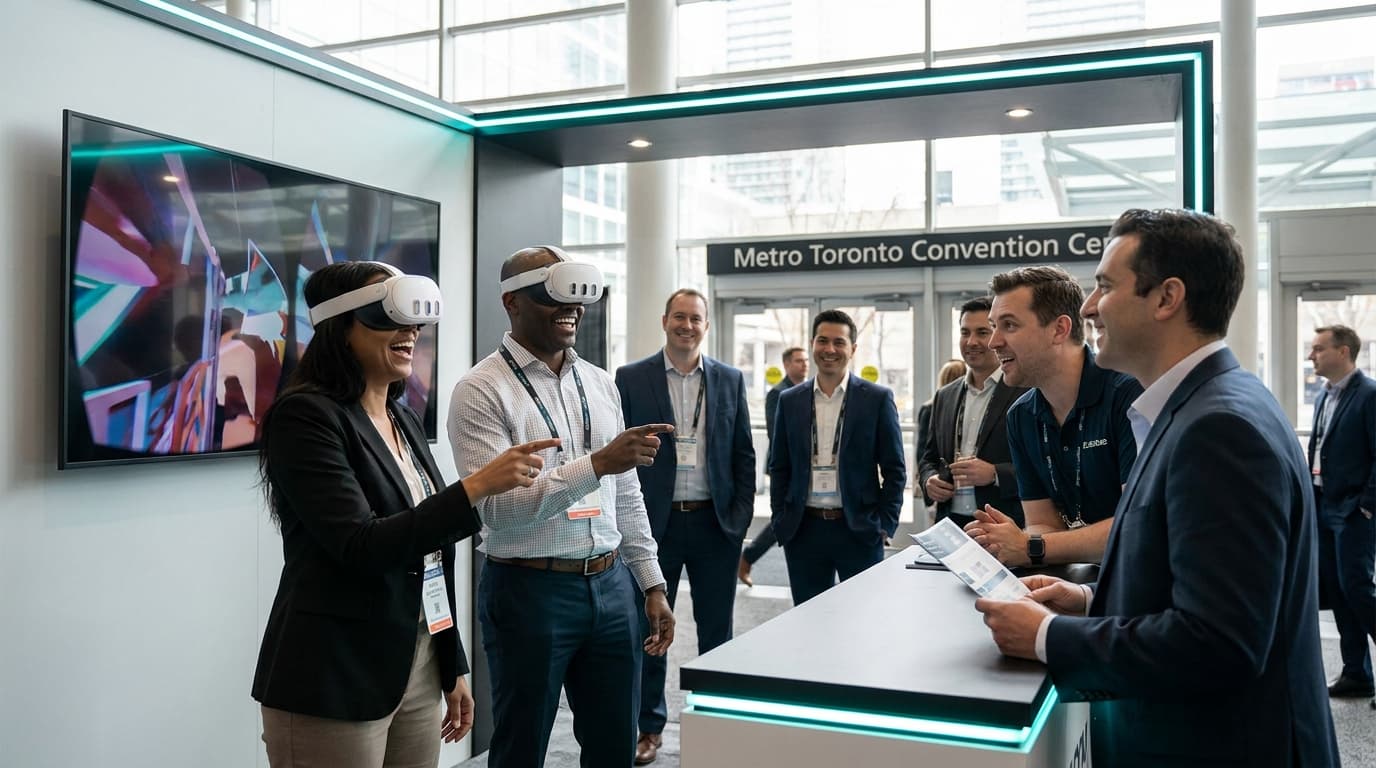
It's 10:00 AM on day two of the industry expo at the Metro Toronto Convention Centre. Aisle 800 is a sea of branded pens, QR codes, and tired sales reps staring at their phones. When marketing directors research trade show booth ideas pricing, they usually focus entirely on the hard cost of the attraction itself—a barista cart, a prize wheel, a photo booth. But as an operator who has run over 200 VR events across the corporate scene in Toronto and the GTA, I evaluate attractions by a different metric: captive dwell time.
An attraction shouldn't just draw a passive crowd; it must hold that crowd long enough for your sales team to qualify them. A line of people waiting for a free espresso is a distraction. A line of people cheering on their colleague in a virtual arena is a captive audience. That is the fundamental difference between generic entertainment and a strategic trade show VR activations strategy.
You aren't buying an arcade game. You are buying three to five minutes of undivided prospect attention. Let's break down exactly what that costs, how the logistics work, and the ROI you should expect.
The Problem with Most Trade Shows Ideas at the Enercare Centre
I've stood on enough concrete exhibition floors to see exactly how standard trade show gimmicks fail. A company rents a premium 20x20 space, drops a massive screen looping a corporate sizzle reel, and maybe hires a magician. Attendees walk up, grab the promotional stress ball, scan their badge out of polite obligation, and leave.
The interaction lasts 15 seconds. No trust is built. No discovery questions are asked. The Cost Per Qualified Lead (CPQL) is astronomical because the leads aren't actually qualified.
Now picture a different scenario. A VP of Operations walks past your booth and sees a crowd gathered around a 55-inch spectator TV casting live gameplay. We put a sanitized Meta Quest 3 Business Edition headset on her. She loads into Walkabout Mini Golf. This is the gold standard for corporate social VR for a reason. Instead of an overwhelming sensory experience, she finds herself in a beautifully designed pirate cove, putting a golf ball at a relaxed pace. It is a low-intensity, 1-4 player environment perfect for socializing and networking.
She is playing, smiling, and letting her guard down. Meanwhile, her two colleagues are watching the monitor. Your account executive strikes up a conversation with them. "Is she always this competitive?" The ice is broken. Over the next three minutes, your rep uncovers that their company is struggling with legacy software integration—exactly the problem your product solves. That conversation happened because the VR activation created a natural, low-pressure holding zone.
Trade Show Booth Ideas Pricing: Real Numbers and Models
When you look into hiring a vendor for mobile VR events Canada, you will encounter a few different pricing models: per-guest, per-hour, and flat-rate. Let me save your budget right now: absolutely avoid per-guest pricing for trade shows. Per-guest pricing penalizes you for success. If your booth goes viral and 300 people want to play, your budget blows up.
At VRPlayin, we use tiered flat-rate packages based on event duration and the number of active stations. This provides absolute cost predictability for your marketing budget.
Average Pricing Benchmarks (Toronto & GTA)
While custom footprints vary, here is what you should expect when budgeting for premium trade show booth ideas pricing:
- Single Station Activation (Half-Day): $900 - $1,200 CAD. Ideal for smaller 10x10 booths, providing one headset, one spectator display, and one dedicated facilitator.
- Dual Station Setup (Full 8-Hour Day): $1,800 - $2,500 CAD. The most popular choice for 10x20 booths. Allows head-to-head multiplayer, significantly increasing spectator engagement and doubling throughput.
- Enterprise Mega-Booth (4+ Stations, Multi-Day): $3,500 - $6,000+ CAD. Designed for massive anchor booths. Includes redundant hardware, multiple facilitators, and custom-branded in-game assets.
These tiers cover everything: the 90 minutes of pre-event setup, trained facilitators who stay on-site to manage the tech, commercial licensing for the software, backup hardware (because tech fails and we don't take chances), and teardown. We require a 50% deposit to secure your dates, with the balance due on event day.
Beyond the Badge Scan: Your Post-Event KPI Dashboard
Our repeat booking rate sits at 40% because we treat VR as a lead quality engine, not a toy. To justify your trade show investment, you need metrics that translate to the bottom line. Here is the exact post-event KPI dashboard we recommend tracking, based on benchmarks from our 200+ successful events.
Trade Show Activation Benchmarks
- Average Dwell Time: 5-8 minutes per group. Our standard VR sessions run 2-4 minutes per turn, plus transition time. This is your active selling window.
- Spectator-to-Player Ratio: 3:1. For every one person in the headset, three people are watching the casting TV. Your sales reps should be targeting the watchers, not the player.
- Lead Capture Conversion: 65-80%. Visitors are significantly more willing to hand over accurate contact information or answer BANT (Budget, Authority, Need, Timeline) questions in exchange for premium entertainment.
Calculating Your CPQL
Let's do the math. If you spend $2,000 on a dual-station setup for a single day, and process 40 guests per hour over 7 active hours, you've engaged 280 prospects. If your team qualifies just 50% of them (140 leads), your Cost Per Qualified Lead for the attraction is roughly $14. Try getting a $14 CPQL on LinkedIn Ads for Enterprise B2B buyers.
Execution on the Floor: The Non-Negotiable Logistics
Running a flawless activation on a packed Bay Street floor requires strict operational discipline, not just flashy hardware. Here is what veteran marketing directors plan for.
Space and Power: We require a minimum 6.5 x 6.5 foot (2m x 2m) dedicated footprint per standing VR station. If you have a smaller 10x10 booth, we pivot to seated or stationary experiences that only require 3 x 3 feet. Crucially, you must advance power with the venue. We need a standard 120V/15-amp electrical drop. Insider tip: at venues like the MTCC or Enercare Centre, union rules often dictate that their in-house electricians must run the drop. Order this well in advance to avoid surge pricing.
Networking: Convention center Wi-Fi is notoriously terrible and wildly expensive. We bring our own localized enterprise networking gear to cast gameplay to the TVs with zero latency. If the venue's cellular reception is entirely dead, we deploy fully offline single-player experiences so your booth never stops running.
Hygiene Protocols: I have personally cleaned 40 headsets at midnight after a 300-person gala. Our team treats sanitation with absolute severity. We use medical-grade silicone face covers replaced between every single user. We employ UV-C sanitization for all equipment, wipe everything down with antibacterial wipes, and provide hand sanitizer stations. In today's landscape, your attendees will not put on a headset unless they literally see it being sanitized in front of them.
Addressing the Skeptics: Non-Gamers and Motion Sickness
The most common objection I hear from marketing directors is, "Our executive buyers are in their 50s and 60s; they aren't gamers."
They don't need to be. We specifically curate our brand activation solutions for zero gaming skill. Point, grab, throw—that is the entire learning curve. We see it constantly: the senior VP who initially crosses their arms and refuses to participate is exactly the person who ends up laughing the loudest.
If you want a high-energy draw, we load up Racket: NX. It is a medium-intensity, 1-2 player game that feels like futuristic racquetball inside a giant glass dome. Players hit glowing targets in 360 degrees. It tests reaction speed, requires zero button-mashing, and looks incredibly dynamic on the spectator TV.
What about motion sickness? In our 200+ completed events, fewer than 2% of guests report any discomfort. We achieve this by strictly curating "zero-nausea" experiences for corporate environments. We use stationary gameplay with no artificial locomotion (no virtual walking or rollercoasters). Our facilitators are rigorously trained to spot the early signs of discomfort and will safely end the session immediately.
The Real Value of Premium Trade Show Engagement Ideas
You can spend your budget on a flashy backdrop that blends in with every other booth, or you can invest in an interactive experience that forces attendees to stop, engage, and connect with your team. We provide the equipment, the hygiene protocols, and the trained staff. Your sales team provides the conversation.
The impact speaks for itself. As the VP of People & Culture at a Toronto SaaS company told us recently: "We've booked VRPlayin three times now. Each event, they bring something new and the team loves it. It's the only attraction that actually keeps people at our booth."
Convention season in Toronto fills up quickly, especially for prime dates at major venues. If you are tired of empty badge scans and want an attraction that actively supports your sales pipeline, it is time to upgrade your booth strategy.
Turn Floor Traffic Into Qualified Leads
Stop settling for shallow badge scans and generic giveaways. Book a mobile VR activation that keeps prospects at your booth long enough for your sales team to have a real conversation.
GET A CUSTOM QUOTE