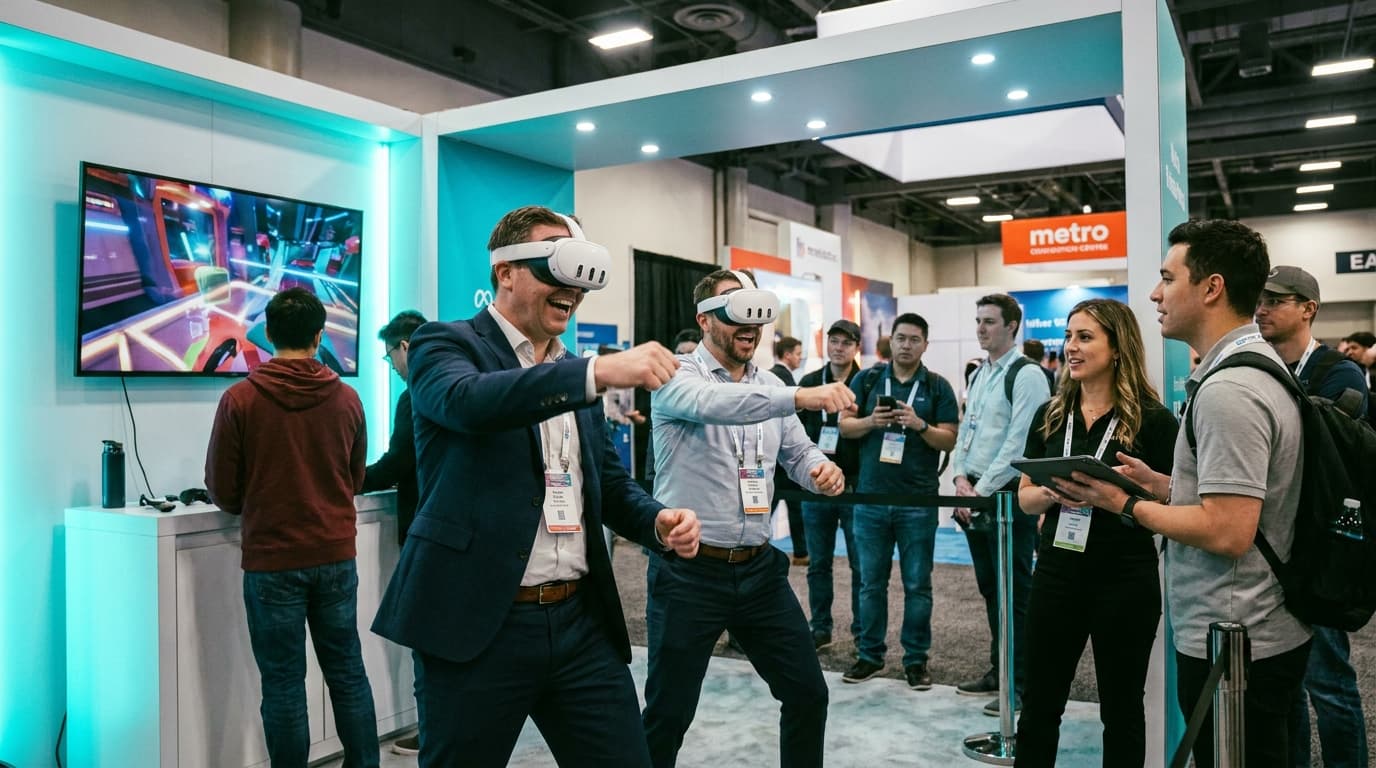
When evaluating high-tech trade show booth ideas, power requirements are often the first major roadblock planners face. Fortunately, modern mobile VR setups like the Meta Quest 3 require only a standard 110V/15-amp wall outlet to keep backup battery straps charged, while standalone gameplay needs zero dedicated hardline power drops. If you curate offline, single-player experiences, you bypass convention centre Wi-Fi fees entirely.
Ordering power drops and enterprise internet access at the Metro Toronto Convention Centre or Enercare Centre can drain a marketing budget faster than the booth fabrication itself. I have stood on the concrete floors of Hall A, watching exhibitors panic because their massive lead generation tool required a hardwired 10GB connection and 30 amps of dedicated power—and the union venue electricians were nowhere to be found.
After running 200+ events across the GTA, I can tell you that the most effective activations do not require an engineering degree or a five-figure IT invoice to keep running. High-volume environments demand bulletproof operations. If your technology fails when the convention centre Wi-Fi chokes, your lead generation stops. Here is exactly how to engineer a VR activation that runs flawlessly on standard power, skirts the Wi-Fi trap, and converts crowds into qualified sales conversations.
The Reality of Trade Show Booth Ideas: Power Requirements
Many marketing directors assume VR requires massive, glowing PC towers trailing thick black cables across the aisle. Five years ago, they were right. Today, that assumption leaves money on the table, mostly in the form of exorbitant venue infrastructure fees.
We exclusively deploy the Meta Quest 3 Business Edition. These are entirely self-contained, standalone mobile VR units. They track movement, render graphics, and cast video to external spectator TVs without a single wire connecting the player to a computer. For trade show VR activations, this completely changes your technical footprint.
Your primary power need is strictly for charging logistics. We use extended battery straps on every headset. While a guest plays, the battery strap powers the unit. When that strap depletes, our technicians hot-swap it for a fresh one in seconds. The depleted battery goes onto a multi-port charging dock hidden in your storage closet or under a counter.
To keep a continuous rotation of six headsets running for an eight-hour show floor, along with two 55-inch spectator TVs, we only need a single standard 15-amp wall outlet. That is the exact same power requirement you need to plug in a mini-fridge or a laptop charger. You avoid ordering expensive, specialized three-phase power drops from the venue, and you eliminate tripping hazards on your floor plan.
Bypassing Wi-Fi Dead Zones with Offline Gameplay
Convention centre internet is notoriously hostile. Thousands of attendees carrying multiple mobile devices saturate the local bandwidth, bringing even expensive dedicated vendor networks to a crawl. If you plan trade shows ideas around complex, cloud-hosted multiplayer servers, you are gambling your ROI on the venue's infrastructure.
This is why we aggressively advocate for offline, single-player experiences designed specifically for quick turnover and high energy. Multiplayer experiences need internet; single-player runs offline perfectly. We load the headsets locally so they never have to ping an external server to function.
Consider Fruit Ninja 2. It is a single-player, medium-intensity game perfect for stress relief and quick sessions. The hook is simple: classic fruit-slicing with dual swords. It is highly satisfying and completely offline. Guests can step up, understand the mechanics in three seconds, and immediately start chasing a high score on your local leaderboard.
Alternatively, we rely heavily on Beat Saber and Richie's Plank Experience. Beat Saber creates incredible crowd excitement as guests slash flying blocks to the beat of adrenaline-pumping music. Richie's Plank Experience allows guests to step off a virtual skyscraper—an intense, 2-minute thrill that generates massive audible reactions from the crowd. Both run entirely on local hardware. No Wi-Fi, no latency, no venue internet fees.
The Secret to Spectator TV Casting Without Internet
A frequent question we get from IT directors is: If you don't use the venue Wi-Fi, how do you cast the wireless headset video to the spectator TVs?
The answer is a localized, closed-loop network. We bring our own high-speed, offline LAN router to the booth. We plug a Chromecast or similar casting receiver into the HDMI port of your spectator TV. The router creates a private Wi-Fi network that only the Quest 3 headsets and the TV receivers connect to. Because it doesn't need to reach the outside internet (WAN), the router provides a flawless, uncompressed local video stream to your monitors. The venue's internet can completely crash, and your crowd will still be watching the CEO of a target account flawlessly slicing watermelons on your 55-inch displays.
The Queue and Throughput Calculator: Maximizing Booth Traffic
A massive crowd is only valuable if you can process them efficiently. Managing booth traffic generation requires a precise understanding of your throughput capability. Mathematics dictates exactly how many leads you can capture.
For corporate settings, we budget a 4-minute total cycle per guest. This breaks down into a 3-minute gameplay session and a strict 1-minute hygiene and hardware transition.
During that one minute, our facilitators swap the medical-grade silicone face cover for a freshly sanitized one, wipe down the controllers with antibacterial wipes, and secure the headset onto the next guest. In 200+ events, we have never compromised on this process. Cleaning headsets at midnight after a 300-person gala is muscle memory at this point.
Based on 15 guests per hour per headset, here is your throughput capability for a standard 8-hour exhibition day:
2 Headset Station Calculator
- Guests per hour: 30
- Guests per 8-hour day: 240
- Space required: Minimum 13 x 6.5 feet (Two 6.5 x 6.5 ft zones)
- Ideal for: Standard 10x20 booths focused on deep, qualified conversations.
4 Headset Station Calculator
- Guests per hour: 60
- Guests per 8-hour day: 480
- Space required: Minimum 26 x 6.5 feet (or configured in a 13 x 13 ft square)
- Ideal for: Island booths and aggressive lead capture targets.
6 Headset Station Calculator
- Guests per hour: 90
- Guests per 8-hour day: 720
- Space required: Minimum 39 x 6.5 feet
- Ideal for: Major title sponsors, massive pavilion footprints, and maximum brand awareness.
We arrive 60-90 minutes before the event starts to physically tape these safety boundaries on the floor. While stationary gameplay technically requires only 3 x 3 feet, we mandate the full 6.5 x 6.5 feet for active games to ensure attendees have adequate safe buffer zones from your booth counters.
Booth Layout: Positioning for Maximum Lead Capture
Where you place the VR activation is just as important as the technology itself. We advise our clients to mount their spectator TVs on 6-foot truss stands positioned at the very edge of the aisle, facing outward.
If you face the TVs inward, the crowd steps deep into your booth to watch, creating a bottleneck that traps your sales staff. If you face the TVs outward, the crowd gathers in the aisle. This keeps your actual booth footprint clear, allowing your sales team to easily navigate the perimeter and pull highly qualified prospects out of the spectator crowd for private conversations at your demo stations.
Engineering Qualified Lead Generation
The goal of our brand activation solutions isn't just entertainment—it's building a high-converting pipeline. The VR gameplay is simply the magnet that keeps attendees anchored in your booth while your sales team works the queue.
When an attendee sees a VP of Finance enthusiastically balancing on a virtual plank, they stop walking. Because attendees are physically anchored to your booth waiting for their 3-minute turn, your staff has a captive, relaxed audience. This is the exact window to scan badges, ask qualifying questions, and schedule follow-up software demos.
One Marketing Director at a recent tech conference in the Financial District summarized the dynamic perfectly: "Our booth had a line around the corner the entire conference. VRPlayin made us the talk of the show." They did not just get a crowd; they generated 300% more badge scans than the previous year because their reps actively worked the queue we built for them.
Operational Reliability on the Show Floor
Any vendor can promise a great time, but live events are chaotic ecosystems. Hardware fails. Controllers get dropped onto concrete floors. If a headset goes dark during the busiest hour of the trade show, your lead engine stops.
Because we've run over 200 high-stakes corporate events across Toronto, we never walk onto a show floor without cloned backup hardware. Our facilitators are trained technicians who can swap a malfunctioning headset for a cloned unit in under two minutes, resulting in zero noticeable downtime for your queue. We do not just drop off the gear; we stand at the station, manage the crowd flow, and protect the hardware so your team can focus entirely on selling.
We also carefully curate our full VR game catalog to eliminate the risk of motion sickness. We only deploy zero-nausea experiences for corporate environments, focusing on stationary gameplay with no artificial locomotion. By strictly managing the content, fewer than 2% of guests ever report any discomfort, protecting your brand's association with a positive, energetic experience.
Protecting Your Exhibition ROI
Your booth footprint is the most expensive real estate your company will rent all year. Filling it with technology that demands thousands of dollars in hidden venue infrastructure fees is an operational misstep you can easily avoid.
By leveraging self-contained mobile hardware, offline single-player mechanics, and a strict throughput strategy, you transform your booth from a passive display into an active, high-volume lead qualification engine. Let the venue charge your competitors for 30-amp drops and dedicated IP addresses. You only need a standard 15-amp wall plug, a 6.5-foot footprint, and an active queue waiting their turn to play.
Turn Your Next Trade Show Booth Into a Lead Magnet
Stop paying exorbitant convention centre fees for power drops and enterprise Wi-Fi. Our self-contained mobile VR setups drive massive booth traffic while your sales team qualifies the queue.
GET A CUSTOM QUOTE