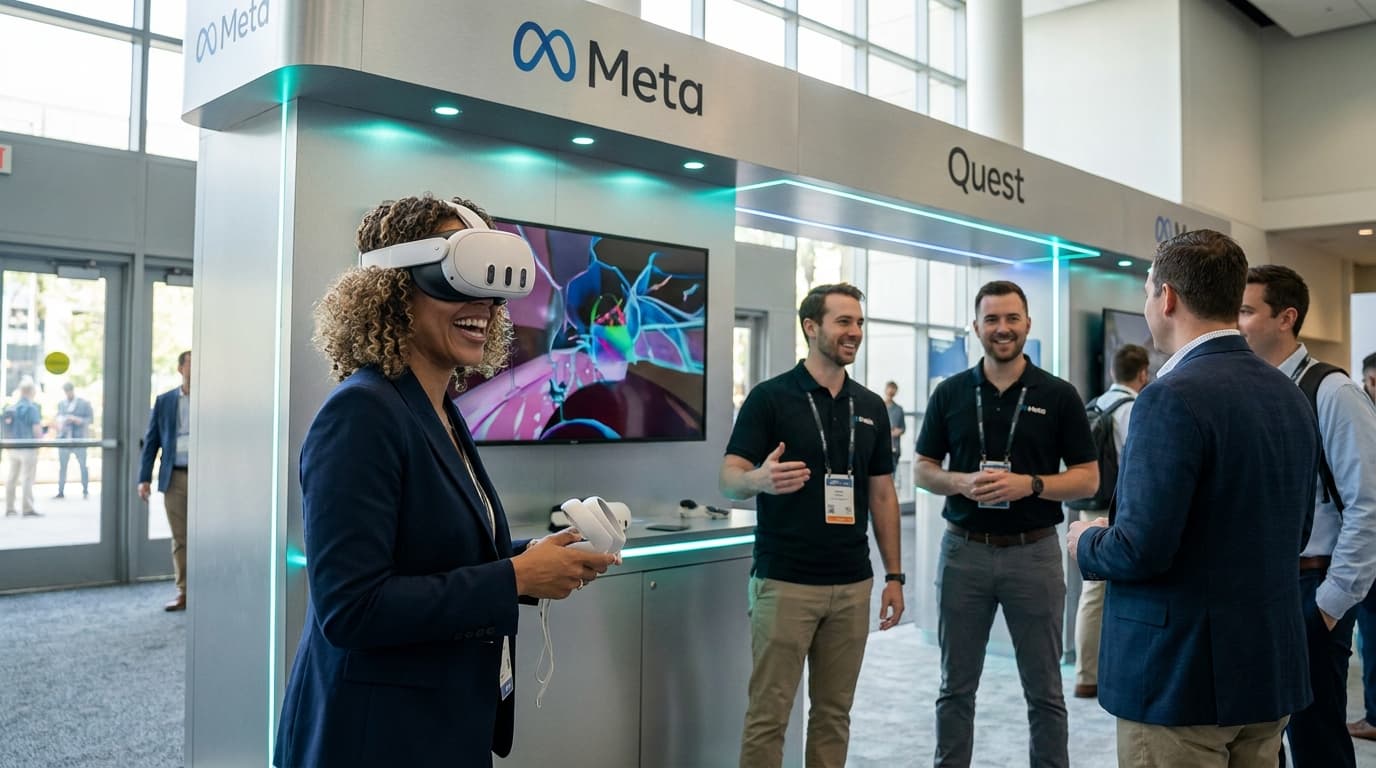
When researching trade show booth ideas mistakes to avoid, the most critical operational error you can make is prioritizing crowd size over lead quality. You need a floor strategy that pairs high-throughput activations with seamless sales transitions, ensuring attendees don't just grab a branded giveaway and disappear into the aisle. Successful booths use structured engagement, predictable turnaround times, and clear spatial planning to capture qualified conversations rather than just temporary attention.
I recently stood at the back of the Enercare Centre watching a massive, six-figure exhibit fail in real-time. The marketing director had rented an interactive digital wall that drew a crowd of hundreds. The problem? The line stretched out into the aisle, blocking floor traffic and infuriating the venue staff, while the sales team stood awkwardly on the sidelines holding iPads. They were entirely unable to interrupt the attendees staring at the screen. People played the game, took their complimentary tote bag, and left. Not a single badge was scanned.
After running over 200 corporate events across the Greater Toronto Area, I see this operational failure constantly. Planners obsess over drawing a crowd but completely forget how to process that crowd into actual pipeline revenue. If you want a real return on your floor space, you need to stop thinking like an entertainer and start thinking like a ruthless floor manager. An activation is only as good as the conversations it facilitates.
Trade Show Booth Ideas Mistakes to Avoid: 6 Operational Failures
Mistake 1: Treating Entertainment as a Substitute for Conversation
The most common error exhibitors make is choosing an activation that completely isolates the prospect from the sales representative. If your prospect is inside a loud, enclosed photo booth, struggling inside a wind-tunnel cash grabber, or wearing noise-canceling headphones for ten minutes, your Account Executives are benched. You are paying thousands for premium floor space at the Metro Toronto Convention Centre just to babysit attendees.
Your activation must allow for parallel conversations. This is exactly why we rely on specific, low-intensity experiences for our trade show VR activations. Consider a title like Walkabout Mini Golf. It is the gold standard for corporate social VR. Players are dropped into beautiful courses, ranging from pirate coves to space stations, but the actual physical movement requires only minimal pointing and putting.
Because the pace is relaxed and the intensity is low, your sales rep can physically stand next to the player, watch their progress on the spectator monitor, and naturally ask about their Q3 software procurement needs while they line up a putt. You are anchoring the prospect in your booth for a predictable window of time, creating a captive, relaxed audience for your 30-second pitch.
Mistake 2: Failing to Map Your Throughput Physics
Event logistics run on math, not magic. One of the biggest blindspots in event planning is ignoring turnaround times. The formula is brutal: (Total Event Minutes / Minutes Per Turn) = Max Station Capacity. If you have a booth expecting 500 visitors a day, and your activation takes 10 minutes per person, a single station will only process 48 people in an eight-hour shift. The other 452 people will walk right past your booth because the line looks too stagnant.
In our operations, we meticulously track session data. The sweet spot for a high-traffic convention floor is 2 to 4 minutes per turn. This gives the player enough time to experience a "wow" moment, and your SDRs exactly enough time to qualify them, scan their badge, and move them along.
Throughput also includes the reset time between guests. When a nervous executive takes off a headset, the next person in line does not want to put on sweaty equipment. We use medical-grade silicone face covers on all our Meta Quest 3 Business Edition headsets, which are swapped between every single user. Our facilitators wipe down the gear with antibacterial wipes and utilize UV-C sanitization so the turnover takes seconds, maintaining strict hygiene without bottlenecking your line.
Mistake 3: Hiding the Action from the Aisle
If the only person having fun is the person actively participating, your booth is operating at ten percent capacity. The secret to massive lead capture is realizing that the spectator experience is actually more valuable than the player experience.
When we set up brand activation solutions, the physical footprint always includes a 65-inch spectator TV casting exactly what the player sees in real-time. We specifically place this TV at a 45-degree angle facing the primary traffic aisle, and we program high-adrenaline, visually striking games to capture wandering eyes.
Take Pistol Whip, for example. It is a cinematic rhythm shooter where the player dodges bullets to the beat of an electronic soundtrack. The person in the headset feels like John Wick. They are ducking and dodging. But more importantly, the twelve people standing in the aisle watching them on the TV screen are laughing, pointing, and cheering. Your player is occupied. Your sales team should not be talking to the player—they should be qualifying the twelve people watching the screen. The VR headset is the magnet; the TV screen is the net.
Mistake 4: Alienating the Non-Gamer Demographic
I hear it constantly from VPs in Financial District boardrooms: "I don't play video games, this isn't for me." If your activation requires complex controls, extensive tutorials, or gamer reflexes, you will immediately alienate the senior decision-makers holding the actual budgets.
You must curate experiences that require zero gaming skill. We specifically build our full VR game catalog for non-gamers. Experiences like Job Simulator or Cook-Out require attendees to simply point, grab, and throw. If you can hand someone a physical coffee cup in real life, you can play these games in VR.
There is also the persistent objection regarding motion sickness. Planners worry that putting a headset on an attendee will ruin their day. This happens when amateurs run events using roller-coaster simulators or games with artificial locomotion. We curate zero-nausea experiences exclusively. By utilizing stationary gameplay where the user's physical feet match their virtual movement, fewer than 2% of guests at our events report any discomfort. Our facilitators are rigorously trained to spot early signs of hesitation and switch the user to a more comfortable, seated experience immediately.
Mistake 5: Disconnected Lead Capture Workflows
A shocking number of exhibitors rely on the "honor system" for lead capture, hoping an attendee will gladly volunteer their badge after playing a game. This creates an awkward transition that prospects often reject.
Lead capture must be baked into the activation mechanic itself. If you are running a VR leaderboard, the price of admission to get on the scoreboard is a badge scan. We train our on-site facilitators to act as the gatekeepers. When Guest A finishes their 3-minute game of Space Pirate Trainer, the facilitator says, "Great score! Our team just needs to scan your badge to log it on the leaderboard to see if you win the afternoon prize." The SDR steps in, scans the badge, logs the score, and immediately pivots into a qualifying question based on the prospect's title.
Mistake 6: The "Wing It" Approach to Venue Logistics
You cannot simply show up to an exhibition hall in Mississauga or Markham and hope the venue accommodates your hardware. Your VR vendor must perform rigorous site assessments weeks before the load-in date. A single blown fuse, dropped Wi-Fi signal, or cramped footprint will derail your entire investment.
The Technical Venue Readiness Checklist:
- Power Distribution: Dedicated 15-amp or 20-amp circuits are mandatory for casting equipment and charging stations. Never share circuits with catering equipment like coffee machines, which draw massive power and trip breakers constantly.
- Network Stability: Never rely on venue guest Wi-Fi to cast gameplay to a TV. We bring dedicated, localized 5GHz routers to create a closed loop between the headset and the screen, ensuring zero latency or dropouts even in a hall with 10,000 competing mobile phones.
- Clearance and Spatial Mapping: Plan for a minimum of 6.5 x 6.5 feet (2m x 2m) per standing station to allow safe arm movement. Seated activations can be compressed to 3 x 3 feet. Ensure a physical buffer zone (using stanchions or branded counters) between the active player and the aisle traffic.
Expert Insight: The Reality of High-Volume Operations
Running a successful booth activation is a grueling operational challenge. I write this as someone who has personally cleaned 40 headsets at midnight after a 300-person corporate gala, swapped out extended battery straps in the dark, and managed frantic lines of VIPs.
The difference between a good activation and a great one is line management. You need an "on-deck" circle. While Guest A is playing, Guest B is already briefed on the controls, has their medical-grade silicone cover ready in hand, and knows exactly what to expect. This simple system shaves 45 seconds off every transition. Across a four-hour trade show block, those 45 seconds add up to dozens of extra badge scans and potential thousands in pipeline revenue. We bring backup, pre-charged equipment to every single event, and our trained technicians can swap hardware within 30 seconds. You cannot afford a twenty-minute technical delay to charge a battery when the exhibit floor is at peak capacity.
Closing Thoughts on Booth Execution
Trade show ROI is purely a byproduct of flawless floor execution and high-volume lead capture. The data supports this ruthlessly structured approach. When planning your next floor strategy, focus on the mechanics of the interaction above the flashiness of the technology.
Choose activations that draw a crowd naturally, keep that crowd anchored through strategically angled spectator displays, and give your sales team the perfect low-pressure environment to qualify leads. Manage your throughput math ruthlessly, prioritize strict hygiene, and never isolate your prospect from the conversation. By treating your entertainment as a structured lead generation tool rather than just a shiny distraction, you will maximize the return on every single square foot of your booth.
Turn Your Next Trade Show Booth Into a Lead Generation Engine
Stop losing qualified conversations to poorly planned booth activations. Our mobile VR trade show packages are specifically designed to capture attention, manage high-volume throughput, and give your sales team the perfect environment to close deals.
GET A CUSTOM QUOTE