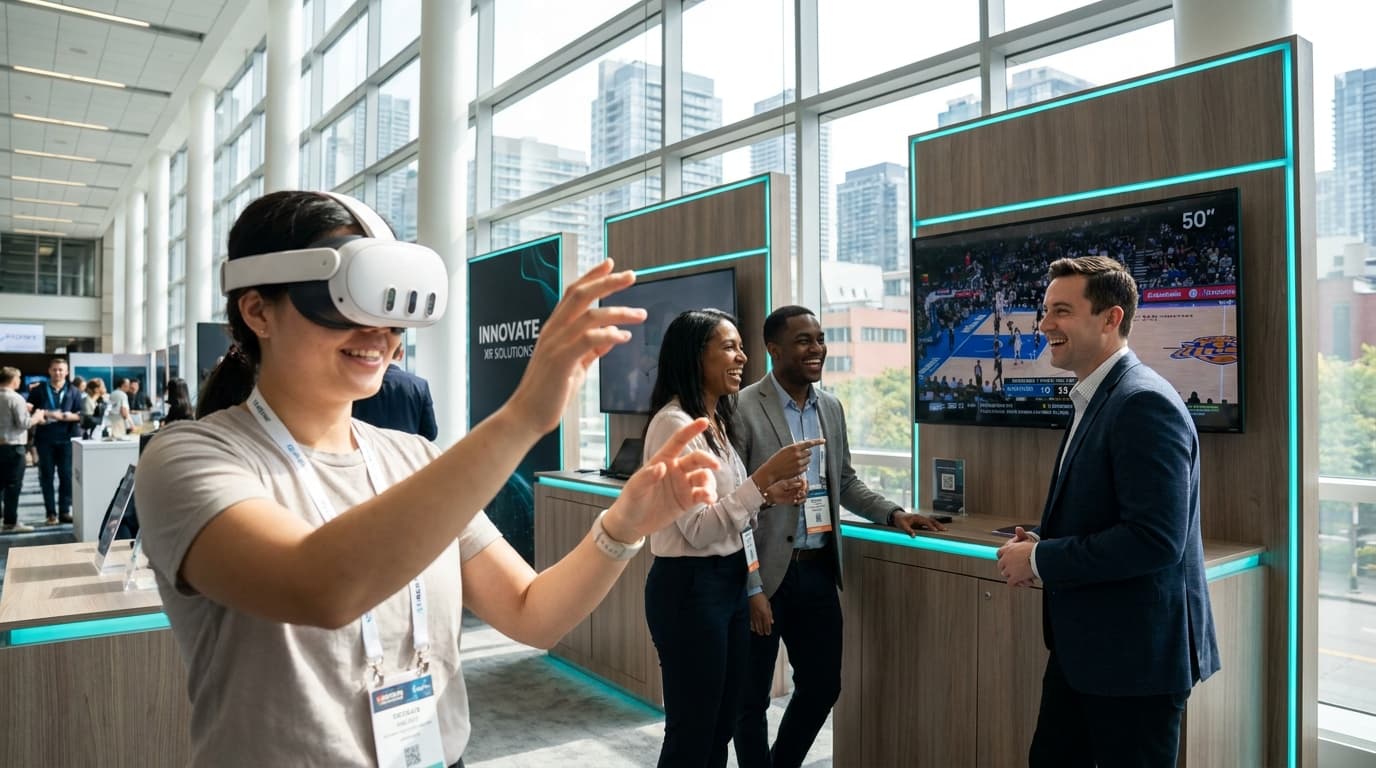
Effective trade show booth ideas for small groups prioritize lead qualification over pure foot traffic, using localized activations like mobile virtual reality to capture and hold attention. A standard 10x10 exhibit space can comfortably fit two active VR stations, giving your sales team a guaranteed 3 to 5 minutes to qualify prospects while their colleagues watch the live gameplay on a spectator screen.
Picture this: You have a 10x20 footprint at the Metro Toronto Convention Centre, a highly targeted list of 50 VIP buyers you need to connect with, and a strict mandate to generate qualified pipeline. Tossing branded stress balls into the aisle simply will not get the job done. I have personally run and managed technical activations for over 200 corporate events across Toronto, and I can tell you exactly what happens when you rely on passive attractions for high-level B2B audiences: visitors grab your free coffee, actively avoid eye contact with your Account Executives, and vanish.
Rethinking Trade Show Booth Ideas for Small Groups
You do not need a massive crowd of 500 unqualified people blocking the aisles and annoying your booth neighbors. You need 20 to 50 of the exact right decision-makers staying in your booth long enough to answer three specific qualification questions—like "What CRM are you currently using?", "Are you expanding your tech stack in Q3?", and "Who handles implementation?" We treat VR as a ruthless lead quality engine, not just a flashy digital gimmick.
The initial draw of a headset is undeniable, but if you don't control the flow and curate the experience, your booth turns into a chaotic arcade rather than a lead generator. When you deploy strategic trade show VR activations, the execution must be methodical. Consider the psychology of the modern buyer: they hate being pitched. But when a Marketing Director is swinging virtual swords, your Account Executive can stand right next to their VP, watch the live gameplay cast to a 50-inch TV, and casually start a conversation. We call this the "Spectator Triangle." The prospect is looking at the screen, the rep is looking at the screen, and they are talking to each other. The high-pressure friction of eye-to-eye sales pitches disappears entirely.
The Throughput Math: Managing 20-50 Guests Without Chaos
When engaging a targeted VIP invite list, controlling traffic flow is your top priority. Having key decision-makers wait 20 minutes to play a 3-minute game is a massive operational failure. You lose the lead, and you frustrate the prospect.
Let’s break down the queue and throughput calculator for a standard exhibit block. Our average VR session is strictly timed to last between 2 and 5 minutes per turn. The math dictates your footprint requirements and your hardware needs.
Two Headsets (Target: 20-30 Guests)
A standard 10x10 booth provides enough physical space for two VR stations, requiring a minimum of 6.5 x 6.5 feet (2m x 2m) per standing user to ensure safety. Running two headsets yields roughly 20-24 plays per hour. This setup is perfect for intimate VIP gatherings of 20-30 guests where deep, five-minute qualification conversations are your primary objective.
Four Headsets (Target: 40-50 Guests)
If you have upgraded to a 10x20 footprint, four stations become your sweet spot. This setup processes 40-48 plays per hour. It keeps a short, active queue moving swiftly, giving your sales reps enough time to chat with the prospects in the "on-deck circle" without anyone getting impatient and walking away to a competitor's booth.
Six Headsets (Target: 50+ Guests)
For dedicated side-events, hospitality suites in a Bay Street boardroom, or a larger 20x20 island footprint, six headsets process 60-72 plays per hour. This volume ensures that even during the chaotic post-lunch rush or networking happy hour, nobody waits more than three minutes to participate.
High-Energy, Low-Sweat: Curation Matters
You cannot hand a 50-year-old CEO a controller, drop them into a complicated first-person shooter game, and hope they figure out the controls. Our most popular corporate experiences require absolute zero gaming skill. Point, grab, slice — that is the entire learning curve. We specifically curate our software library for non-gamers, ensuring immediate success, high engagement, and zero frustration.
For small, targeted trade show groups, we rely heavily on three specific titles to drive energy without causing physical fatigue.
Fruit Ninja 2
This is a single-player, medium-intensity experience perfect for stress relief and rapid throughput. The hook is simple: classic fruit-slicing with dual samurai swords. It is highly satisfying and instantly understandable. Better yet, it is leaderboard-competitive. We track high scores on a branded digital or physical whiteboard in your booth, giving attendees a compelling reason to circle back at the end of the day to see if their score held up—giving your team a second touchpoint.
Beat Saber
As the world's most popular VR game, this medium-intensity title gets the heart rate up and builds massive crowd excitement. You slash neon blocks to the beat of licensed music. It is incredibly easy to learn and highly addictive. I once watched a stoic Financial District CFO refuse to play for two hours at an event, finally give in to peer pressure, and then return to our booth three times trying to beat her junior analyst’s high score.
Space Pirate Trainer
An arcade-style gallery shooter where attendees blast incoming droids using blasters and shields. Because it relies heavily on dodging, it creates fantastic spectator moments for the crowd watching the TV monitors. It is stationary, visually impressive, and highly competitive.
Because all of these titles use stationary gameplay with absolutely no artificial in-game locomotion, they completely eliminate the motion sickness objection. In 200+ events, fewer than 2% of our guests report any discomfort. We curate zero-nausea experiences only, and our on-site facilitators are trained to spot early signs of hesitation, immediately adjusting the gameplay to ensure absolute comfort.
Overcoming the "Suit and Tie" Objections
The most effective trade show strategies eliminate physical and social friction. At high-end corporate events, executives will often decline VR simply because they wear expensive prescription glasses or do not want to ruin professional hair and makeup. An inexperienced operator will just accept the "no." We engineer around it.
We use customized Meta Quest 3 headsets equipped with BoboVR M3 Pro halo straps. Instead of a traditional elastic band that clamps tightly onto the user's face and crushes their hair, a halo strap rests comfortably on the top of the forehead, hovering the lenses over the eyes. We also integrate magnetic prescription lens spacers to ensure executives wearing thick-rimmed glasses can play without scratching their frames or our equipment. Removing these micro-frictions increases VIP participation by up to 40%.
Operational Realities of Mobile VR Events in Canada
Providing the headsets is the easiest part of running mobile VR events in Canada. The actual logistical challenge is keeping the equipment spotless, charged, and functional when 50 different people use it over a grueling four-hour exhibit block, often in venues with terrible infrastructure.
Never rely on convention center WiFi. At massive venues like the Enercare Centre, standard WiFi networks are aggressively throttled and notoriously unstable. We bring independent 5G cellular hotspots dedicated solely to casting the VR feed to your spectator TVs, guaranteeing zero lag. Furthermore, there are no heavy cables tethering users to gaming PCs on your booth floor—we run completely wireless.
More importantly, we enforce a strict, medical-grade hygiene protocol. I have personally sanitized 40 headsets at midnight after a 300-person gala, and that exact same uncompromising standard applies to a 20-person VIP activation. We use medical-grade silicone face cushions that are wiped down between every single user. At the end of the day, we apply Cleanbox UV-C sanitization to all equipment. Controllers are scrubbed with antibacterial wipes, and automatic hand sanitizer stations are mandated at the boundary of the play space. If a Bay Street executive is going to strap hardware to their face, it will be pristine.
Turning the Spectator Screen Into a Qualification Tool
As one Toronto Event Planner noted after a recent booking: "We've booked VRPlayin three times now. Each event, they bring something new and the team loves it." That repeat success comes from understanding a counter-intuitive truth: the VR activation is actually designed for the people waiting in line, not the person wearing the headset.
When you deploy brand activation solutions, the magic happens on the screens outside the hardware. By casting the live VR view to your booth's large monitors, you create a shared focal point. This drops professional defenses. It turns a rigid, uncomfortable B2B sales pitch into an authentic human interaction. You are no longer selling to them; you are reacting to an entertaining, shared moment with them.
Do not build a passive attraction; build a reliable conversation framework. Structure your small footprint so the engagement tool forces prospects to stand next to your team, facing the same direction. Review our full VR game catalog to see exactly which stationary, zero-nausea experiences map best to your specific buyer demographics, and start turning your small 10x10 booth into your strongest, most reliable pipeline generator.
Turn Your 10x10 Booth Into a Lead Engine
Stop relying on passive giveaways to capture attention. Let us bring our mobile VR setups to your next trade show and help your sales team generate qualified pipeline while your prospects slash targets.
SEE TRADE SHOW PACKAGES