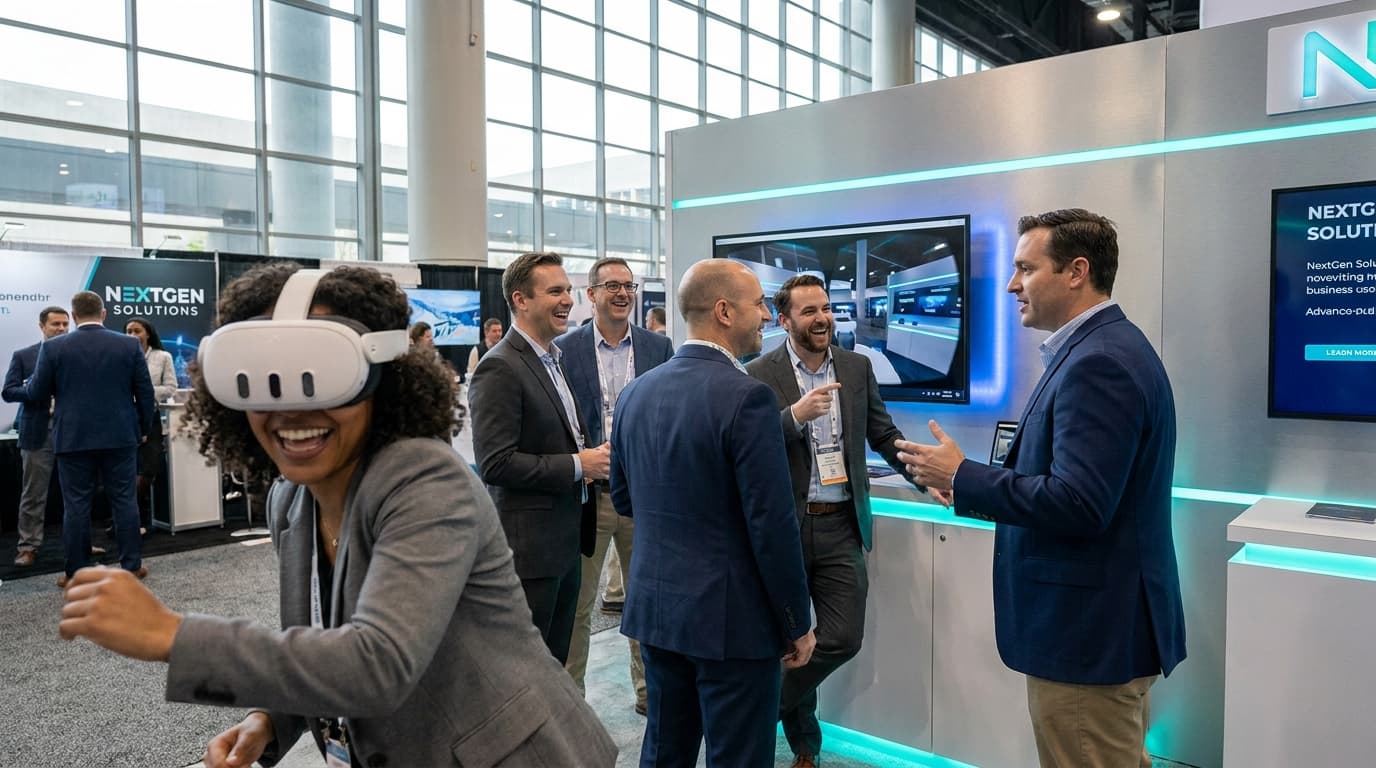
If you are actively researching trade show booth ideas for large groups, you are likely terrified of the "swag table bottleneck." Picture aisle 400 at the Metro Toronto Convention Centre. You rented a premium 20x20 island booth. You just managed to pull 150 prospects to your footprint immediately following the morning keynote. It looks incredible for a LinkedIn photo—until you realize your top account executives are trapped handing out branded tote bags instead of actually speaking to decision-makers.
Drawing a crowd of that size is only 10% of the battle. Processing that massive group without burning out your staff, creating a fire hazard, or ignoring your top buyers is a severe operational challenge. I have personally overseen the crowd management mechanics across 200+ mobile VR events. Relying on a rented spin-the-wheel game or a lone iPad survey when a tidal wave of attendees hits your footprint is a guaranteed way to bleed qualified leads. You do not just need a gimmick; you need an entertainment system engineered for high volume, sustained visual engagement, and structured data capture.
Why Typical Trade Show Booth Ideas for Large Groups Collapse Under Pressure
Most standard exhibit ideas work perfectly fine for a slow trickle of ten people an hour. But large-scale exhibits require unforgiving mathematical planning. If 150 people want to interact with your activation, and your chosen activity takes 10 minutes per person, you have just created a static, frustrating 25-hour wait time that actively repels passing foot traffic.
When VRPlayin deploys trade show VR activations for enterprise clients, throughput is the first variable we isolate and solve. We restrict average session times to a strict 2-5 minutes per guest. With a standard four-station setup utilizing the Meta Quest 3 Business Edition, we can comfortably process up to 80 people an hour.
This structured timing accomplishes two critical objectives: it keeps the physical line moving fast enough to prevent abandonment, and it creates a highly predictable window for your sales team. A three-minute VR session means your rep has exactly three minutes to qualify the person standing next in line. They can ask about current software stack limitations, supply chain challenges, and seamlessly scan their badge. The entertainment serves the sales process, never the other way around.
The "Watch and Talk" Strategy for Booth Traffic Generation
If you want serious booth traffic generation, providing a fun activity is not enough. You need an activity that is highly visual for spectators. When one person puts on a VR headset, the other 149 people in your booth footprint need a compelling reason to stick around.
This is where spectator TV casting becomes a massive lead-generation asset. At a recent SaaS conference at the Enercare Centre, we deployed Pistol Whip to anchor the afternoon crowd. It is a cinematic rhythm shooter where players physically dodge bullets and shoot targets to a thumping neon beat. Inside the headset, the player feels exactly like John Wick.
More importantly, the crowd watching the 65-inch casting monitor gets completely invested in the physical comedy of watching their VP of Sales squatting and weaving to avoid virtual lasers. We had a line wrapping around the adjacent aisle for the entire three-day conference. The client's marketing director told us afterward, "VRPlayin made us the talk of the show floor." But that crowd was not just standing idle. Our client's sales team aggressively worked the perimeter, standing at a 45-degree angle to the screen to use the gameplay as an organic icebreaker, turning laughter into qualified B2B conversations.
Matching the Experience to the Lead Quality Conversation
Not every massive conference requires high-adrenaline arcade shooters. Sometimes a large group consists of high-value, C-suite targets where the goal is extended rapport-building, rather than rapid-fire badge scanning. If your primary objective is Account-Based Marketing (ABM) or relationship building, your activation must slow down the pace naturally without causing a traffic jam.
For these scenarios, we frequently deploy Walkabout Mini Golf for clients hosting VIP lounges or closed-door activations. It remains the gold standard for social VR. Picture four executives standing in a highly detailed virtual pirate cove or a low-gravity space station, putting golf balls while discussing their Q4 projections.
This specific experience requires zero gaming literacy. The mechanics are entirely intuitive: point the controller, grab, and putt. Because the pace is completely relaxed, your own account executives can put on a headset and jump into a local multiplayer session with the prospects. Instead of delivering a stiff 30-slide pitch deck in a sterile boardroom in the Financial District, your reps are building genuine, memorable trust on a virtual 18th hole.
The Operational Reality of Mobile VR Events Canada-Wide
Executing high-volume VR on a trade show floor is a logistical knife fight. Any vendor can rent you a headset, but very few know how to keep a booth functioning flawlessly when hundreds of sweaty people pass through over an eight-hour exhibit window. We build brand activation solutions around hardware redundancy and clinical hygiene, treating both as mission-critical infrastructure.
When processing large groups, hygiene objections from attendees are guaranteed. We operate with strict medical-grade protocols: silicone face covers replaced and sanitized between every single user, utilizing Cleanbox CX1 UV-C light sanitizers to kill 99.9% of bacteria in 60 seconds, and dedicated antibacterial wipe stations. I have stood behind a corporate booth at midnight, meticulously deep-cleaning 40 headsets just to ensure they were pristine for an 8:00 AM exhibit hall opening.
Hardware uptime is equally vital. We never rely on the venue's extortionately priced, highly congested Wi-Fi. We deploy our own local 5GHz TP-Link enterprise routers purely to handle the casting traffic between the headsets and the TVs. Furthermore, to prevent headsets from dying mid-pitch, we utilize hot-swappable 10,000mAh magnetic battery straps, changing them out every two hours so the main headset battery never drops below 90%.
Physical space and safety are also non-negotiable. We require a minimum 6.5 x 6.5 feet (2m x 2m) per standing station to ensure attendees can move freely without striking a bystander. For planners worried about motion sickness disrupting their lead flow, we strictly curate stationary, zero-nausea experiences for corporate events. In our history of 200+ events, fewer than 2% of guests report any discomfort because we avoid artificial locomotion entirely.
Pre-Event Stakeholder Briefing Template
Managing massive booth traffic requires absolute, militant alignment between the entertainment vendor, the booth staff, and the marketing leaders before the loading dock doors even open. Below is the exact briefing template we use to assign responsibilities and ensure the activation drives actual CRM revenue.
The Large-Group Booth Responsibility Matrix
Assign these roles at least two weeks before load-in:
- Marketing Director (The Strategist): Defines the exact lead qualification criteria. Determines the 2-3 specific qualifying questions reps must ask while attendees watch the monitor, and dictates how the badge scanner data maps to Salesforce or HubSpot.
- Booth Captain / Lead Sales Rep (The Traffic Cop): Manages the perimeter of the 6.5 x 6.5 foot VR footprint. Approaches attendees watching the TV casting. Uses the phrase, "Have you tried VR before?" as the initial low-friction icebreaker, then gracefully pivots to the core qualifying questions.
- VRPlayin Facilitator (The Operator): Owns the hardware performance and guest throughput. Manages the strict 2-5 minute session timers. Swaps the medical-grade silicone covers. Ensures zero downtime by hot-swapping extended battery straps and managing the local router network.
- Operations Lead (The Logistics Owner): Confirms the layout dimensions on the CAD drawing. Secures the required electrical drops from the venue (essential at massive spaces like the Toronto Congress Centre). Enforces the rule that no booth staff can leave half-empty coffee cups near the $600 VR headsets.
The Golden Rule: Neutralize Staff Distraction Early
Here is an operational truth learned the hard way: your own booth staff will get distracted by the VR hardware. It happens at nearly every major B2B show. The first 30 minutes of setup before the exhibit floor opens are crucial for your team's discipline.
We specifically use our 60-90 minute morning setup window to let the client's sales reps play Fruit Ninja 2. The classic fruit-slicing mechanics with dual virtual swords act as a great stress reliever and satisfy their inherent curiosity about the tech. By getting the novelty completely out of their system early, your reps will keep their backs to the TV screens and their eyes locked on the aisle the moment attendees flood the hall. If they don't play it early, you will find your top closer staring at the TV monitor instead of scanning badges.
Post-Show Data Integration: Closing the Loop
A 150-person crowd is a vanity metric if it doesn't generate CRM data. The ideal moment to capture a lead is not when they are putting the headset on (they are too distracted), nor when they are playing. The absolute best time to scan a badge and ask a closing question is during the "cool down" phase.
When our VR Facilitator helps the guest take off the headset, the guest is universally smiling, full of adrenaline, and highly receptive. The Facilitator hands them a branded sanitizing wipe for their hands, and immediately introduces them to the Booth Captain: "Sarah, great job in there! This is Mark from the team, he's going to scan your badge to enter you into today's leaderboard." This creates a seamless, frictionless handoff that guarantees data capture without feeling sleazy or aggressive.
A Final Word on Booth Execution
The next time you are planning for a major influx of attendees, you must engineer the waiting experience just as heavily as the main attraction. Stop relying on outdated promotional tactics that cause line abandonment. Give the crowd a visually arresting casting screen to watch, enforce strict sub-five-minute gameplay sessions, prioritize clinical hygiene, and train your staff to aggressively work the perimeter.
If you want to review our full VR game catalog and pinpoint the exact virtual experience that aligns with your specific lead generation goals, review our corporate event options. Let's build a structured, high-throughput plan for your next major floor layout.
Capture Qualified Leads With High-Volume VR
Stop losing valuable conversations to poorly managed booth lines. Our mobile VR trade show setups are engineered to process massive crowds while keeping your prospects engaged, relaxed, and ready to talk business.
SEE TRADE SHOW PACKAGES