I have spent enough midnight hours navigating the Voyager freight elevators at the Metro Toronto Convention Centre, wiping down Pelican cases full of Meta Quest 3 hardware, to know exactly what separates a decent conference presence from a spectacular one. You are not just looking for a flashing light to waste your Q3 marketing budget on. When Toronto marketing directors start frantically searching for a "trade show booth ideas company near me" weeks before a major MTCC or Enercare Centre conference, they aren't looking for another branded pen vendor—they need a highly specific mechanical outcome. You want to stop attendees in their tracks, hold their attention, and give your sales team exactly five minutes of uninterrupted time to qualify them as a lead.
Over the course of running 200+ corporate VR events across the Greater Toronto Area, I have watched companies burn tens of thousands of dollars on generic giveaways that end up in hotel trash cans. Vendors who actually see a return on their $15,000+ floor space spend understand one operational truth: entertainment is a waste of budget if it doesn't force a sales conversation. We design trade show VR activations specifically to solve the "conference fatigue" problem. We break down the natural defensive barriers of attendees so your Account Executives can actually do their jobs.
How Interactive Booth Experiences Drive Lead Quality
Conference floors are hostile environments for capturing attention. Attendees have tired feet, heavy tote bags, and a finely tuned radar for avoiding eye contact with aggressive sales representatives. Most trade show activation ideas fail because they require the attendee to cross the threshold and initiate the business conversation themselves.
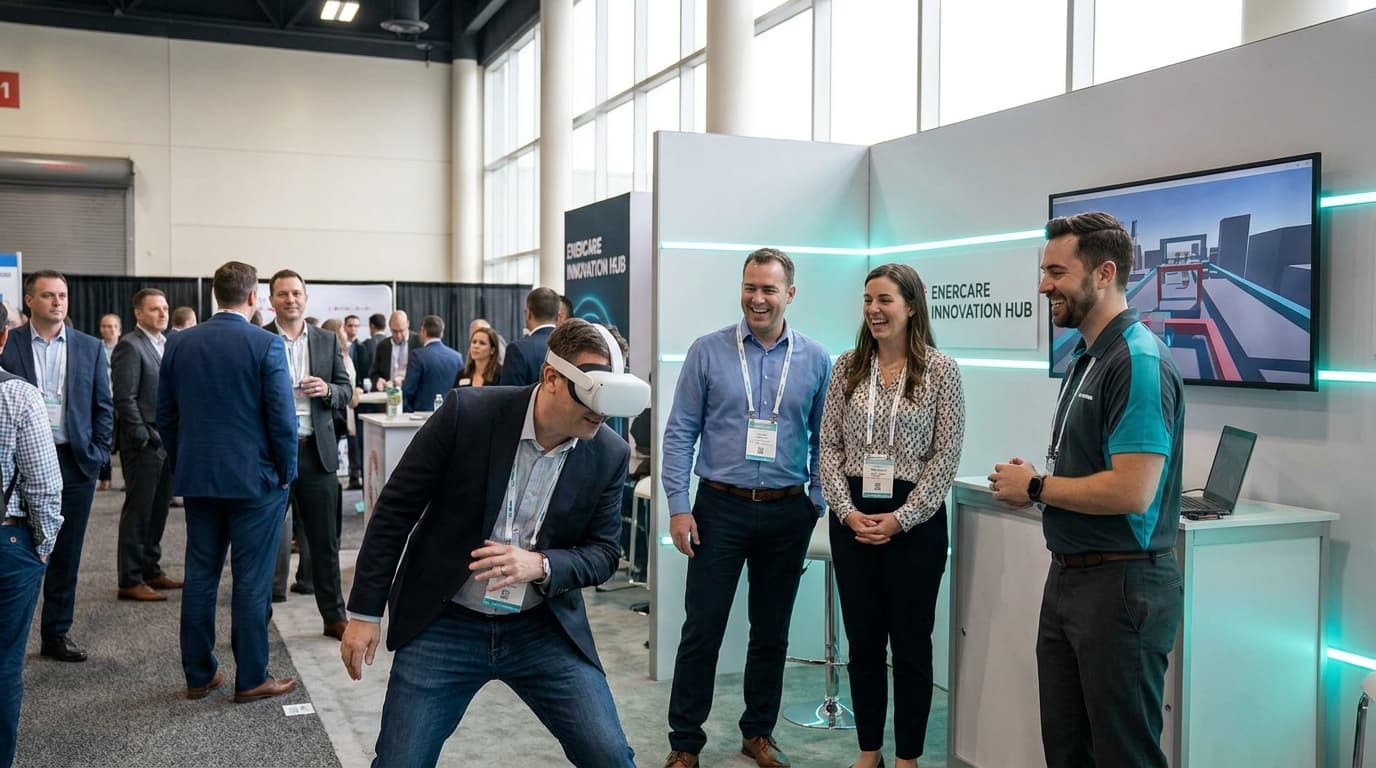
We bypass that psychological friction entirely using a technique called spectator TV casting. This is the absolute core of our activation strategy. We hardwire our Meta Quest 3 Business Edition headsets to cast the live, in-headset gameplay directly to 50-inch 4K monitors positioned at the very edge of your booth space. We don't hide the gameplay in the back; we put it right on the aisle line.
Here is exactly how the interaction plays out on the floor. A VP of Operations is walking past your footprint. They hear the heavy bass track from Pistol Whip and see their colleague physically dodging virtual bullets on the large monitor. They stop walking. They laugh. They take out their smartphone to record a video for Slack. At that exact moment, your sales rep steps up beside them, laughs along, and asks, "Have you guys tried VR before? By the way, what vendor are you currently using for your cloud infrastructure?"
You are no longer cold-pitching a stranger in an aisle. You are sharing a mutually entertaining, human experience. The VR gameplay anchors the prospect in your physical space for the 3 to 5 minutes it takes for a gaming session to complete, giving your team a captive, relaxed audience to qualify.
CRM and Badge Scanner Integration: The Lead Capture Engine
Generating a crowd is a vanity metric if you aren't capturing data. We don't just run games; we integrate the VR experience directly into your lead retrieval process. The most effective way to do this is through competitive leaderboard mechanics.
We set up a digital or physical leaderboard next to the spectator monitors. When an attendee finishes their session, our dedicated VRPlayin facilitator takes the headset and says, "You just hit 4,500 points! That puts you in the top ten for today. Go scan your badge with Sarah over there to log your score on the official leaderboard. The top score at 4:00 PM wins a prize."
The attendee enthusiastically walks straight to your Account Executive, willingly hands over their badge to be scanned into your Cvent or LeadRetrieval system, and eagerly engages in a conversation about their score—which naturally pivots into a conversation about your product. This completely eliminates the awkward "Can I scan your badge?" friction that plagues most trade show interactions.
Curating the Right Content: Pistol Whip and Fruit Ninja 2
Choosing the wrong software will bottleneck your booth, cause motion sickness, and frustrate non-gamers. We strictly avoid long, narrative-heavy games or anything requiring complex button combinations. For a high-traffic environment, you need immediate gratification, simple mechanics, and fast turnover. We curate specific titles tailored to the exact demographic of your B2B event.
Pistol Whip: For the Competitive B2B Tech Crowd
If you are exhibiting at a massive tech conference at the MaRS Discovery District or targeting a younger, high-energy SaaS demographic, Pistol Whip is our primary deployment. This is a cinematic rhythm shooter where players feel exactly like John Wick. They dodge bullets and shoot targets to the beat of heavy electronic music through neon-drenched scenes. It is high intensity, incredibly fun to watch on the spectator monitors, and draws massive crowds because the physical movements of the player (squatting, dodging, aiming) are highly exaggerated and highly visible from down the aisle.
Fruit Ninja 2: For High Volume and Zero Gaming Experience
When we need to cycle 300 to 400 people through a 10x20 booth in a single afternoon, we deploy Fruit Ninja 2. The hook is universally understood: classic fruit-slicing with dual swords. It requires absolutely zero gaming skill or controller knowledge—attendees just point their hands, grab the hilts, and swing their arms. It serves as excellent stress relief for attendees who have been sitting in boring breakout sessions all morning. It is also the perfect title for the leaderboard mechanics mentioned above.
The Live Event Troubleshooting Flowchart for Mobile VR Events
Hardware fails. Venue Wi-Fi drops. Schedules run late. As a vendor who has executed over two hundred live corporate activations, I know that success on the trade show floor is entirely dependent on how you handle friction. When you hire an experienced operator for mobile VR events in Canada, you are paying for their battle-tested contingency plans. Here is the exact troubleshooting flowchart our trained technicians use on the floor to guarantee zero downtime.
Scenario 1: The Venue Wi-Fi Drops Completely
The MTCC and Toronto Congress Centre are notorious for saturated networks that instantly kick mobile devices offline when 5,000 attendees enter the hall.
The Fix: We do not rely on venue internet to keep your booth running. While complex multiplayer experiences require connectivity, all of our high-turnover booth games run flawlessly offline. If the network dies, our technicians seamlessly transition all casting to localized, offline router networks. The attendee never notices a blip. We also bring our own enterprise-grade networking gear (like Ubiquiti UniFi setups) if complex brand activation solutions require a stable, dedicated LAN.
Scenario 2: An Attendee Experiences Motion Sickness
Some senior prospects are hesitant to put on a headset because of past bad experiences with cheap consumer VR rollercoasters.
The Fix: We curate zero-nausea experiences exclusively. We strictly lock out "artificial locomotion" (using joysticks to walk virtually) and only deploy stationary gameplay where the virtual movement matches the physical movement 1:1 in the real world. Across our operational history, fewer than 2% of guests report any discomfort. If a facilitator spots early signs of unease—like a guest losing their balance or mentioning dizziness—they immediately pause the game, help the guest remove the headset, and offer a seated, low-intensity alternative.
Scenario 3: Battery Drain During Peak Traffic
A standard Quest 3 battery dies in under two hours under heavy graphical load. A standard trade show runs for eight to ten hours.
The Fix: We utilize BoboVR extended battery straps on all our units, but we also bring a complete set of redundant backup hardware to every single activation. Our technicians perform rapid hot-swaps. When Headset A drops to 20% battery, we instantly hand the next guest Headset B, placing Headset A on a dedicated rapid charging station hidden inside your podium. Your booth never stops operating, and there is never a "please wait while this charges" sign on your table.
Scenario 4: Hygiene Concerns from Attendees
Guests absolutely do not want to put a sweaty sponge on their face, especially in a modern, post-pandemic conference environment.
The Fix: We completely remove the stock fabric facial interfaces and utilize medical-grade, non-absorbent silicone face covers. Our trained facilitators physically wipe down the entire headset, controllers, and straps with antibacterial wipes between every single user. We also utilize UV-C sanitization protocols for all backup equipment and provide dedicated, branded hand sanitizer stations right at the VR staging area.
Scenario 5: The Show Floor is Deafeningly Loud
An industrial or heavy machinery expo at the Enercare Centre can easily hit 90 decibels of ambient noise, drowning out the built-in headset speakers.
The Fix: We bypass the Meta Quest's internal audio straps entirely. For loud environments, we deploy closed-back, noise-isolating over-ear headphones (such as the Sennheiser HD 280 Pro). This completely immerses the attendee in the game, shutting out the chaos of the trade show floor, while our monitors handle the audio for the spectators.
Why Hiring a Local "Trade Show Booth Ideas Company Near Me" Solves Logistics Headaches
Executing a flawless VR activation requires strict adherence to physical space, power, and timing requirements. We do not guess on these metrics; they are hard operational rules built to ensure physical safety and maximum attendee throughput. Working with a local Toronto team means we handle the venue logistics directly.
First, we require a minimum of 6.5 x 6.5 feet (2m x 2m) of clear, unobstructed floor space per standing VR station. This ensures the player has a safe, mapped physical boundary to swing dual swords in Fruit Ninja 2 without hitting your podiums, banner stands, or passing attendees. If your booth footprint is restricted to a standard 10x10 space, we can pivot to seated or forward-facing stationary experiences, which require only 3 x 3 feet of space per unit.
Our logistics team arrives at the loading dock precisely 90 to 120 minutes before the exhibition hall opens to attendees. This allows us ample time to map the Guardian boundaries, test the spectator casting feeds for latency, and run a quick training huddle with your sales staff on the flow of traffic. Teardown takes 30 to 45 minutes after the hall closes. We handle all of this directly; your sales team does not lift a single piece of hardware.
Regarding power, each station requires a single, dedicated standard 120V outlet to keep our casting monitors and rapid battery chargers operational throughout the day. We assess all of this during the planning phase, directly reviewing your exhibitor manual to ensure total venue compliance regarding cable management and trip hazards.
"A Line Around the Corner": Data-Backed Results
You do not have to take my word for the efficacy of this lead generation strategy. Our 4.9-star Google rating across over two hundred corporate activations was built on actual, measurable B2B results.
As the Marketing Director of a Toronto-based enterprise SaaS company recently reported after we managed their MTCC activation: "Our booth had a line around the corner the entire conference. VRPlayin made us the talk of the show, and we scanned 3x the qualified leads compared to last year."
That line is not just a vanity metric. It represents dozens of captive conversations and qualified badge scans. With an average session time of 2 to 5 minutes per guest, a dual-station VR setup can cycle between 40 and 60 prospects through your footprint every single hour. Over a two-day conference, that is a sustained volume of engagement that a bowl of branded mints and a PDF brochure simply cannot match.
Securing Your Dates and Next Steps
Toronto's major conference season is heavily compressed into the spring and fall months. Dates at major venues like the Fairmont Royal York, the Beanfield Centre, and the MTCC book up months in advance, and our hardware and staffing inventory follows that exact same demand curve. We require a 50% deposit to secure your hardware and technical staff, with the balance due on the day of the event.
We accept corporate invoicing, EFTs, and all major credit cards to make the procurement process straightforward for your finance department. We also offer standard $5M liability insurance for all operations. For venues requiring custom named-insured certificates, we seamlessly handle those requests with our broker, provided they are submitted to our team at least two weeks prior to load-in.
Stop relying on passive marketing collateral to do the heavy lifting on the exhibition floor. Give your sales team an unfair, magnetic advantage by deploying hardware that forces attendees to stop, engage, and listen.
Dominate the Floor at Your Next Toronto Conference
Stop handing out branded pens and start pulling attendees into high-energy VR experiences. We handle the hardware, the hygiene, and the facilitation so your team can focus entirely on qualifying leads and closing deals.
SEE TRADE SHOW PACKAGES