A highly effective trade show booth ideas checklist goes far beyond ordering branded pens and setting up banner stands. It requires a strategic plan that maps foot traffic directly to specific engagement windows, ensuring your sales team secures exactly two to five minutes of captive time to qualify a prospect while they are entertained.
You are standing on the concrete floor of the Metro Toronto Convention Centre. It is day two. Your sales reps are aggressively scanning the badges of people who only stopped by to grab a free branded phone charger. You have 400 badge scans, but maybe three actual, qualified conversations. I have seen this exact scenario play out repeatedly.
The fundamental flaw with most convention strategies is treating the booth as a giant net rather than a filter. A crowd is useless if your sales team cannot hold a meaningful conversation with the individuals in it. We have run over 200 events across the GTA, and the data is clear: forcing a pitch on someone reaching for a freebie creates resentment. Giving them a spectacle to watch while you naturally strike up a conversation creates rapport.
Reframing Booth Traffic Generation: The Spectator Strategy
When most marketing directors research trade show booth ideas, they focus exclusively on the person interacting with the activation. If you hire a caricature artist, the artist is engaging one person. If you set up a prize wheel, the engagement lasts five seconds.
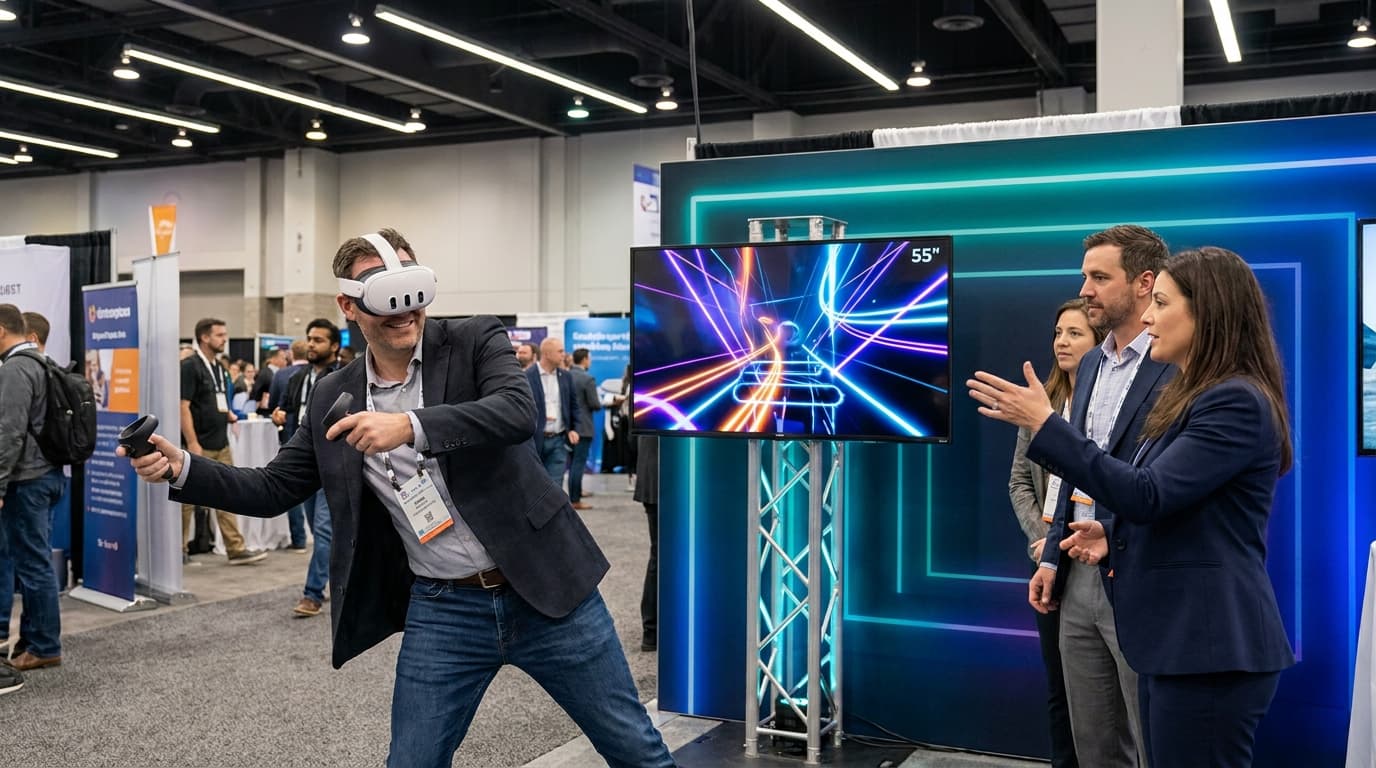
When we deploy trade show VR activations, the person wearing the Meta Quest 3 headset is actually our secondary target. Our primary target is the group of three colleagues standing behind them, watching their friend flail wildly at an invisible target.
Consider a title like Fruit Ninja 2. It is one of our most requested experiences for corporate crowds because it requires zero gamer skills. You hold dual swords and slice flying fruit. It is simple, highly satisfying, and intensely leaderboard-competitive. While the prospect is safely occupied for an average session of 2-5 minutes, we cast their first-person view to a 55-inch TV screen facing the aisle.
This is your strict three-minute conversion window. A passerby stops because they see a grown professional in a suit aggressively chopping the air. They look at the TV to see the flying fruit. They laugh. Your sales rep steps up next to them, smiles, and says, "He's currently in 4th place, but the guy from Deloitte set a massive high score this morning. Have you guys checked out our new software platform yet?"
You just earned a warm, high-value qualification window. No friction. No awkward badge scanning.
Your Operational Trade Show Booth Ideas Checklist
You cannot execute a high-end activation by simply tossing a consumer headset on a table. Flawless execution requires commercial-grade hardware and strict operational protocols. Add these seven non-negotiable items to your trade show booth ideas checklist:
1. Space and Footprint Verification
A cramped VR station is a liability. You need a minimum of 6.5 x 6.5 feet (2m x 2m) per standing station to ensure a safe boundary. If you have a standard 10x10 booth, you can comfortably fit one standing station alongside a small reception counter. For a 20x20 island, we typically deploy two to three stations. We always assess your exact floor plan during the planning phase to map out the flow of traffic.
2. Medical-Grade Hygiene Protocols
Corporate event planners frequently ask about cleanliness. Your checklist must include a relentless sanitization process. We use medical-grade silicone face covers that are swapped and sanitized between every single user. Our technicians wipe down the controllers, head straps, and lenses with antibacterial wipes and utilize UV-C sanitization. We also provide hand sanitizer stations right at the activation. In 200+ events, we have never compromised on this standard.
3. Offline Redundancy and Power Management
If you have ever purchased exhibitor internet at the Enercare Centre or the Toronto Congress Centre, you know venue Wi-Fi is notoriously expensive and occasionally unstable. This is why our checklist prioritizes offline reliability. We specifically load our Meta Quest 3 Business Edition headsets with premium single-player experiences that run entirely offline. Furthermore, we use extended battery straps and hot-swap hardware to ensure zero downtime. We arrive 60-90 minutes before the event starts to test every variable.
4. Motion Sickness Mitigation
The fastest way to ruin a lead is to make them nauseous. We curate zero-nausea experiences strictly designed for corporate environments. This means stationary gameplay with absolutely no artificial locomotion. You are standing on a virtual platform that does not move. Because of this strict curation, fewer than 2% of guests report any discomfort across our entire operational history.
5. Real-Time CRM and Lead Integration
A leaderboard is useless if the data dies on a whiteboard. High-performing booths digitize the competitive element. We deploy dedicated iPad kiosks running custom leaderboard software. When the VP of Marketing at Shopify wants to log their score to win your daily prize, they input their name, email, and company. This data is synced directly to your CRM (like HubSpot or Salesforce) via API, meaning by the time they take off the headset, your sales rep already has their prospect profile open.
6. Infrared Lighting and Tracking Interference
Massive overhead LED truss lights and towering convention center windows can flood the show floor with infrared light, blinding the inside-out tracking cameras on standard VR headsets. Your operational checklist must account for environmental interference. Our technicians conduct light-meter tests during load-in and can adjust headset tracking frequencies or utilize specialized IR illuminators if your booth is assigned to a tracking dead zone.
7. Audio and Noise Floor Management
The ambient noise floor of a busy convention is consistently above 75 decibels. Pumping game audio through the built-in headset strap speakers will be completely drowned out, ruining the prospect's immersion. We mandate closed-back, over-ear noise-isolating headphones for the player, while routing the game's bass-heavy soundtrack to a dedicated soundbar at the edge of your aisle boundary to actively draw in foot traffic.
The 60-Minute Run-of-Show Example: Managing 100 Guests
If your booth gets rushed by 100 people right after a keynote speech ends, how do you manage the chaos? Here is a precise 60-minute run-of-show example demonstrating how we handle a sudden surge using two VR stations and our hub-and-spoke crowd management model.
Minute 00:00 - 00:10: The Initial Hook
The keynote doors open. Our facilitators immediately launch Pistol Whip on both stations. This is a cinematic rhythm shooter where players feel like John Wick, dodging bullets and shooting targets to an intense neon beat. Our staff physically demonstrates the game. The sheer kinetic movement draws the first wave of 15-20 attendees to the edge of the booth. The outward-facing TVs do the heavy lifting for traffic generation.
Minute 00:10 - 00:30: The Qualification Window
A queue naturally forms. We cap sessions at exactly three minutes. With two stations, we process 40 guests per hour through the headsets. However, the remaining 60 guests are actively engaged in the booth. They are watching the screens, cheering on their colleagues, and interacting with your brand ambassadors. Your sales team uses this 20-minute block to rapidly qualify the spectators, filtering out the tire-kickers and booking follow-up meetings with the decision-makers.
Minute 00:30 - 00:50: The Leaderboard Spike
We highlight the competitive element on the iPads. The competitive drive takes over. We see directors from Bay Street financial firms circling back to the booth just to beat the high score of a rival company's VP. Your reps now have a warm excuse to talk to these high-level targets a second time.
Minute 00:50 - 00:60: Teardown or Transition
As the rush dies down and attendees move to their next breakout session, our facilitators immediately sanitize all hardware, hot-swap battery packs, and reset the staging area for the next wave. We are ready to go again in less than five minutes.
Expert Insight: The Spectator Screen Secret
I write this as an operator who has cleaned 40 headsets at midnight after a massive 300-person corporate gala, packed the vans, and showed up the next morning to run a trade show activation. I have seen exactly what causes a booth to fail and what makes it the talk of the convention.
The single biggest rookie mistake exhibitors make with brand activation solutions is pointing the action inward. They set up their attraction so the participant is facing the back wall of the booth, and the TV screen is hidden from the aisle. They build a walled garden.
You must build a stage. We always position our VR boundaries right on the edge of the aisle line. The participant faces outward, and the 55-inch casting screens are angled so anyone walking down the convention aisle can clearly see the gameplay. You do not want people to have to step into your booth to see what is happening. You want the spectacle to arrest them in the aisle, breaking their autopilot convention walk. Once they stop walking, your sales team owns the interaction.
This level of operational precision is why we maintain a 4.9-star Google rating and a 40% repeat booking rate. It is why a VP of People & Culture at a major SaaS company recently told us: "We've booked VRPlayin three times now. Each event, they bring something new and the team loves it."
Executing Mobile VR Events Canada Coast-to-Coast
While we are heavily entrenched in Bay Street boardrooms and Liberty Village tech hubs, the demand for high-caliber mobile vr events canada wide has grown exponentially. Whether you are hosting a VIP client lounge at the Fairmont Royal York or activating a massive footprint at an industry expo, the hardware is only 10% of the equation. The other 90% is facilitation.
Your team should not be troubleshooting Wi-Fi routers, explaining how controllers work, or wiping down silicone face plates. Your team needs to be selling. Our trained technicians handle the 60 to 90-minute setup, actively coach the non-gamers through their experiences, manage the safety boundaries, and execute the 30 to 45-minute teardown seamlessly.
We bring backup equipment to every single deployment. If a controller tracking ring glitches due to battery failure, our technicians swap it out within 60 seconds. The attendees never even notice. That is the standard of execution required to represent your brand on a busy convention floor.
Stop Gathering Traffic, Start Engineering Conversations
If your current activation relies on passively hoping attendees will drop a business card in a fishbowl, you are wasting expensive floor real estate. Shift your mindset from gathering generic foot traffic to engineering specific, timed conversation windows. Use a highly visible, engaging operational tool to occupy the prospect's hands and eyes, giving your sales team the perfect, frictionless opening to engage their mind and qualify the lead.
Stop Guessing, Start Qualifying
Transform your next trade show booth into a high-converting lead engine. We provide the commercial hardware, the medical-grade hygiene, and the expert facilitators so your sales team can focus entirely on closing deals.
SEE TRADE SHOW PACKAGES