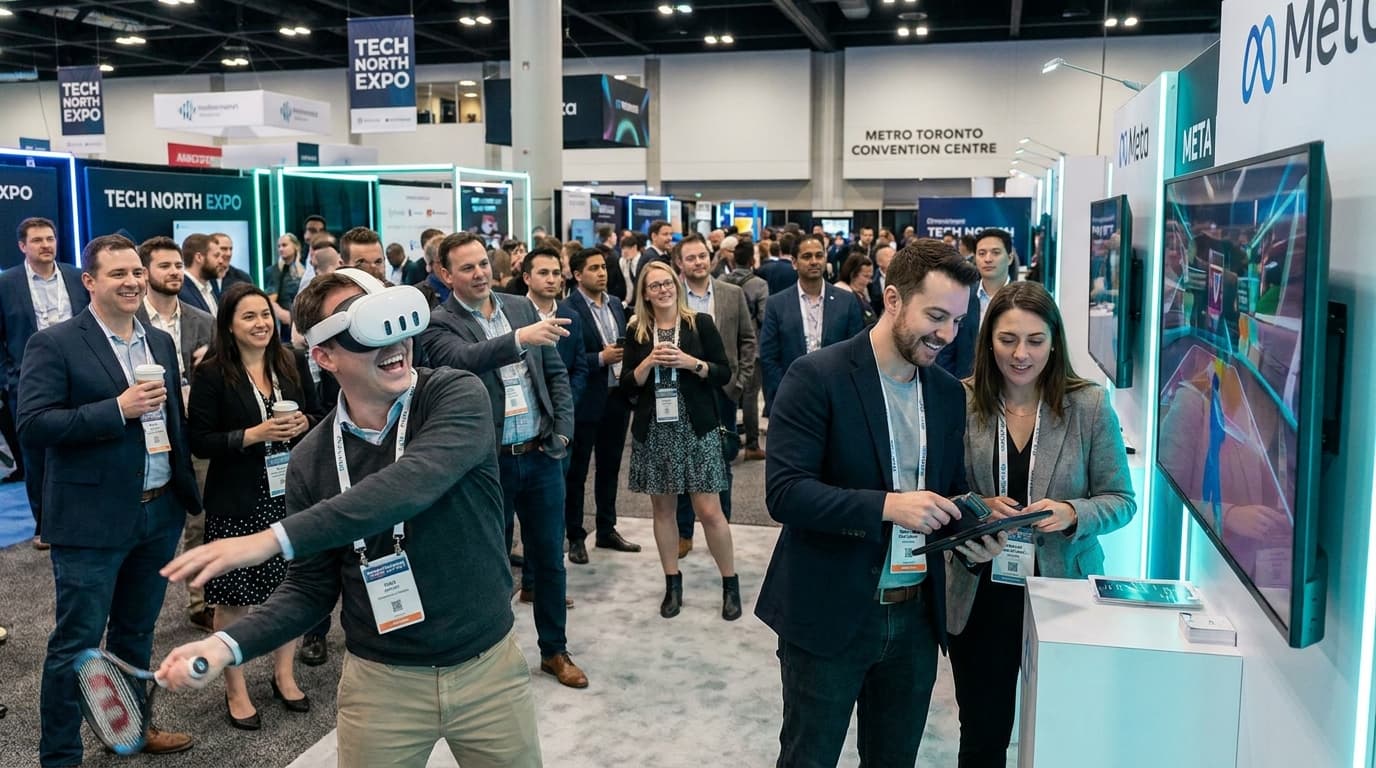
I have walked the concrete aisles of the Metro Toronto Convention Centre more times than I can count. I have seen marketing teams spend $50,000 on a prime 20x20 footprint, only to staff it with bored sales development reps handing out branded lip balm to people actively avoiding eye contact. If you are reading this, you are likely building a trade show booth ideas case study to prove to your leadership team that your next event budget will actually generate pipeline, not just empty foot traffic.
You do not need another spinning prize wheel. You need a conversational trap—a mechanism that holds a prospect in your physical space long enough for your sales team to qualify them. After running 200+ events across the GTA, from Yorkville boardrooms to massive Bay Street corporate galas, I can tell you exactly what works. We use virtual reality not as a cheap gimmick, but as a highly calibrated, managed lead generation engine.
Building Your Trade Show Booth Ideas Case Study: A 400% Lead Increase at Collision
Event planners often ask us for a concrete trade show booth ideas case study they can present to their CMO. Let’s look at a recent B2B SaaS client exhibiting at the Collision Conference at the Enercare Centre. They had a standard 10x20 booth and were competing against monolithic tech giants with million-dollar budgets.
Their historical average was 80 to 100 badge scans over a three-day event. Their typical dwell time (how long a prospect stayed in the booth) was under 45 seconds—barely enough time to hand over a flyer.
We deployed a dual-headset Meta Quest 3 setup with two large spectator casting monitors facing the aisle. We instituted a simple, low-friction gatekeeping mechanism: to play a 3-minute round of a high-score VR game, attendees had to let the sales rep scan their badge. Furthermore, we set up a physical whiteboard leaderboard next to the monitors. To get their name on the board for a daily grand prize, players handed over a business card.
The results completely transformed their ROI. Over three days, they captured 412 qualified badge scans (a massive increase from their 100-scan average). More importantly, the average dwell time skyrocketed to 6 minutes. Because attendees were captivated by watching their peers on the monitor, the client's sales team had an organic, captive audience. They walked away with 32 strictly qualified, booked demo meetings. That is the difference between a gimmick and a lead engine.
The Operational Reality Check: 200+ Events Later
Most lists of interactive event concepts focus entirely on the initial visual hook. They completely ignore what happens after the prospect stops walking. When you book a vendor to supply interactive booth experiences, the goal is not to entertain your prospect. The goal is to buy your sales team exactly 3 to 6 minutes of undivided attention.
Here is the operational reality of our setup: we bring Meta Quest 3 Business Edition headsets equipped with extended battery straps. But the absolute most critical piece of hardware we set up is the spectator casting TV. When a mid-market logistics director puts on a headset and starts wildly swinging at virtual targets, a crowd immediately forms in the aisle to watch their colleagues on the 55-inch monitor.
Your sales team should never be watching the screen. They should be working the aisle, scanning badges, and qualifying the dozen people laughing and pointing at the spectacle. The person in the headset is the bait; the crowd is the catch.
If you want to validate this approach internally, trade show VR activations provide a measurable, data-backed return on floor space. But choosing how to execute this makes or breaks the event.
Direct Comparison: The Cost, Staffing, and Risk of Interactive Booth Experiences
Marketing managers often assume they can just rent a few headsets from a local AV supplier, download a game, and let their account executives run the activation. I have personally cleaned 40 headsets at midnight after a 300-person gala at The Carlu. I promise you, your top-performing sales reps do not want to spend their $1,000-a-day trade show time acting as IT support and wiping down sweaty silicone face gaskets.
Here is a direct comparison framework to help you evaluate your booth activation options for your internal pitch.
| Evaluation Criteria | Managed VR Activation (VRPlayin) | DIY Tech Rental (iPad/VR) | Standard Booth Gimmick (Prize Wheel) |
|---|---|---|---|
| Lead Qualification Time | High (3-6 captive minutes per guest plus the spectator crowd) | Low (Guests abandon immediately if tech glitches occur) | Zero (Scan badge, spin wheel, take pen, leave immediately) |
| Staffing Burden | Zero. Dedicated facilitators run setup, teardown, casting, and gameplay. | High. Sales reps must troubleshoot WiFi drops and clean equipment constantly. | Medium. Requires constant, exhausting energetic hawking by your team. |
| Equipment & Risk | Backup hardware on-site. Technicians swap dead gear in under 60 seconds. | High risk. If the rental breaks, your booth is entirely dead. | Low risk, but extremely low reward for pipeline generation. |
| Hygiene Standards | Medical-grade silicone covers, UV-C sanitization, antibacterial wipes. | Typically poor. Handled ad-hoc by busy, distracted booth staff. | N/A |
Game Selection as a Lead Gen Strategy
You cannot just load any game onto a headset and expect it to generate leads. The software must match your specific brand identity, the venue's vibe, and your required throughput. Here is how we strategically deploy specific titles to manipulate floor traffic.
Beat Saber and the Enercare Centre Energy Spike
When you need to generate immediate, undeniable energy on a sluggish Tuesday afternoon at the Enercare Centre, you deploy Beat Saber. It is the world's most popular VR game for a very specific reason. Guests slash glowing blocks to a heavy electronic bass beat. It is a 1-player, medium-intensity experience that is easy to learn, incredibly satisfying, and gets the heart rate up.
Warning: it is highly addictive and will cause bottlenecks if unmanaged. We strictly cap the session per guest at 3 minutes depending on your floor traffic. Because it requires zero gaming skills, even the most skeptical, suit-wearing executives will give it a try. They grab the controllers, the music hits, and suddenly you have a massive crowd blocking the aisle to watch. That is the exact moment your team steps in to discuss brand activation solutions with the onlookers.
Walkabout Mini Golf: The 5-Minute Networking Trap
Not every venue or B2B brand suits high-energy electronic music and flashing neon lights. If you are hosting a VIP pavilion at the Toronto Congress Centre and need to foster deep, relaxed networking, Walkabout Mini Golf is the gold standard for social VR.
This is a low-intensity experience supporting 1 to 4 players simultaneously. The courses are visually stunning, ranging from pirate coves to sprawling space stations. The magic here is the pacing. It is the perfect cadence for chatting while playing. Your account executive can literally put on a headset, join the prospect in the virtual pirate cove, and have a completely natural, relaxed sales conversation while lining up a putt. You are effectively trapping them in a fun, shared digital environment where checking their phone or awkwardly walking away is impossible.
Racket: NX for High-Volume Toronto Congress Centre Crowds
When you have a massive list of registered attendees and need high throughput to hit aggressive lead targets, Racket: NX is our go-to recommendation. Think of it as futuristic racquetball played inside a giant, glowing glass dome. Players hit targets in 360 degrees. It requires fast reaction speeds and delivers an immediate visual spectacle for the spectator monitor.
Because it is intensely focused and fast-paced, we can cycle guests through rapidly, maintaining a high volume of badge scans without creating an unmanageable bottleneck. We assess your physical footprint during the planning phase to ensure the required 6.5 x 6.5 feet (2m x 2m) per standing station is clearly marked, safe, and highly visible.
Addressing the 6.5-Foot Space, Hygiene, and WiFi Elephants
When you pitch this concept to your events leadership, they will throw predictable objections at you. The first will be hygiene. After executing 200+ events, we operate with clinical precision. We use medical-grade silicone face covers that are thoroughly wiped down between every single user. We employ UV-C sanitization wands for all controllers, use antibacterial wipes constantly, and provide standalone hand sanitizer stations. The gear looks and feels brand new for every single prospect.
The second objection is motion sickness. We curate zero-nausea experiences exclusively for corporate events. We utilize stationary gameplay with absolutely no artificial locomotion (where the player moves in the game but not in real life). In our entire operating history, fewer than 2% of guests report any discomfort. Our trained facilitators spot early signs of hesitation and can switch a guest to more comfortable content immediately.
The third objection is venue connectivity. Anyone who has run a booth knows that convention center WiFi is notoriously expensive and unreliable. Multiplayer experiences and casting to TVs require a strong network. We do not rely on venue internet. We bring our own enterprise-grade 5GHz local networking routers to create a closed, flawless loop between the headsets and the casting monitors, completely bypassing the venue's saturated network.
The Verdict: Dominating Mobile VR Events Canada Wide
You do not need to guess if this works. The data and our corporate retention rate speak for themselves. We maintain a 4.9-star Google rating and a 40% repeat booking rate among corporate clients because we treat entertainment as a strict, managed operational service tied directly to your business outcomes.
As one of our enterprise clients recently noted:
"Setup was seamless, the staff was professional, and our team had an absolute blast while tripling our normal lead capture rate." — Event Marketing Director, B2B Consulting Firm
If you are ready to stop handing out branded pens and start capturing actual pipeline, you need an activation that demands attention. We are based in Toronto, but as a premier provider of mobile VR events Canada wide, we travel wherever your major shows are happening. Our setup takes 60-90 minutes before the event starts, and teardown takes just 30-45 minutes. You show up, you sell to a captive audience, and we handle the rest.
Stop Losing Trade Show Leads to Boring Booths
Turn your next convention floor footprint into a high-converting lead engine. We provide fully managed mobile VR activations for trade shows and brand activations, complete with commercial hardware, dedicated staffing, and spectator casting to capture the crowd.
SEE TRADE SHOW PACKAGES