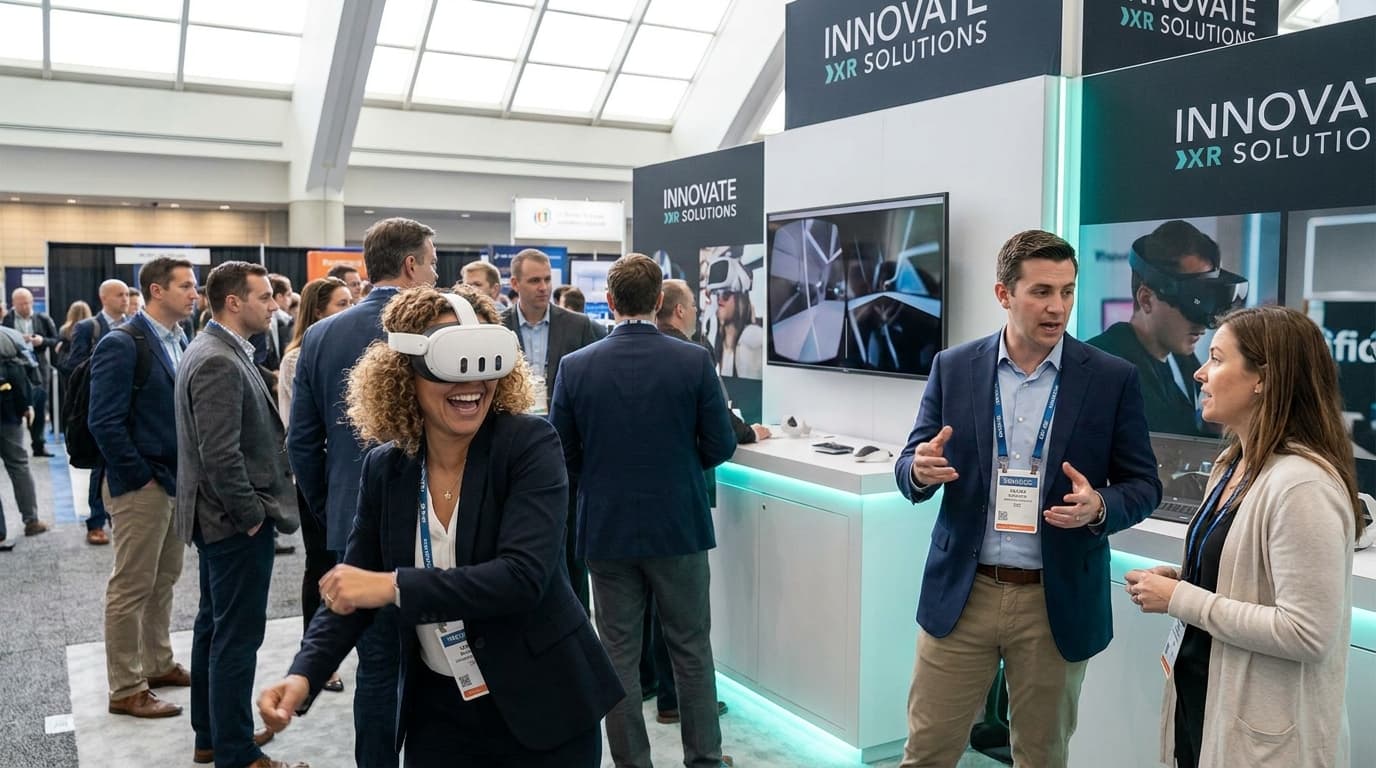
When mapping out a highly profitable trade show booth ideas booking timeline, the operational sweet spot starts 90 to 120 days before load-in. Finalizing your interactive concept and securing vendor deposits must happen at the three-month mark. Pre-show promotional campaigns launch at 60 days, and finalizing venue logistics—like union labor rules, power drops, and drayage fees—must be locked in 30 days out.
It is 8:00 AM on the floor of the Metro Toronto Convention Centre. You are staring at an empty 10x10 booth armed with a fishbowl for business cards and a stack of expensive, ignored corporate brochures. Across the aisle, a competitor has a crowd of thirty people cheering loudly, cell phones out, recording a VP of Finance as they walk a virtual plank 80 stories in the air. You realize immediately that a bowl of complimentary peppermints will not secure your Q3 lead quota.
After operating 200+ corporate VR events across the GTA, I have seen exactly what separates the booths that scan 500 qualified badges from the ones that pack up early on day three. It is not about having a flashy gimmick. It is about deploying a strategic interactive asset to trap attention long enough for your sales team to do their actual job.
The 90-Day Mark: Kicking Off Your Trade Show Booth Ideas Booking Timeline
Securing a vendor three months out is not just about equipment availability; it is about footprint strategy. The 90-day mark is when you lock in the physical floor plan and pay your activation deposit, triggering a cascade of operational planning.
The most critical factor at this stage is spatial mathematics. A proper room-scale VR setup using our Meta Quest 3 Business Edition headsets requires a minimum of 6.5 x 6.5 feet (2m x 2m) per standing station to ensure player safety. If you are restricted to a standard 10x10 booth, we pivot to seated or stationary experiences—like virtual racing or immersive escape room puzzles—that require only a 3 x 3 foot footprint.
I have assessed hundreds of floor plans, from Financial District boardrooms to massive halls at the Toronto Congress Centre. You must know your exact square footage before signing off on any interactive vendor. At this 90-day milestone, your primary objectives are defining the physical footprint, securing the hardware allocation, and mapping out the data capture flow.
The 60-Day Mark: Pre-Show Promotion and Appointment Setting
Relying entirely on passive foot traffic is a rookie mistake. By the 60-day mark, your field marketing team must integrate the VR experience into pre-show emails, LinkedIn SDR cadences, and targeted VIP outreach. You are no longer hoping attendees stop by; you are engineering deliberate booth traffic.
Instead of sending a generic "Come visit us at Booth 402" blast, give prospects a competitive reason to schedule time with you. Software selection here is paramount. For highly competitive B2B crowds (think tech, finance, or sales professionals), we deploy Racket: NX. This title places the user inside a giant glass dome where they play futuristic racquetball, hitting glowing targets in a 360-degree arena.
Because it tests reaction speed, you can build a "Fastest Reaction Time of the Day" digital leaderboard on a dedicated TV monitor. Your pre-show emails now have a highly specific hook: "Book a 10-minute discovery chat with our product engineers and get priority access to our VR leaderboard. The top score at 4:00 PM on Tuesday wins a pair of Bose noise-canceling headphones."
Linking gameplay to a scheduled conversation is the core of highly profitable brand activation solutions. It turns your activation from a toy into an appointment-driven lead engine.
The 30-Day Mark: Venue Logistics, Drayage, and Operator Sanity
One month out is where amateur planners panic and experienced operators thrive. This phase is entirely focused on navigating venue restrictions, union rules, and technical logistics.
Let us address the operational hurdles we clear for you at the 30-day mark:
- Drayage and Material Handling: If you order massive physical booth builds, you pay exorbitant union drayage fees to move crates from the marshaling yard to your booth. Because VRPlayin is a mobile tech service, our technicians can often carry the hardware directly onto the floor, bypassing thousands of dollars in material handling fees at venues like the Enercare Centre.
- Internet Connectivity: Single-player VR experiences run perfectly offline. Multiplayer experiences require stable internet. We confirm this 30 days out. If the venue charges an outrageous $1,500 for a hardline Ethernet drop, we pivot to localized offline leaderboards to protect your budget.
- Hygiene Protocols: Medical-grade silicone face covers are swapped between every single user. We use UV-C sanitization boxes and antibacterial wipes constantly. I have stood in a loading dock at midnight meticulously cleaning 40 headsets after a 300-person corporate gala. Strict hygiene is non-negotiable.
- Zero-Nausea Curation: We curate zero-nausea experiences exclusively. We rely on stationary gameplay with 1:1 physical tracking and zero artificial locomotion. Across our company's history, fewer than 2% of guests report discomfort.
As a leading provider of trade show VR activations in Canada, we do not leave venue logistics to chance. Your 30-day checklist ensures execution day runs without friction.
The 14-Day Mark: Sales Team Training and RoE (Rules of Engagement)
Having the best tech on the floor is useless if your Account Executives (AEs) treat it like a babysitting station. Two weeks before the show, you must define the Rules of Engagement (RoE).
Your AEs are not there to explain how a VR controller works—our provided technicians handle 100% of the onboarding, strapping guests in, and troubleshooting. Your sales team's only job is to work the crowd. Train your SDRs to position themselves near the spectator TV screens. When a crowd gathers to watch an attendee play, your reps should seamlessly approach with a low-friction opener: "Have you ever tried this before? It's intense, right? By the way, what company are you with?"
Comparing Interactive Booth Activations: Cost, ROI, and Dwell Time
Let’s compare the actual ROI, hidden costs, and dwell times of three common booth activations based on real operational data.
Activation Format Comparison
- Mobile VR Activation (VRPlayin) - Cost: Medium-High. Staffing: 1-2 Vendor Techs (Provided), 2 Client Reps. Drayage Cost: Zero to Low. Generates massive localized crowds, high dwell time (2-5 mins per user), and naturally facilitates sales conversations through spectator casting.
- Custom Photobooth - Cost: Medium. Staffing: 1 Vendor Tech, 1 Client Rep. Drayage Cost: Medium. High throughput, but terribly low dwell time. Guests take a photo and leave in under 30 seconds, providing almost zero window for meaningful lead qualification.
- Branded Espresso Bar - Cost: High (Venue catering minimums + Union labor). Staffing: 1-2 Baristas. Drayage Cost: High. Generates a long line, but attendees are frequently annoyed by the wait. The interaction is purely transactional; guests grab their latte and walk away before your SDR can even scan their badge.
The core metric event planners ignore is active dwell time. A coffee line makes people impatient. A spectator-casted VR station keeps people entertained while they wait, giving your sales team a captive, happy audience perfectly primed for a conversation.
Execution Day: The "Pitch the Spectator" Strategy
This is the single most critical operational insight I can offer after managing this exact scenario hundreds of times: Do not pitch the person in the headset. Pitch the people watching them.
Our standard booth deployment includes sleek spectator TV casting. Everything the player sees in the headset is broadcast live to the aisle. We frequently use Beat Saber for this exact reason. Users slash flying blocks with virtual lightsabers to the beat of high-energy music. It requires zero gaming skill, gets the heart rate up, and is incredibly satisfying for bystanders to watch.
While an attendee is playing their 3-minute round, three to five of their colleagues or passing attendees will stop in the aisle to watch the screen. This is your sales window. Your reps should stand next to the TV, explaining the gameplay, laughing with the crowd, and transitioning into qualification questions before scanning badges.
We bring backup headsets and pre-charged battery arrays to every single event. Our technicians can hot-swap hardware within 60 seconds to ensure absolute zero downtime. You never troubleshoot hardware; you only qualify the crowd we build for you.
Post-Event: The 48-Hour Follow-Up Strategy
The activation doesn't end when the convention center lights turn off. Because you utilized a leaderboard strategy, your follow-up emails instantly bypass the typical "nice to meet you" spam.
Within 48 hours, your SDRs can send highly personalized outreach: "Hey David, you placed 4th on our Beat Saber leaderboard with 42,000 points—impressive! While you were in the headset, we briefly discussed how your team is struggling with legacy CRM integration. I'd love to schedule a 15-minute call next week to show you how our API solves that."
The Final Word on Event Strategy
By adhering to a strict 90-day timeline, selecting games that drive specific competitive behaviors, and deploying spectator casting to build a lead generation funnel, you transform a generic 10x10 square of carpet into the most valuable real estate at the conference.
"We scanned 412 qualified badges in three days. The VRPlayin team managed the crowd and the tech perfectly while my SDRs worked the spectators. It completely changed our event ROI." — Sarah J., Field Marketing Manager
Do not wait until the final hour to figure out why attendees are walking past your booth. Map your space, secure your interactive elements early, and prepare your sales team to capitalize on the crowds.
Turn Your Next Trade Show Booth Into a Lead Magnet
Stop relying on fishbowls and branded pens. We bring the hardware, the hygiene protocols, and the operational expertise to keep your booth packed so your sales team can focus on closing.
GET A CUSTOM QUOTE