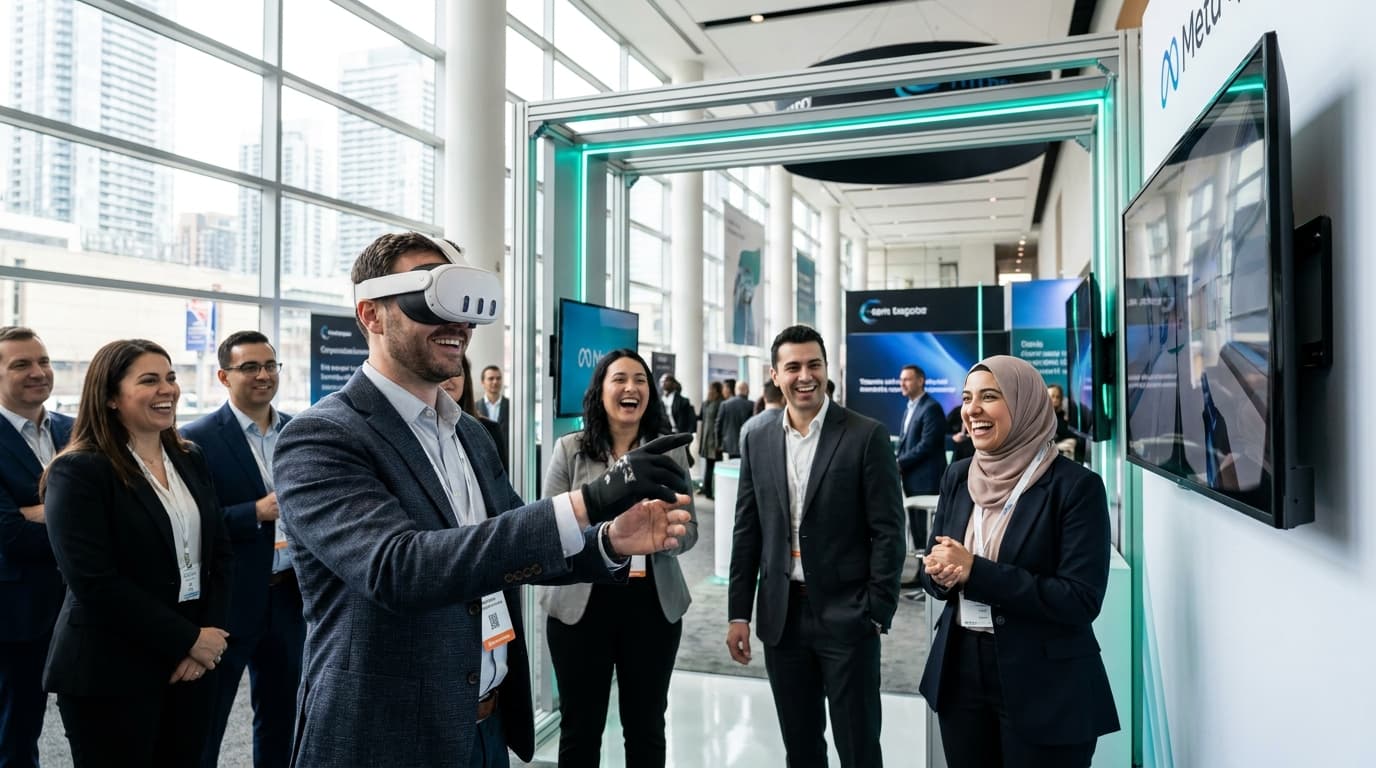
If you are searching for a trade show booth ideas beginner guide, the core lesson is simple: deploy interactive experiences that capture attention, filter qualified leads, and manage booth traffic safely. For corporate event planners, the most effective strategy combines a high-visibility hook—like a mobile VR station casting live gameplay to an aisle-facing spectator TV—with a structured 2-5 minute engagement loop that transitions attendees directly into sales conversations.
Picture this: Your company just wired fifteen thousand dollars securing a 10x20 footprint at the Metro Toronto Convention Centre. Your pop-up banners are pristine. Your sales representatives are standing at the edge of the carpet, clutching clipboards and forcing smiles. And for three painful hours, attendees have treated your booth like an invisible barrier, detouring around your space to grab a mini cupcake from the SaaS startup next door.
I've walked that floor. I've seen the panic in a marketing director's eyes when heavy foot traffic completely ignores their activation. A bowl of branded mints and a stack of glossy brochures won't save a failing footprint. You need a mechanism that halts attendees in the aisles, gives them a compelling reason to linger, and provides your team a natural, non-aggressive opening to start a qualification conversation. If your current attraction isn't starting conversations, it is just taking up expensive square footage.
Why Most Advice in a "Trade Show Booth Ideas Beginner Guide" Misses the Mark
Most planners approach their first large-scale activation assuming the goal is maximum volume. It isn't. The actual goal is a predictable flow of qualified conversations. If you blast a t-shirt cannon into the center aisle of the Toronto Congress Centre, you generate a massive crowd, but your team cannot meaningfully pitch software to fifty people scrambling for XL cotton. You end up with noise, not leads.
We anchor our approach on creating a sustainable lead quality engine. Let’s look at a scenario using Fruit Ninja 2. It is a medium-intensity, zero-nausea VR title where players use dual virtual swords to slice flying fruit in an augmented dojo. Because the mechanics are instantly intuitive—literally point your controllers and swing—we can cycle guests through tight 2-5 minute sessions without lengthy tutorials.
While the prospect is inside the standalone Meta Quest 3 Business Edition headset (eliminating tripping hazards from PC cables), their gameplay is cast live to a 50-inch spectator TV mounted on a 6-foot truss facing the aisle. That elevated television screen builds your crowd organically. Onlookers stop to watch their colleague wildly slice virtual watermelons. Your sales representatives work that captive audience. By the time the prospect takes the headset off, laughing and energized, your team has a warmed-up target ready for a pitch.
Sourcing Interactive Booth Experiences for Non-Gamers
The most frequent objection I hear from Bay Street marketing directors is, "Our demographic consists of C-suite executives and financial analysts; they do not play video games." That is exactly why this methodology works. We specifically curate interactive booth experiences that require absolutely zero gaming literacy.
Consider Beat Saber, globally recognized as the most popular VR game on the market. The premise is brilliantly simple: slash colored blocks to a musical beat. Even a nervous CEO who hasn't touched a console since 1985 can figure out the mechanics in ten seconds. The visual of a suited executive aggressively chopping neon blocks in a VR headset instantly humanizes them, making them highly approachable to the rest of the convention floor.
We have executed over two hundred events across the GTA, and the psychology remains consistent: skeptics watch the TV casting for thirty seconds, realize they don't need a teenager's twitch reflexes to succeed, and immediately join the queue. When you integrate trade show VR activations into your strategy, the focus remains squarely on energy, reaction speed, and crowd excitement—not complex button combinations or thumbstick navigation.
The Risk Mitigation Matrix: Safety, Hygiene, and Crowd Flow
You cannot deploy hardware in a high-traffic environment without a rigid operational protocol. A physical line around the corner is a massive liability if it blocks a fire exit or encroaches on a neighboring competitor's space. We rely on a specific risk mitigation matrix developed through hundreds of hours on convention floors.
Spatial Requirements and Safety
We mandate a strict minimum of 6.5 x 6.5 feet (2m x 2m) per standing station. We restrict corporate event content strictly to stationary experiences. This means the player stands physically in one spot while the digital environment comes to them. Think of Racket: NX, a futuristic racquetball game inside a giant glass dome where you hit glowing targets in 360 degrees. Because you aren't virtually walking through a landscape, we eliminate the artificial locomotion that traditionally causes motion sickness. Across our entire operating history, fewer than 2% of guests report any discomfort.
Medical-Grade Hygiene Standards
I have personally stood in a loading dock at the Enercare Centre at midnight, meticulously scrubbing forty headsets after a massive 300-person gala. We simply do not compromise on sanitation. We utilize medical-grade silicone face covers that are swapped out between every single user. Equipment undergoes thorough UV-C sanitization, and we use non-alcoholic, microfiber lens wipes to ensure sweat never ruins the visual immersion. We also position standalone hand sanitizer stations immediately adjacent to the play zone. Your attendees will never put on a damp or compromised headset.
Optimizing Crowd Flow
Our facilitators arrive 60-90 minutes before your event starts to establish clear entry and exit vectors. To prevent fire marshal complaints about aisle-blocking queues, we frequently implement SMS-based digital waitlists. Attendees register with your sales team, walk the floor, and receive a text when their headset is ready. As players finish their VR session, our staff physically guides them out the opposite side of the play area. This unidirectional flow pushes the energized prospect directly into the path of your waiting sales representatives, preventing bottlenecks near the televisions.
Operational Execution: The Art of the Post-Game Handoff
This specific interaction is where successful mobile VR events separate the amateurs from the operators. The most critical second of your entire event footprint is the exact moment the headset comes off the prospect's face. Most generic entertainment vendors will simply say, "Thanks for playing," and let the attendee wander back into the aisle.
We engineer a deliberate, strategic handoff. Because we provide comprehensive service—handling the setup, live operation, and teardown—our trained technicians manage all the technical heavy lifting. We adjust the extended battery straps, clean the lenses, swap out hardware using our backup equipment if necessary to ensure zero downtime, and monitor the live gameplay.
This deliberate division of labor frees your sales staff to focus entirely on closing deals. As a player hands the Quest 3 back to our technician, we explicitly pivot their attention back to your team. We say, "Excellent reaction time on that last round! Sarah right over there has your final leaderboard ranking and a quick question for you." That is a warm, seamless transfer that converts an entertainment activation into a tangible business lead.
Data-Backed Results Over Vague Tactics
You do not have to guess if this framework functions; the analytics validate the methodology. We consistently observe a 40% repeat booking rate among corporate clients because the system generates quantifiable engagement. When evaluating booth attractions, planners often rely on gut feeling. We rely on throughput data and proven technical execution.
An HR Director from a prominent Toronto Financial Services Firm recently noted, "Best team event we've ever organized. Everyone was talking about it for weeks." While they were reviewing an internal corporate initiative, the underlying psychology translates identically to the convention floor: shared, highly engaging experiences forge immediate rapport. Furthermore, if your venue charges extortionate rates for spotty internet, we bypass it. Single-player experiences run completely offline, and we bring our own enterprise-grade local networking gear for multiplayer setups, ignoring the venue's unreliable WiFi entirely.
Building Your Next Lead Generation Engine
By anchoring your footprint with a visually striking, low-barrier activity like VR, you completely eliminate the awkward cold approach. Your booth attraction must actively serve your sales process, not distract from it.
Even if you choose not to utilize our brand activation solutions or our full VR game catalog, apply this core operational principle: map out your physical footprint with unidirectional flow in mind. Lock in an activity that naturally generates an audience through spectator casting, and ruthlessly train your representatives on the precise moment they need to step in to capture the lead. Do that, and you'll never rely on a bowl of mints again.
Turn Booth Traffic Into Qualified Conversations
Stop relying on branded pens to capture attention on the trade show floor. Book a mobile VR activation that reliably stops attendees in the aisle and hands them directly to your sales team.
SEE TRADE SHOW PACKAGES