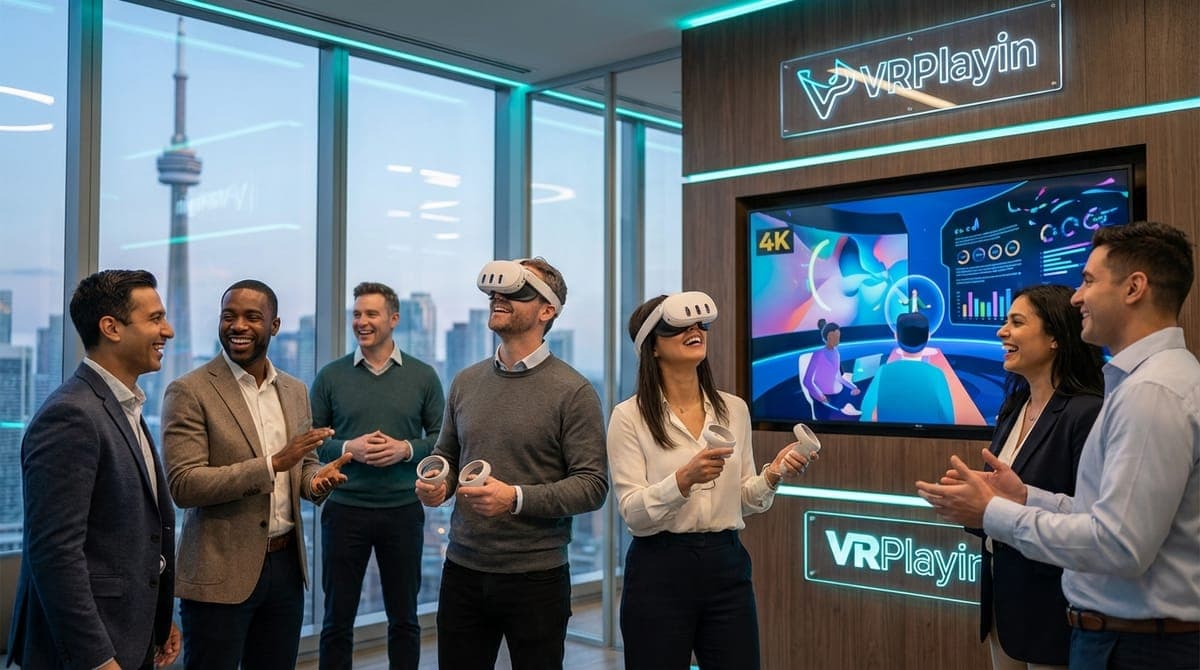
When analyzing the top Toronto event trends for 2025, immersive VR is standing out not as a gimmick, but as a solution to a specific problem. This isn't just marketing fluff we put in a pitch deck; it's the direct result of a shift we've watched happen on the ground at over 200 events across the GTA. Companies are no longer looking for passive entertainment to fill dead air—they are desperate for activities that force genuine, active presence in an increasingly distracted world.
Let me paint a picture I’ve seen a dozen times. It’s 7:00 PM at a networking gala in the Metro Toronto Convention Centre. The open bar is busy, but the energy is flat. People are clustered in their usual cliques, checking emails on their phones, awkwardly balancing plates of hors d'oeuvres. Then, we flip the switch on the casting TV for a VR station.
Suddenly, a Senior VP from a major bank is ducking under a virtual neon wall in plain sight of her entire team. She misses a block, laughs out loud, and the junior analysts cheering her on actually mean it. The phones go away. The barriers drop. That is the operational reality of VR in 2025: it is the fastest way to turn a room of polite strangers into a cohesive group.
1. Toronto Event Trends 2025: Immersive VR vs. "Forced Fun"
The old model of corporate team building Toronto planners relied on—trust falls, generic scavenger hunts, or passive keynote speakers—is dying. The trend for 2025 is active, skill-based play that doesn't require actual athleticism. We see this constantly with Beat Saber.
I remember a holiday party we ran for a logistics company in Mississauga. They were skeptical. The HR Director told me, "Our team isn't really into gaming." Two hours later, we had to extend the rental because the line for Beat Saber was ten deep.
Why? Because the mechanics are intuitive. You slash colored blocks to the beat of the music. It’s high energy, but the rounds are short—typically 2-5 minutes per turn. This keeps the line moving and the energy high. Unlike a 45-minute escape room where you might get stuck with a colleague you don't mesh with, VR offers quick, high-intensity bursts of dopamine. It’s spectator-friendly, meaning the 20 people watching are having just as much fun as the person in the headset.
2. Asymmetric Multiplayer: Solving the "Isolation" Myth
One of the biggest misconceptions I fight when talking to clients from Yorkville to Markham is the idea that VR is isolating. "I don't want my guests with boxes on their faces ignoring each other," they say. If we were running a solitary experience, I’d agree. But the dominant trend for 2025 is asymmetric multiplayer.
Take Acron: Attack of the Squirrels!. This game single-handedly saves employee engagement activities for large groups. Here’s the setup: One person is in the VR headset playing as a giant tree. Up to eight other guests pull out their own smartphones, scan a QR code, and join the game as squirrels trying to steal the tree's acorns.
We ran this at a launch party at Steam Whistle Brewing recently. Instead of one person playing and everyone else watching, we had nine people screaming instructions at each other simultaneously. It turns a single 6.5 x 6.5-foot station into a multiplayer arena. It bridges the gap between the "gamer" in the headset and the "non-gamers" on their phones. If you are planning a large volume event, this is the mechanic that prevents bottlenecks.
3. The "Third Space" Effect: Why Hybrid Teams Need Virtual Golf
With so many Toronto companies maintaining hybrid work policies, the office is no longer the primary social hub. Teams need a "third space" to connect that isn't a Zoom call or a boardroom. While we specialize in VR team building packages where we come to you, the content we curate is specifically designed to replicate the casual serendipity of a golf course or a bowling alley.
Walkabout Mini Golf is the gold standard here. It’s low intensity. You aren't fighting zombies; you're putting golf balls on a space station or a pirate cove. The physics are perfect, but the pacing is what matters. It allows for conversation during the activity.
I watched a team of engineers at a MaRS Discovery District event use this game to break the ice with their new sales director. They weren't talking about Q4 projections; they were laughing because the director accidentally knocked his ball into a virtual lagoon. That shared vulnerability is what builds culture, not the quarterly all-hands meeting.
4. Logistics and Hygiene: The Boring Stuff That Actually Matters
You can't talk about event trends without talking about the operational reality. In a post-2020 world, hygiene isn't a "nice to have"—it's the first question I get asked by every HR manager. If you are looking into corporate social events, you need to know how the sausage is made.
We use medical-grade silicone face covers that are replaced between every single user. We don't just wipe them down; we swap them out. We use UV-C sanitization and antibacterial wipes on controllers. In 200+ events, we have refined this workflow to take less than 30 seconds, ensuring zero downtime while maintaining hospital-grade cleanliness.
Furthermore, reliability is king. We arrive 60-90 minutes early for setup because Toronto traffic is unpredictable (to put it mildly). We bring enterprise-grade networking gear because we know hotel Wi-Fi at the Sheraton or the Royal York often creates firewalls that block multiplayer servers. An amateur brings a headset; a professional brings a backup router.
Expert Insight: The "Motion Sickness" Filter
After running hundreds of events, from Bar Mitzvahs in Forest Hill to trade shows at the Enercare Centre, here is the secret nobody tells you: Curating for zero nausea is more important than the graphics.
There are incredible VR games involving roller coasters and fighter jets. I refuse to bring them to corporate events. Why? Because if your CEO gets motion sick at 2:00 PM, the event is ruined. We strictly curate stationary or room-scale experiences (like Job Simulator or Cook-Out) where your body movement matches your visual input. This is why our data shows fewer than 2% of guests report any discomfort. As an operator, my job isn't just to entertain your guests; it's to protect them.
Social Proof That It Works
You don't have to take my word for it. After a recent activation for a financial services firm in the Financial District, the HR Director told us: "Best team event we've ever organized. Everyone was talking about it for weeks." That is the metric that matters—not the technology itself, but the lingering memory of the experience.
The Takeaway for 2025
The trend for 2025 isn't about the hardware. It's about using mobile VR team building to create a shared emotional experience. Whether you are hosting a team of 15 or a gala of 300, the goal is to get people out of their heads and into the moment.
If you're planning your 2025 calendar and want to avoid the eye-rolls that come with another standard mixer, look for entertainment that requires active participation. The best events aren't the ones where people watch—they're the ones where people play.
Planning a Toronto Event for 2025?
Don't settle for passive entertainment. Let us bring the most engaging, hygienic, and managed VR experiences directly to your venue.
SEE TEAM BUILDING PACKAGES