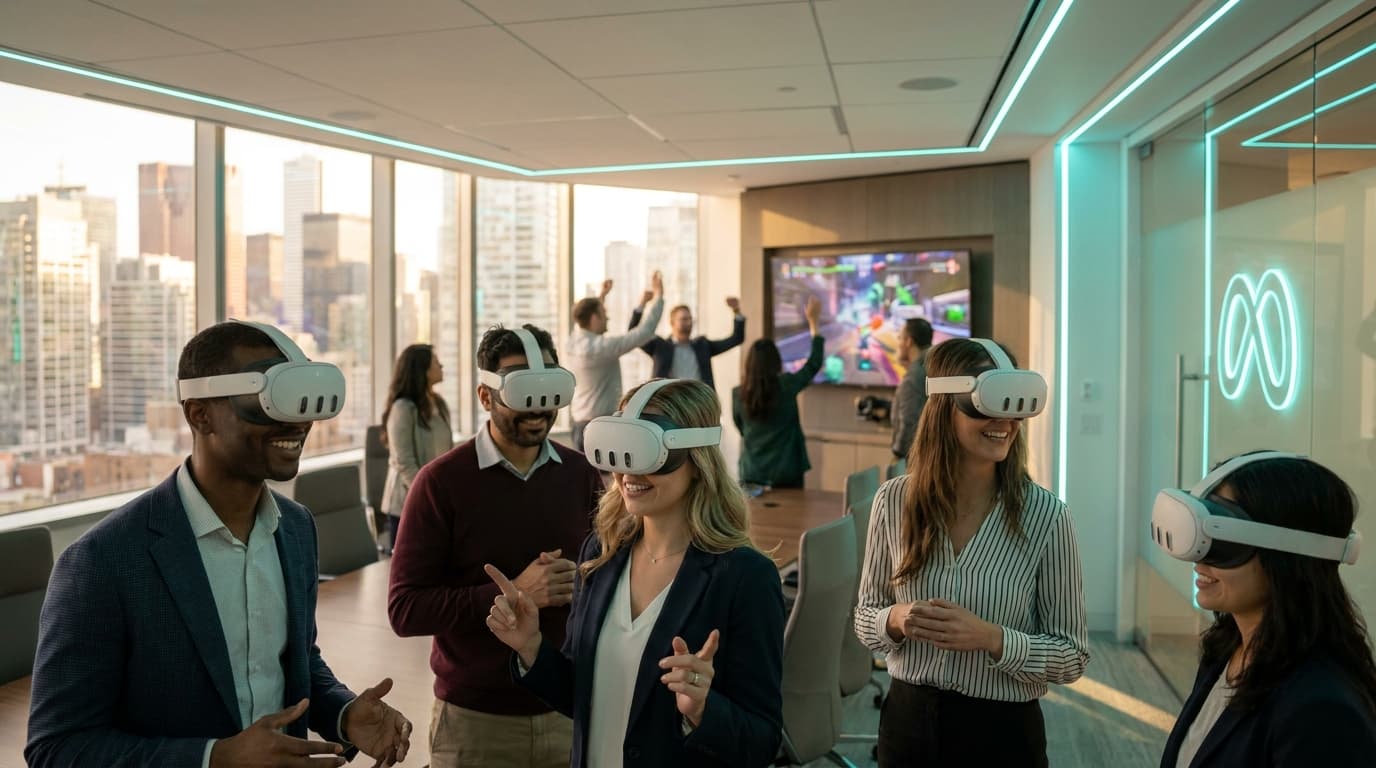
When HR directors and executive assistants start planning their quarterly offsite, the search history usually looks exactly like this: team building activities toronto vs escape room. Finding an activity that accommodates a 55-year-old CFO and a 23-year-old marketing coordinator, without the logistical nightmare of moving 40 people across the DVP at rush hour, is the real challenge.
Escape rooms have been the default corporate outing for a decade. They require communication, they put people in a new environment, and they technically tick the box for an offsite. But having facilitated over 200 corporate events across the GTA, I've watched planners slowly abandon the escape room model. The math simply stops working once your headcount pushes past ten people.
At VRPlayin, we bring Meta Quest 3 Business Edition hardware directly to offices and venues. I've personally wiped down and sanitized 40 headsets at midnight after a massive tech gala, and I'll do it again tomorrow because the results are undeniable. Instead of locking small factions of your staff in separate dark rooms across town, managed mobile VR keeps the energy centralized, loud, and incredibly inclusive.
Team Building Activities Toronto vs Escape Room: The Hard Math on 40-Person Groups
Here is the reality of trying to force 40 accountants from a Financial District firm into a standard escape room facility. Most individual rooms have a strict fire-code capacity cap of six to eight people. Your department arrives at the facility, you awkwardly divide the group into five distinct teams, and you all disappear behind different locked doors for an hour.
You aren't actually team building as a department; you are doing five parallel activities that happen to share a postal code. Furthermore, the economics of this don't scale. You are paying roughly $35 to $45 per head just for the tickets, not including the sheer cost of transit and lost billable hours getting there.
Worse, you miss the organic moments. You don't get to see the quiet junior analyst suddenly barking orders at the Managing Director. When teams finish their specific rooms at different times, they mill around a tiny, crowded lobby waiting for the stragglers to escape. The energy splinters instantly.
This is precisely why corporate planners are shifting toward VR team building packages that come directly to them. When VRPlayin rolls three hard-cases of equipment into a boardroom at MaRS Discovery District, we aren't splitting your group up. We set up four to six casting stations where the entire room can see exactly what the person in the headset is experiencing on 75-inch TVs. The downtime isn't spent staring at a wall in a lobby; it's spent holding a drink, cheering on colleagues, and laughing at the CEO swatting at invisible blocks.
The Venue Logistics: Why Transit Bleeds Your Corporate Budget
Logistics will kill an event's momentum faster than a bad activity. Moving an average corporate group size of 25 to 40 guests from an office in Liberty Village to an entertainment complex in Vaughan or Scarborough is a massive operational headache. It requires chartered buses, managing corporate Uber codes, and building in a 30-minute buffer for the inevitable stragglers who stopped for coffee. You pay for the activity, but you bleed budget on transportation.
Managed mobile VR eliminates the transit variable entirely. We operate out of Toronto, but our technicians are fully mobile across the GTA and anywhere in Canada. We arrive 60 to 90 minutes before your event starts. We assess the space—requiring just 6.5 by 6.5 feet for our standard standing stations—and build the arena where you already are. Whether you've rented out Steam Whistle Brewing for a holiday party or you just want to repurpose your Bay Street cafeteria on a Friday afternoon, the activity comes to you.
The IT Department's Nightmare: Why We Bring Our Own Network
Corporate IT departments despise external vendors plugging into their secure networks. We bypass this entirely. We deploy our own isolated 5GHz enterprise Wi-Fi routers so we never touch your corporate network. We tape down all cables with high-visibility gaffer tape to eliminate tripping hazards, and we run hot-swappable battery straps so the Quests never die. If a headset misbehaves, our trained technicians swap it with a backup unit within two minutes. No downtime. No IT support tickets. Just continuous engagement.
Escaping the "Non-Gamer" Objection with Beat Saber and Walkabout Mini Golf
The most common objection I hear from event planners is, "Half our team doesn't play video games, so we should probably just do a trivia night." It's a highly valid concern, but it assumes VR requires complicated Xbox-style controller inputs. We specifically curate our full VR game catalog for absolute beginners.
Let's look at Beat Saber. It is arguably the world's most popular VR game, and it is the anchor of our corporate events. The premise is brilliantly simple: you have two virtual light swords, and you slash blocks to the beat of high-energy music. There are no buttons to memorize. There are no complex joystick movement mechanics. If you can physically swing your arms, you can play.
At a recent law firm event at the InterContinental Toronto Centre, we had a group of senior partners who swore they "didn't do games" standing next to the buffet with their arms tightly crossed. Our facilitators are trained specifically for this dynamic. We don't pressure; we just start putting the eager folks into Beat Saber. Within ten minutes, the music is pumping, the crowd is shouting directions, and those same skeptical partners are asking to be slotted in next. This happens at almost every single one of the 200+ events we've completed.
For those who want an even lower heart rate, we immediately pivot to Walkabout Mini Golf. It requires using only one hand to swing a virtual putter. It is instantly intuitive to anyone who has ever held a stick, allowing older or less mobile team members to participate fully without breaking a sweat.
Pistol Whip and the Spectator Experience: Casting is Everything
One of the primary benefits of VR as an alternative to escape rooms is the spectator experience. In a traditional escape room, the people outside the room have nothing to do. In our mobile VR events, the gameplay is cast directly to local screens via Chromecast so the crowd is entirely looped in.
When we load highly competitive sales teams into Pistol Whip, the room erupts. Pistol Whip is a cinematic rhythm shooter where players dodge bullets and shoot targets to the beat of an electronic soundtrack through neon-soaked scenes. It feels exactly like being John Wick. Because the game is high-intensity, we keep turns to a brisk 2 to 5 minutes.
This rapid cycling of players is the operational secret to a successful event. A guest plays for three minutes, gets their heart rate up, pulls off the headset to roaring applause from their coworkers, and immediately heads to the bar to grab a drink and watch the next victim step up. It creates a highly social, continuous loop of action and conversation that traditional team building ideas simply cannot replicate.
Measuring Success: The Corporate Event KPI Dashboard
When you spend corporate budget on team building, you need to justify the ROI to your finance department. We track specific engagement metrics across our events to ensure we are delivering actual value. Here is a look at a typical post-event KPI dashboard for our managed VR setups, based on historical averages from our past deployments.
| Metric | Target Benchmark | What It Measures |
|---|---|---|
| Station Utilization Rate | 85% - 95% | The percentage of time the VR headsets are actively in use by guests during the event window. |
| Guest Participation Rate | 70% - 85% | The percentage of total attendees who put on a headset at least once (far exceeding industry norms). |
| Average Turnover Time | Under 45 seconds | The time it takes our facilitators to clean a headset, swap a user, and launch the next session. |
| Repeat Play Rate | 40% - 50% | The percentage of guests who return to the line for a second or third turn after their initial attempt. |
These numbers don't happen by accident. They are the result of active, aggressive facilitation. Our staff doesn't just stand there guarding equipment. They manage the queue, they hype up the crowd, they identify the wallflowers and offer them low-pressure stationary experiences, and they keep the turnover tight. While one technician is wiping down a headset, the other is already explaining the rules to the next player.
Handling the Skeptics: Motion Sickness, Hygiene, and Space
You cannot write a proposal for mobile VR events in Canada without addressing the big three objections from HR: hygiene, space, and motion sickness. Let's tackle them exactly how we handle them on the floor.
The Motion Sickness Reality
We curate zero-nausea experiences strictly for our corporate catalog. We use stationary gameplay with no artificial locomotion. You are moving your physical body, but the virtual world is not sliding around you. In our history of operations, fewer than 2% of guests report any discomfort whatsoever. Furthermore, our facilitators are trained to spot the early physical signs of hesitation and can instantly switch a user to a more comfortable, grounded experience.
Medical-Grade Hygiene Protocol
I know exactly what a headset looks like after an intense three-minute round of Pistol Whip. It's why our hygiene protocol is non-negotiable. We use medical-grade VRCover silicone face gaskets that are aggressively wiped down with antibacterial wipes between every single user. We provide hand sanitizer stations at every single setup. Before, during, and after the event, all equipment undergoes UV-C sanitization. We maintain a cleaner environment than most commercial gyms.
Flexible Space and Power Requirements
Planners often over-worry about space. A standing VR station requires a minimum footprint of 6.5 by 6.5 feet (2m by 2m). If you have a smaller venue, we can deploy seated or stationary experiences that require only 3 by 3 feet. As for power, we don't need heavy industrial drops; our entire multi-station setup can run safely off standard 110V wall outlets without tripping breakers. We confirm all of this during the planning phase, easily adapting to a boardroom, a rented hall, or an open-concept office floor plan.
The Final Decision: Matching the Vendor to the Vision
If you have exactly six people and want to solve a logic puzzle in silence, book an escape room. If you have 40 people and want them actively cheering each other on in your own office, book mobile VR.
As one Office Manager from a major consulting firm recently told us, "Setup was seamless, the staff was professional, and our team had an absolute blast. Even the people who didn't want to play spent the whole time laughing at the screens." That is the exact dynamic we engineer. We handle the heavy lifting, the technical troubleshooting, and the crowd management. You just provide the venue and the team.
We charge a clear, tiered package rate based on your group size, the duration (typically 2-3 hours), and the number of stations required. A 50% deposit secures the date, and we handle the rest. We also carry full commercial liability insurance, ensuring you satisfy any strict venue or property management requirements.
Stop Splitting Your Team Into Separate Rooms
Bring the entire department together with a managed mobile VR experience that fits right inside your office or chosen venue. See how our facilitators turn skeptics into participants and keep the energy high from the first headset to the last.
SEE TEAM BUILDING PACKAGES