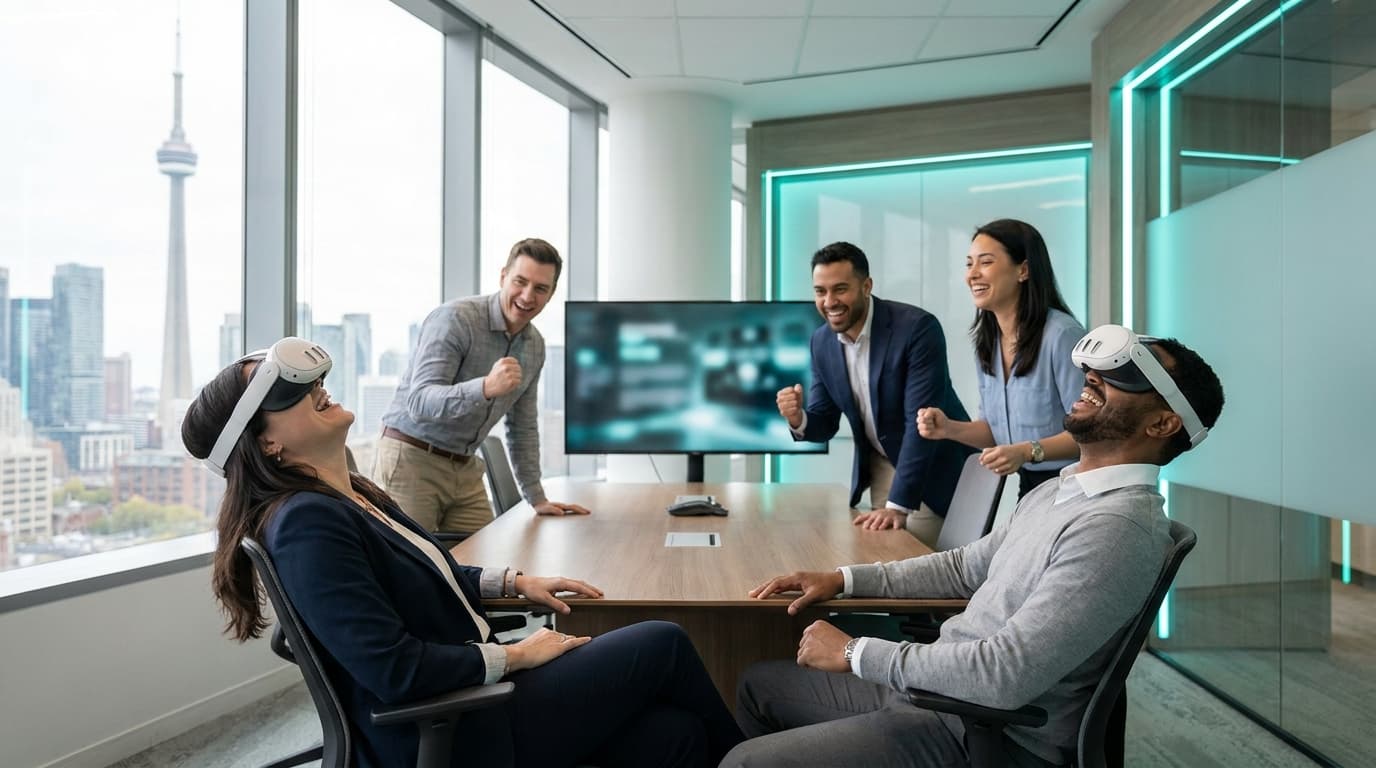
I have cleaned 40 Meta Quest 3 headsets at midnight after a 300-person gala at the Metro Toronto Convention Centre, and I will gladly do it again tomorrow. When you run over 200 corporate events across the GTA, you stop guessing what professionals want and start relying on hard operational data. Planning a corporate offsite usually starts with an enthusiastic committee, a massive Google Sheet, and absolute panic over budgets. Figuring out team building activities toronto pricing is often the biggest hurdle event planners face. You want something highly engaging, but you also need a predictable invoice that will not multiply just because three extra people from accounting decided to show up at the last minute.
The standard per-head corporate entertainment model is fundamentally broken. Most vendors charge per head, which inherently punishes high attendance and creates a nightmare for HR managers trying to finalize a budget weeks in advance. I have watched organizers sweat bullets at the door of an escape room because they had to pay a premium for five unexpected walk-ins. We do things differently. Here is a transparent breakdown of how managed mobile VR solves the budgeting chaos, keeps your most skeptical executives engaged, and removes the friction from event planning.
Decoding team building activities toronto pricing: The Problem With Per-Guest Fees
If you are researching corporate team building toronto options, you will quickly notice two dominant pricing structures: per-head and flat-rate packages. Per-head pricing works fine if you are taking exactly four people to lunch. It is a disaster for a department-wide social.
When an event hinges on per-guest fees, organizers naturally try to restrict who can attend to protect the budget. You end up with a fragmented office where some people get to participate and others sit at their desks answering emails. Our approach at VRPlayin eliminates this friction entirely. We use flat-rate tiered packages based on event duration and the number of VR stations you need—not a strict headcount.
To give you real numbers: a standard 2-hour, 2-station setup for up to 30 guests typically ranges between $900 to $1,200. If you are running a massive holiday party, a 6-station deployment for 100+ guests scales into the $2,500+ range. Whether 25 or 45 guests cycle through those standard stations over your event duration, your invoice remains exactly the same. You pay for the hardware footprint and our professional facilitators, not the headcount.
To secure a date, we require a standard 50% deposit with the balance due on the day of the event. We process credit cards, e-transfers, and corporate invoicing because we know exactly how procurement departments operate. You get a clear, upfront quote that includes travel within the GTA, parking fees, setup, and our staff. Zero surprises, zero hidden surcharges for extra players.
Cost Comparison: Mobile VR vs Traditional Toronto Team Building Options
Let us do the actual math for a mid-sized Toronto office of 45 employees looking for an afternoon team building event.
Option A: Axe Throwing or Escape Rooms (Per-Head Pricing)
The standard rate for premium facilities in Toronto is around $40 to $45 per person. Your baseline cost is $2,025. But you also have to transport 45 people to a specific facility in Mississauga or the east end. Add $400 for a shuttle bus, plus inflated on-site catering costs because they force you to buy their in-house drinks. Your total budget quickly balloons to $3,000+. Worse, if eight people call in sick that morning, you still pay the $2,025 baseline because you locked in the headcount 48 hours ago.
Option B: Managed Mobile VR in Your Office (Flat-Rate Pricing)
We bring 3 fully managed VR stations directly to your existing downtown boardroom or catered venue for a 3-hour block. The cost typically lands around $1,400 to $1,600. Travel and setup are included. You can provide your own food or simply utilize your office's existing snack budget. Your total entertainment budget is capped at ~$1,500. If eight people call in sick, the cost is the same. If ten extra people from the marketing department walk in to see what the cheering is about, the cost is exactly the same.
Winning Over Bay Street Skeptics with Job Simulator
You can have the most transparent, budget-friendly pricing in the world, but if the activity itself alienates half the room, you have wasted your money. The biggest objection I hear from HR managers is, "My team does not play video games." Neither did the senior partners at a major Bay Street law firm we hosted last month. They walked into the boardroom in tailored suits with crossed arms.
We do not hand non-gamers complex controllers and tell them to figure it out. Our facilitators curate experiences specifically for zero gaming experience. For that law firm, we loaded up Job Simulator. It is a brilliant, low-intensity parody of office life set in a world where robots have replaced humans. All you do is point, grab, and throw things in a virtual cubicle. Within five minutes, a notoriously stern senior partner was aggressively throwing virtual staplers at a robotic boss while the rest of the firm howled with laughter at the spectator casting TV.
That is the actual value of our VR team building packages. We manage the software, guide the users, and ensure absolutely no one feels foolish. Every participant averages a 3-5 minute turn, meaning a single headset cycles through dozens of people smoothly. You do not need gamer reflexes to have a great time; you just need a willingness to put on the headset.
Scaling Engagement: Acron and Beat Saber Tournaments
One of the fatal flaws of traditional VR rentals is isolation. One person puts on a headset and disappears from the party, leaving everyone else to stare at their phones. When we run corporate social events at premium venues like The Carlu or Evergreen Brick Works, isolation is not an option. We need group energy.
The Acron Multiplayer Approach
This is exactly why we deploy asymmetric multiplayer games like Acron: Attack of the Squirrels! It turns a single VR station into a massive, 9-person party. One player puts on the Meta Quest 3 and becomes a massive virtual tree trying to protect golden acorns. Up to eight other guests pull out their own iPhones or Androids, connect to the game via a free app, and play as squirrels trying to steal the acorns from the tree. Suddenly, the VR player is physically turning and tossing virtual boulders while eight coworkers surround them, frantically tapping their phones and shouting tactics across the room.
High-Energy Beat Saber Leaderboards
For more competitive teams, nothing creates crowd momentum quite like a customized Beat Saber tournament. We hook the Quest 3 up to your venue's main projector or our provided 50-inch screens. Players slash incoming neon blocks to the rhythm of recognizable pop and rock hits while their coworkers keep score on a physical whiteboard leaderboard we maintain. It completely solves the spectator problem. You get maximum engagement from a minimal hardware footprint, which is a core strategy for anyone looking for effective team building ideas that actually unite a room.
The 6.5 x 6.5 Foot Rule: Venue Logistics and Setup
Bringing mobile vr events canada into your office or chosen venue requires precise logistics. Over 200 successful deployments have taught us exactly what we need to execute flawlessly. You do not need a massive empty warehouse, but you do need defined, safe physical boundaries.
For every standing VR station, we require a minimum of 6.5 x 6.5 feet (2m x 2m) of clear space. If you are extremely tight on space in a downtown office, we can seamlessly switch to seated, stationary experiences that only require 3 x 3 feet per user. We arrive 60-90 minutes before your event starts. Our facilitators tape out the boundaries, set up the Meta Quest 3 Business Edition headsets with extended battery straps, establish the spectator casting screens, and rigorously test the network. Teardown takes exactly 30-45 minutes after the final guest takes off the headset.
During the event, hygiene is strictly non-negotiable. We use medical-grade silicone face covers that are completely wiped down or replaced between every single user. You will see our staff utilizing antibacterial wipes and UV-C sanitization wands between rounds. We provide hand sanitizer stations at every setup. I would never ask a guest to put on a headset I wouldn't comfortably wear myself.
Live-Event Troubleshooting Flowchart: Handling 200+ Events
Live events are chaotic by nature. Venues lose power, corporate Wi-Fi networks block external devices, and executive speeches run late. If you hire a generic AV vendor, a technical glitch can derail your entire schedule. Because we exclusively run managed VR events, our facilitators follow a strict troubleshooting protocol to ensure zero downtime. Here is exactly how we handle the most common live-event hurdles.
Scenario 1: The Venue Wi-Fi Drops
Corporate firewalls and hotel networks frequently block casting or multiplayer servers. We confirm network requirements during planning, but if the Wi-Fi dies mid-event at a venue like the InterContinental Toronto Centre, we pivot immediately.
The Fix: Multiplayer games require internet, but single-player games run entirely offline. If the venue network fails, our staff instantly switches the active stations to offline heavy-hitters like Job Simulator, Space Pirate Trainer, or rhythm games. If you booked a multiplayer-heavy package, we deploy our own enterprise networking gear and 5G local routers to bypass the venue's infrastructure entirely.
Scenario 2: Guest Reports Motion Sickness
We specifically curate zero-nausea experiences for corporate crowds, utilizing stationary gameplay and aggressively avoiding artificial locomotion (games where you use a joystick to walk). Statistically, across our 200+ events, fewer than 2% of guests report any discomfort. However, if a guest feels even slightly dizzy, we act fast.
The Fix: Facilitators are trained to spot hesitation or early signs of discomfort. We immediately have the guest remove the headset, offer them a seat, and provide water. We then adjust the software lineup on that headset to a purely seated, stationary experience before letting the next guest begin. Comfort always supersedes gameplay.
Scenario 3: A Headset Freezes or Fails
Hardware fails. Batteries drain. Controllers get dropped by overly enthusiastic sales directors.
The Fix: We bring fully charged, configured backup equipment to every single event, regardless of size. If a headset freezes, our technicians do not waste fifteen minutes rebooting and troubleshooting while a line forms. We swap the headset for a backup unit in under 60 seconds, keeping the queue moving while we diagnose the faulty hardware off to the side.
Join 200+ Teams Who Ditched the Trust Falls
You have enough on your plate managing catering, speeches, and venue contracts. You do not need an entertainment vendor who requires hand-holding, hidden fees, or constant supervision. You need a transparent partner who shows up, handles the technical execution perfectly, and leaves your team energized.
Our 4.9-star Google rating and 40% repeat booking rate exist because we treat event logistics and pricing transparency as seriously as the entertainment value itself. "Even our executives who 'don't do games' were laughing and high-fiving in VR," an Executive Assistant from a major law firm recently told us. That is the exact outcome we deliver. If you want to explore our full VR game catalog and see exactly how our flat-rate pricing can transform your upcoming corporate gathering, it is time to look at hard numbers.
Lock In Your Corporate Event Without the Budget Guesswork
Stop stressing over fluctuating headcounts and per-guest fees. We offer transparent, tiered pricing for mobile VR team building events that scale to your exact group size and venue.
GET A CUSTOM QUOTE