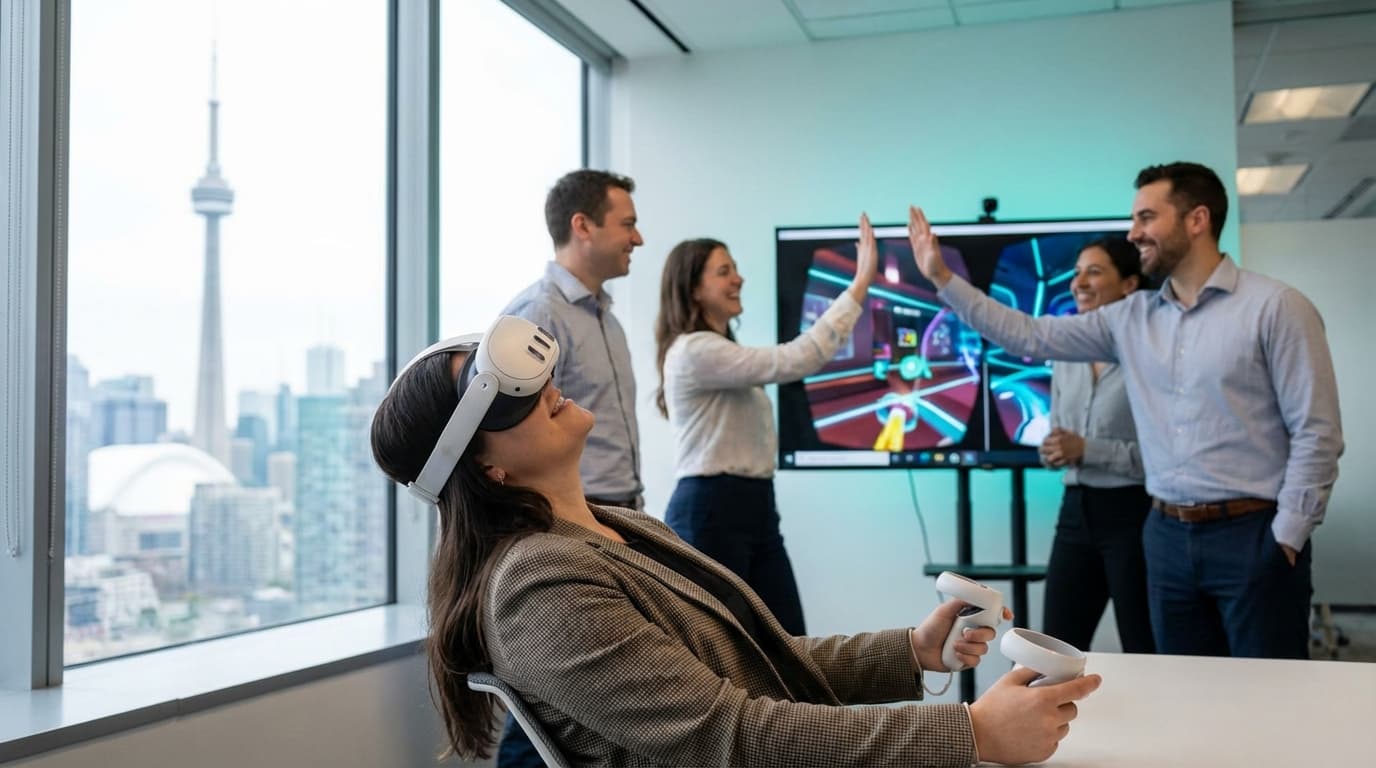
When searching for team building activities Toronto for small groups (20-50 people), you usually find the same tired list of escape rooms and trust falls. But managing a group of this size requires a delicate balance of high-energy engagement and low-pressure participation. Mobile virtual reality setups equipped with spectator TV casting achieve this perfectly. They allow guests to take quick 2-5 minute turns while the rest of the group watches and interacts, sparking natural conversation without forcing everyone into a mandatory, synchronized exercise.
Picture this: You have booked a premium boardroom in the Financial District. The catering from King West is scheduled to arrive in thirty minutes. You have 35 employees walking through the door shortly, ranging from a 22-year-old marketing coordinator to a 58-year-old CFO who visibly cringes at the word "icebreaker."
The pressure is entirely on you to deliver an afternoon that does not end in awkward silence or people quietly checking Slack on their phones. I have personally run over 200 corporate VR events across the GTA, and I can tell you exactly why most small-scale team building falls flat: it forces an unnatural dynamic onto a diverse group of people.
When you have 25 to 40 guests, the group is too small to split into isolated, anonymous factions, but too large for a single unified conversation. Traditional VR team building packages solve this specifically because they create a shared focal point without demanding constant, active performance from every single person in the room.
Why Traditional Team Building Activities Toronto for Small Groups Fall Flat
Consider the typical escape room. You lock ten people in a room. Two alpha personalities immediately take over the puzzle, three people pretend to look for clues in the corner, and the rest stand around waiting for the hour to end. It does not build trust; it just highlights existing office dynamics.
A 35-person group requires modular entertainment. You need an activity that scales down to the individual but broadcasts up to the crowd. This is where mobile VR alters the entire room dynamic. By setting up three Meta Quest 3 Business Edition stations in an office or a venue like the MaRS Discovery District, we create hubs of activity. The magic is not just what happens inside the headset; the magic is what happens on the TV screen we cast the gameplay to.
When a quiet Bay Street accountant puts on a headset to play a game of Cook-Out and turns out to be the only person who can coordinate virtual sandwich orders under intense pressure, that is the exact moment authentic team bonding happens. The entire room is watching the TV, cheering them on, and suddenly the office hierarchy dissolves. You cannot manufacture that with a trust fall.
Breaking the Ice with Spectator Casting and Beat Saber
The most common hurdle in any small corporate event is the first ten minutes. Nobody wants to go first. People grab a drink, stand at the perimeter of the room, and wait to see if the activity is "safe" to participate in.
This is where expert facilitation matters. My team and I arrive 60-90 minutes before your event start time to set up our minimum 6.5 x 6.5 feet (2m x 2m) per standing station. We also manage the room's environment—for example, if your boardroom has floor-to-ceiling glass walls, we draw the blinds so the infrared tracking on the controllers doesn't bounce and lose connection. These are the operational details a generic rental company misses. By the time your team walks in, the spectator TVs are live, and we are deliberately running a demo of Beat Saber to catch their attention.
Beat Saber is the perfect catalyst for medium-intensity, crowd-excitement energy. It is the world's most popular VR game. The mechanics are simple: slash blocks to the beat. It is incredibly easy to learn, intensely satisfying, and gets the heart rate up instantly. Warning: it is highly addictive.
We specifically target a senior leader or a highly extroverted team member for the first round. Once the rest of the room sees their VP of Operations laughing, missing blocks, and having a great time on the TV screen, the tension in the room vanishes. The barrier to entry drops to zero. Our facilitators enforce strict 2-5 minute turns per guest, ensuring the headset rotates quickly. This pacing means a group of 30 people will cycle through multiple stations rapidly, keeping energy high and preventing boredom.
High-Intensity Engagement: Enter Pistol Whip
While Beat Saber handles the initial icebreaking, you also have competitive personalities in your office who want a challenge. A diverse office requires diverse entertainment.
For those seeking adrenaline and a true gamer experience, we load up Pistol Whip. This is a high-intensity, single-player cinematic rhythm shooter where you feel like John Wick. Players dodge virtual bullets and shoot targets to the beat through neon scenes. It requires physical movement, deep focus, and an aggressive play style.
Watching a colleague physically duck and weave in the middle of a Bay Street boardroom while the TV casts their neon-drenched gameplay is a massive crowd-pleaser. It generates organic laughter and creates immediate inside jokes that carry over into the office on Monday morning. Because multiplayer experiences need internet but single-player games like Pistol Whip run perfectly offline, we can deploy this high-intensity setup in virtually any venue without worrying about corporate firewall blocks or spotty hotel Wi-Fi. We always confirm technical requirements during planning, but our redundancy ensures zero downtime.
Managing Comfort Levels, Non-Gamers, and Medical-Grade Hygiene
When you propose a VR event to your HR department or planning committee, three objections will instantly arise: motion sickness, hygiene, and the fact that most employees are not gamers. If you are presenting team building ideas to leadership, you need concrete answers.
First, address motion sickness. We specifically curate zero-nausea experiences only for corporate events. We utilize stationary gameplay with no artificial locomotion. Out of the 200+ events we have executed across the GTA, fewer than 2% of guests report any discomfort. Furthermore, our facilitators are highly trained to spot early signs of hesitation or unease and will switch a user to more comfortable content immediately.
Second, address hygiene. If you are renting consumer headsets and passing them around a sweaty office, you are doing it wrong. We use Meta Quest 3 Business Editions equipped with medical-grade silicone face covers that are replaced between every single user. We employ UV-C sanitization for all equipment alongside antibacterial wipes and dedicated hand sanitizer stations. I write this as someone who has literally cleaned 40 headsets at midnight after a 300-person gala. The hygiene protocol is rigorous, non-negotiable, and visible to your guests.
Third, address the non-gamers. Your 55-year-old Director of Sales might have never held a gaming controller in their life. Our most popular experiences require zero gaming skill. Games like Walkabout Mini Golf and Job Simulator rely entirely on intuitive human mechanics: point, grab, throw. That is it. If you can pick up a coffee cup in real life, you can play these games. We assess the crowd and match the game to the person.
Sample Budget Breakdown for Mobile VR Events Canada
Corporate event planners need actual numbers, not vague pricing promises. When budgeting, you must account for hardware, facilitation, and logistics. We offer tiered packages based on event size, duration, and the number of stations required. We require a 50% deposit to book, with the balance due on event day. We also hold liability insurance, which we can customize to name your specific venue.
Below is a realistic sample budget breakdown and operational timeline for a standard small-group corporate booking.
Scenario Assumptions
- Group Size: 35 guests
- Event Duration: 3 hours of active gameplay
- Location: Client's downtown Toronto office (e.g., King West or Financial District)
- Hardware: 3 Meta Quest 3 Business Edition stations with spectator TVs
Estimated Line Items
- 3 VR Stations (Hardware, TVs, extended battery straps): $900 - $1,200
- 2 Professional Facilitators (Setup, management, teardown): $300 - $450
- Travel & Parking (Downtown Toronto assessment): $50 - $100
- Custom Event Curation (Game selection, venue layout mapping): Included
- Medical-Grade Hygiene Supplies: Included
- Total Estimated Range: $1,250 - $1,750 CAD (+ HST)
This structure guarantees that your group of 35 people will have constant access to entertainment for three hours, averaging out to roughly $40-$50 per head. Considering this price includes us coming to you, setting up, managing the entire experience, and tearing it down while you simply enjoy the catering, it is a highly practical investment compared to off-site venue rentals where you are paying heavily for food and beverage minimums.
Expert Insight: Reading the Room is the Real Service
Here is a reality you only learn after facilitating hundreds of events: the technology is just the vehicle. The actual service we provide is crowd psychology. When you hire mobile vr events canada vendors, you are not paying for the headsets. You are paying for a facilitator who can spot the introverted employee standing near the catering table and smoothly transition them into a comfortable, seated VR experience without making them feel pressured.
At a recent booking in an Artscape Daniels Launchpad space, we had a group of 45 marketing professionals. The first hour was loud, energetic, and dominated by Pistol Whip leaderboards. But reading the room, our technicians realized the quieter half of the team was hanging back. We seamlessly transitioned one station into a cooperative, low-stress puzzle environment. Within ten minutes, the previously quiet group was clustered around the TV, directing their colleague inside the headset on how to solve the puzzle. You cannot program that kind of interaction; you have to facilitate it live by watching human behavior.
Beyond the Headset: Creating Lasting Office Culture
When the event ends, our teardown time is a swift 30-45 minutes. We pack up the enterprise networking gear, the backup equipment we always carry to ensure zero downtime, and the UV-C sanitizers. We leave your boardroom exactly as we found it.
"Best team event we've ever organized. Everyone was talking about it for weeks." — HR Director, Financial Services Firm
The true ROI of managed VR events reveals itself the next day. The shared memories of the CEO missing a block in Beat Saber, or the marketing coordinator surviving a John Wick scenario, become the new conversational currency in the office. With a repeat booking rate of 40% and a 4.9-star Google rating, the data shows that once a team experiences correctly managed, highly facilitated VR, they rarely want to return to standard trust exercises.
The takeaway for your next planning committee is simple: stop trying to force everyone to participate in the exact same way. Give your team a modular, highly entertaining environment where they can choose to be the star player or the cheering spectator. By removing the pressure and adding the spectacle of casting, you create an environment where genuine team building happens by accident, which is the only way it actually works.
Bring High-Energy, Low-Pressure Team Building to Your Office
Stop stressing over awkward icebreakers and complicated off-site logistics. Let our experienced facilitators bring mobile VR right to your Toronto boardroom, keeping your team of 20-50 guests laughing and engaged for hours.
SEE TEAM BUILDING PACKAGES