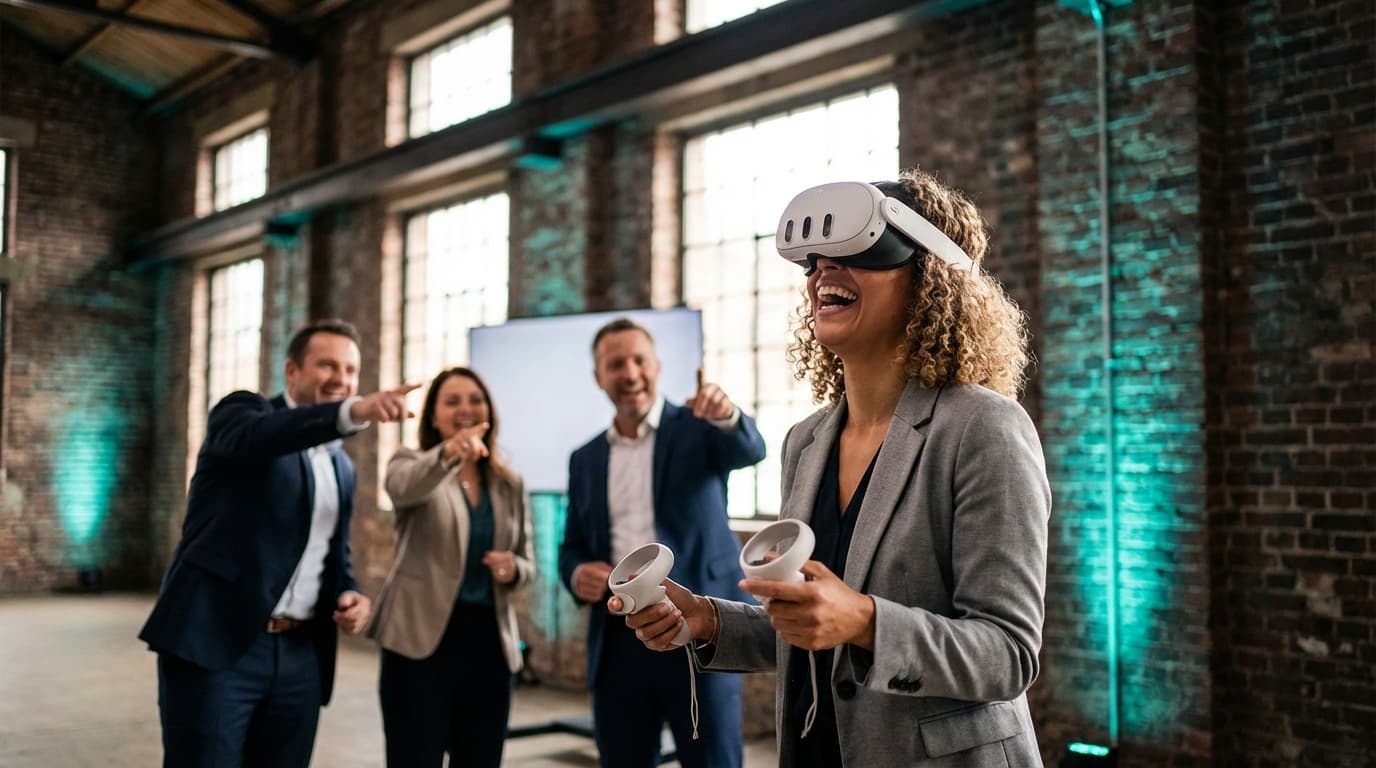
Planning team building activities in Toronto for large groups requires a fundamental shift away from single-track, forced-participation exercises toward decentralized, station-based experiences. For crowds of 150+ guests, the most reliable strategy combines rapid-turnaround interactive stations—like professionally managed mobile VR—with ambient socializing to eliminate bottlenecks, prevent stagnant lines, and keep the energy of the room high from start to finish.
You have booked out the sprawling main room at Steam Whistle Brewing or secured a massive hall at the Enercare Centre. You have 200 employees arriving in exactly three weeks. The catering menu is finalized, the open bar is fully stocked, and the logistical panic is beginning to set in. How exactly do you keep hundreds of people actively entertained without forcing them into a collective, eye-roll-inducing trust exercise?
I have run over 200 VR events across the Greater Toronto Area, primarily for crowds of this exact size. The reality of large-scale corporate entertainment is that traditional employee engagement activities completely fall apart once you cross the 50-person threshold. Escape rooms splinter the group into isolated silos. Scavenger hunts quickly feel like mandatory homework. Trivia alienates the introverts who hate public speaking. I have watched nervous CEOs awkwardly navigate these forced scenarios, only to see them later screaming with genuine laughter while fending off zombies in Arizona Sunshine at our stations.
The operational solution to a massive corporate headcount is not a massive, unified activity. It is structured, high-throughput stations that allow guests to opt in, spectate comfortably, and rotate naturally throughout the venue.
Structuring Team Building Activities in Toronto for Large Groups: The Throughput Calculator
When planning events at scale, the single most critical metric you must track is throughput—the exact number of guests who can experience the activity per hour without standing in a stagnant line. A 300-person gala at The Carlu dies the moment a 45-minute queue forms near the bar.
When deploying mobile VR events across Canada, we solve the queueing problem by strictly but politely managing session lengths. A typical VR experience turn at a massive corporate event lasts 2 to 5 minutes. This duration is highly intentional. It is long enough for a skeptical executive to figure out the controls and experience a genuine emotional reaction, but brief enough that the crowd watching the spectator TV casting stays highly engaged while waiting for their turn.
Here is the exact queue and throughput calculator we use when determining hardware requirements for large corporate bookings, based on a conservative 5-minute average turn (which includes onboarding, headset fitting, and gameplay):
- 2 VR Stations: 24 guests per hour. Best suited for intimate department offsites or as a secondary side activity at a larger corporate mixer.
- 4 VR Stations: 48 guests per hour. The strict baseline for a 150-person event where guests are mingling, eating, and rotating through various entertainment zones over a 2.5-hour period.
- 6 VR Stations: 72 guests per hour. The optimal setup for 200+ guests or dedicated VR-centric events. In a standard 3-hour booking, 6 headsets will comfortably handle over 200 individual sessions.
We actively assess your specific venue space during the planning phase. Each standing station requires a minimum 6.5 x 6.5 foot footprint, while seated experiences need only 3 x 3 feet. This means a high-throughput 6-station setup easily slots into a corner of the Fairmont Royal York ballroom without disrupting the caterer's floor plan or the fire exits.
Leveraging Asymmetric VR to Engage the Entire Room at Once
While casting a player’s view to a spectator monitor is highly effective for ambient entertainment, true corporate team building often requires active, high-stakes collaboration. This is where asymmetric VR becomes an operational superpower for massive corporate crowds.
Asymmetric gameplay means the person inside the VR headset relies entirely on the people outside the headset to succeed. Our absolute most requested experience for this specific dynamic is Keep Talking and Nobody Explodes.
The setup is brilliantly simple: One executive puts on the Meta Quest 3 and is isolated in a virtual room with a ticking time bomb. They can see the bomb, but they have no idea how to defuse it. Meanwhile, three to five colleagues sit around a cocktail table with physical, printed bomb-defusal manuals. They cannot see the bomb.
What follows is a high-stakes, incredibly loud exercise in corporate communication. The player in VR must describe the obscure symbols, tangled wires, and complex keypads they see, while the physical team frantically flips through their binders to shout out the correct sequence of buttons to press before the 5-minute timer hits zero.
Because one VR headset actively engages up to six people simultaneously, your throughput completely skyrockets. A standard 6-station setup running this specific asymmetric format can actively engage 36 people at any given moment. It completely bypasses the isolation of traditional gaming and turns a single 6x6 foot play area into an intense, collaborative hub that tests communication skills under pressure far better than any generic corporate trust fall.
Designing Employee Engagement Activities for Zero-Skill Crowds
The most frequent hesitation HR directors voice before booking VR team building packages is the fear that older employees or non-gamers will sit out and refuse to participate.
In practice, the opposite happens. We specifically curate our software library for zero-skill, high-reward experiences designed explicitly for non-gamers.
Take Job Simulator as the prime example. It is a low-intensity, hilarious parody of everyday office jobs set in a world where floating robots have replaced all humans. There are no complicated joystick combinations to memorize. You simply reach out, grab a virtual stapler, and throw it across a cubicle. Because it requires absolutely zero gaming background, the friction to participate is eliminated. I have watched quiet financial analysts from Bay Street put on the headset, realize they can deliberately burn a virtual sandwich without consequences, and completely lose their corporate composure.
The second major operational objection is motion sickness. We exclusively run zero-nausea, stationary gameplay for corporate events. We utilize absolutely no artificial locomotion—meaning your character only moves if your actual feet move. Across 200+ completed events, fewer than 2% of our guests report any physical discomfort. Furthermore, our facilitators are rigorously trained to spot the early physical signs of hesitation, immediately pausing the software and switching the user to a more comfortable, grounded experience before any actual discomfort sets in.
Turning Awkward Silences into Active Spectating
Dropping consumer tech hardware on a boardroom table and hoping your staff figures it out organically is a guaranteed recipe for broken gear and a bored crowd. Professional facilitation is the dividing line between an awkward tech demo and a successful event.
We cast the player's view directly to large spectator TVs. When a seemingly quiet accountant loads into Pistol Whip—a high-intensity cinematic rhythm shooter where players dodge incoming obstacles and shoot targets to the beat of heavy synth music—the crowd watches the exact neon-soaked chaos the player sees. The player feels like John Wick, and the resulting cheers from the audience turn an isolated VR game into a loud, highly active spectator sport.
For corporate social events focused heavily on networking rather than adrenaline, we pivot the software to Walkabout Mini Golf. It serves as the gold standard for social VR. Up to four players can putt simultaneously through beautiful, absurd courses ranging from pirate coves to zero-gravity space stations. The pacing is intentionally relaxed, allowing colleagues to chat, joke, and actively connect while playing, completely bypassing the forced small talk of a traditional corporate mixer.
The Operational Reality of Managing 200+ Guests
There is a distinct operational grind to event execution that seasoned event planners understand implicitly. I write this as someone who has stood in an empty banquet hall at midnight, scrubbing 40 headsets by hand after a massive holiday party.
Hygiene and hardware reliability are the absolute foundation of our service. We utilize medical-grade silicone face covers that are aggressively swapped out and sanitized between every single user. We employ UV-C sanitization protocols, antibacterial wipes, and provide dedicated hand sanitizer stations at the perimeter of the play space. The equipment is thoroughly cleaned before we load in, actively wiped during the event, and deep-cleaned after teardown.
Furthermore, enterprise hardware fails. Downtown Toronto convention wifi drops without warning. Batteries drain faster than expected. That is precisely why we exclusively run Meta Quest 3 headsets with extended battery straps, and why we bring redundant backup gear to every single deployment. If a controller loses tracking or a headset requires a sudden firmware update, our trained technicians swap the hardware in under two minutes. Your guests never see a loading screen, and your queue never stalls.
Executing Your Next High-Capacity Event
The secret to executing team building ideas for massive groups is optionality. Break your large floor plan into distinct, highly managed zones. Give the introverts a comfortable place to observe, give the high-energy staff a highly active place to compete, and ensure the physical rotation between those zones is entirely frictionless.
When you provide structured, professionally facilitated stations, you completely remove the social pressure of mandatory group participation. You allow organic interactions to flourish. "Best team event we've ever organized. Everyone was talking about it for weeks," noted an HR Director at a major Financial Services Firm after we deployed a multi-station setup. The technology drew the crowd, but the facilitation kept them there.
If you are currently staring at a massive, empty floor plan in the Metro Toronto Convention Centre and calculating how to fill it with actual energy, get a custom quote from our team. We handle the 90-minute setup, the active crowd facilitation, and the rapid teardown, leaving you free to actually step back and observe the event you built.
Scale Your Next Corporate Event With Managed VR
Keep 150+ guests actively engaged without the logistical headaches of traditional group exercises. Let our trained facilitators handle the hardware, manage the queues, and deliver a zero-friction mobile VR team building experience directly to your Toronto venue.
SEE TEAM BUILDING PACKAGES