When budgeting for corporate events in the GTA, the search for team building activities toronto cost toronto often yields confusing results. You get a mix of generic "Call for Quote" landing pages or dated articles listing prices from three years ago. As an event operator who has managed over 200 activations across the city—from tight deadlines in the Financial District to sprawling galas at the Enercare Centre—I prefer to deal in hard numbers.
To give you the direct answer upfront: Standard corporate team building in Toronto typically ranges from $80 to $200 per person once you factor in venue rental, food, beverage minimums, gratuities, and transportation. However, this model is becoming outdated. Smart planners in 2026 are shifting toward Mobile VR events, which generally operate on a flat-rate model. This often brings the effective cost down to $30-$60 per head for groups of 50+, while eliminating the logistical nightmare of moving your team across the city.
In this guide, I am going to break down the actual line-item costs of Toronto’s most popular event types, expose the hidden "logistics taxes" that blow up budgets, and explain why bringing the event to your office is the highest-ROI move you can make this year.
The Hidden "Productivity Tax" of Off-Site Events
I’ve run events in every corner of this city, and if there is one thing I have learned, it is that the sticker price of an activity is never the final cost. That $45-per-person axe-throwing quote looks great until you look at the logistics.
Let’s say your office is at King and Bay. You book a venue in the Port Lands or Liberty Village for a 4:00 PM start on a Thursday.
- The Transit Gap: You need to get 40 people from the office to the venue. If you rely on public transit, you lose morale. If you book Ubers or a shuttle bus, you are adding $500-$800 to the bill immediately.
- The Time Sink: This is the cost nobody calculates. Getting 40 employees to leave their desks at 3:15 PM to travel means you are burning 45 minutes of billable hours per person just on transit. For a law firm or consultancy, that lost productivity can equal thousands of dollars.
When you book an off-site venue, you aren't just paying for the activity. You are paying for their real estate, their staffing minimums, and their markup on catering (often 200%). I recall a specific client in Liberty Village who opted for a "cheap" bowling night. By the time they added ride-share vouchers, covered the mandatory food spend, and paid for the extra hour because the lane software crashed, they spent double what a premium on-site activation would have cost.
Breaking Down Team Building Activities Toronto Cost Toronto by Tier
To help you plan your 2026 budget, let's look at the real numbers. I’ve categorized the typical costs I see in the market against the operational reality of running these events.
Tier 1: The "Premium" Venue Buyout (Ping Pong Clubs, Arcade Bars)
Estimated Cost: $150 - $250 per person.
The Breakdown: These venues usually require a minimum spend to reserve a private area. If you don't hit the food and beverage minimum, you pay the difference as a room rental fee. Plus, mandatory gratuity often sits at 18-20%.
The Operational Reality: If you are booking a space at a trendy spot near Spadina or Queen West, you are paying for the postal code. You also lose exclusivity unless you buy out the entire floor ($5,000+ minimums usually). Without a buyout, your CEO might be trying to give a speech while shouting over a bachelorette party at the next table.
Tier 2: The DIY Workshop (Cooking Classes, Art Jams)
Estimated Cost: $100 - $175 per person.
The Breakdown: Materials fees, instructor fees, and venue rental. These are usually per-head strict pricing.
The Operational Reality: Cap limits are the killer here. Most hands-on workshops cap at 20-30 people due to space/instructor ratios. If you have a team of 60, you have to split the group into shifts or different rooms, which kills the collective vibe. Plus, I’ve seen enough forced enthusiasm at salsa-making contests to know that not everyone wants to get their hands dirty or eat their colleague's cooking.
Tier 3: The Mobile Activation (VR, Trivia, Casinos)
Estimated Cost: Flat rates that typically average $30 - $70 per person depending on group size.
The Breakdown: You pay for the equipment, the staff, and the duration. There are no food minimums because you order your own pizza or catering. There is no venue fee because you are using your own boardroom or canteen.
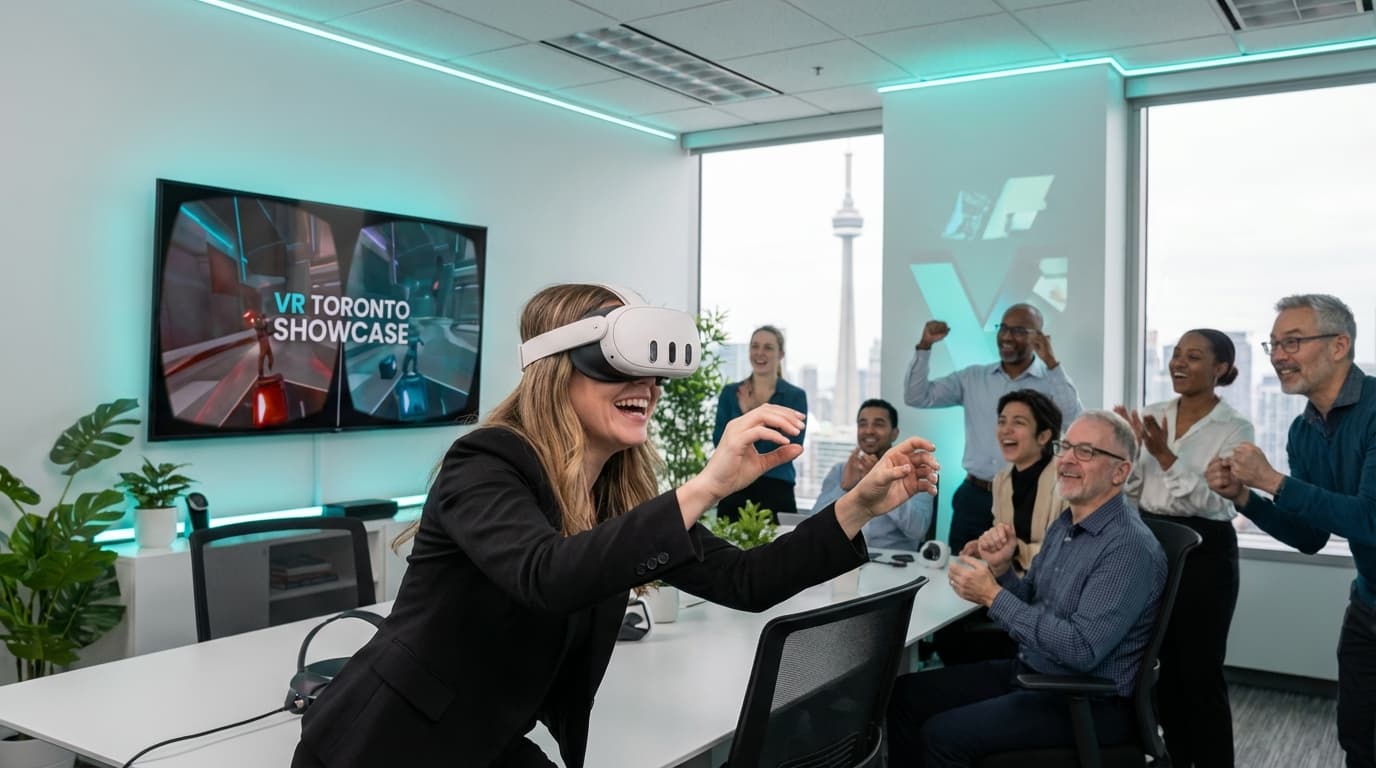
The Operational Reality: VR team building packages bring the venue to you. Whether it’s a town hall in Mississauga or a social mixer in a Yorkville hotel suite, we utilize your existing square footage. You control the catering, you control the alcohol budget, and nobody loses an hour stuck in traffic on the Gardiner.
Structuring a 60-Minute Event for 100 Guests
A common objection I hear from planners regarding mobile VR is throughput: "How do we get 100 people through VR in an hour?" This is where operational experience matters. If you hire a generic rental company that just drops off headsets, you will have chaos. When we manage corporate social events, we run a tight ship designed for high turnover and maximum engagement.
Here is the exact run-of-show I used for a recent 100-person holiday party at a law firm on Bay Street. We utilized 4 VR stations and spectator casting screens.
The High-Throughput Run-of-Show
- 0:00 - 0:10 | The "Icebreaker" Demo: As guests grab drinks, our facilitators (who have already sanitized everything with UV-C light) jump into a demo. We cast the gameplay to a large screen. Seeing a colleague panic because they dropped a virtual donut in Job Simulator is an instant crowd magnet.
- 0:10 - 0:40 | The Rotation (Fast-Paced Gameplay): We switch to short, high-energy experiences. We limit rounds to 3-4 minutes. Games like Space Pirate Trainer or Job Simulator are perfect here. They require zero gaming skill—you literally just point and grab objects. It’s hilarious to watch a Senior Partner duck under virtual lasers. With 4 stations running 4-minute turns, we move 60 people through the headsets in 30 minutes, while the other 40 are cheering, eating, or taking photos of the players.
- 0:40 - 1:00 | The Multiplayer Finale (Acron): This is our secret weapon for large groups. We launch Acron: Attack of the Squirrels!. This is an asymmetric game where one person is in VR (as a tree) and up to 8 other people join the same game via their smartphones (as squirrels). Suddenly, one VR station is engaging 9 people simultaneously. With 4 stations, we can have 36 people actively playing at the exact same second. It turns a solo activity into a riotous team sport.
This structure ensures that nobody is standing around waiting. The energy remains high because the spectators are just as involved as the players.
Space & Technical Requirements: Can Your Office Handle It?
Another factor that influences the "team building activities toronto cost toronto" equation is space. You don't need a stadium, but you do need safety zones.
For a standard VR station using the Meta Quest 3, we require a 10x10 foot (3x3 meter) clear area per active player. This ensures they can swing their arms without hitting a wall or a colleague holding a glass of wine.
Power & Internet:
- Power: We are largely self-sufficient with battery packs, but we need standard wall outlets for casting equipment and charging stations.
- Internet: Multiplayer VR requires a stable connection. If you are in a basement boardroom in the Financial District with spotty reception, let us know during the quote process. We can bring enterprise-grade networking gear to create a local loop, ensuring the game runs smoothly even if your office guest Wi-Fi blocks gaming ports. It’s these small technical details that prevent an event from becoming an expensive IT troubleshooting session.
The Hygiene Factor: A Post-2020 Priority
Let’s address the elephant in the room: hygiene. In 2026, nobody wants to put on a sweaty headset. This is a standard concern I field from HR managers daily, and it's a valid one.
At VRPlayin, we don't just wipe things down with a shirt sleeve. We operate with medical-grade hygiene protocols. Between every single user, the silicone face covers are swapped or thoroughly sanitized with antibacterial wipes. We also utilize UV-C sanitization for the controllers and headsets during downtime. In over 200 events, including sensitive medical conferences, we have never had a hygiene complaint. It’s part of the job—I have personally cleaned headsets at midnight after a 300-person gala, and I ensure my team treats every piece of gear like a surgical instrument.
Why "Non-Gamers" Often Win the Most
There is a misconception that VR is only for the IT department. The reality of my data says otherwise. In our post-event surveys, the demographic that consistently rates the experience the highest (4.9 stars average) is usually the 35-55 age bracket—people who haven't touched a game controller since the 90s.
We curate our full VR game catalog specifically for this. We avoid nausea-inducing rollercoasters. We stick to stationary experiences where your feet stay planted.
- For Communication: We run Keep Talking and Nobody Explodes. One person is in VR looking at a bomb; the rest of the team has the manual (printed or on tablets) but can't see the bomb. They have to talk each other through disarming it. It breaks down silos instantly.
- For Chill Vibes: We use Walkabout Mini Golf. The physics are perfect, and it allows people to just chat and putt in a virtual environment without the pressure of shooting zombies.
When an Account Manager who claims they "don't do tech" suddenly realizes they can play minigolf in space just by swinging their arms naturally, the skepticism evaporates immediately.
Operator Insight: Managing the Energy "Dip"
Here is something a brochure won't tell you. Every event has an energy dip about 90 minutes in. The food is gone, the initial excitement has worn off, and people start checking their phones. This is where a managed service earns its fee.
When I see that dip happening, I don't wait for the client to ask. I signal my team to switch content. We move from the solo experiences to the competitive multiplayer modes. We start a "high score challenge" on the leaderboard for a specific game, usually something fast like Beat Saber or Space Pirate Trainer. We get loud. We announce the current leader on the microphone. A passive rental unit sits in the corner collecting dust; a managed activator reads the room and injects energy back into it. That is the difference between renting hardware and booking an experience.
Final Practical Advice for Planners
If you are looking at cost comparisons, remember to calculate the "Total Event Cost" (TEC), not just the activity fee.
TEC = (Activity Cost) + (Venue Rental) + (Food/Bev Minimums) + (Transportation) + (Productivity Loss).
When you run that math, staying on-site with a high-end mobile activation usually wins by a landslide. You keep your team comfortable, you control the catering costs, and you get a cutting-edge experience that feels expensive but costs less than a dinner out.
Get a Precise Quote for Your 2026 Event
Stop guessing with venue minimums and hidden fees. We provide clear, flat-rate quotes for mobile VR team building and corporate socials in Toronto and the GTA.
GET A CUSTOM QUOTE