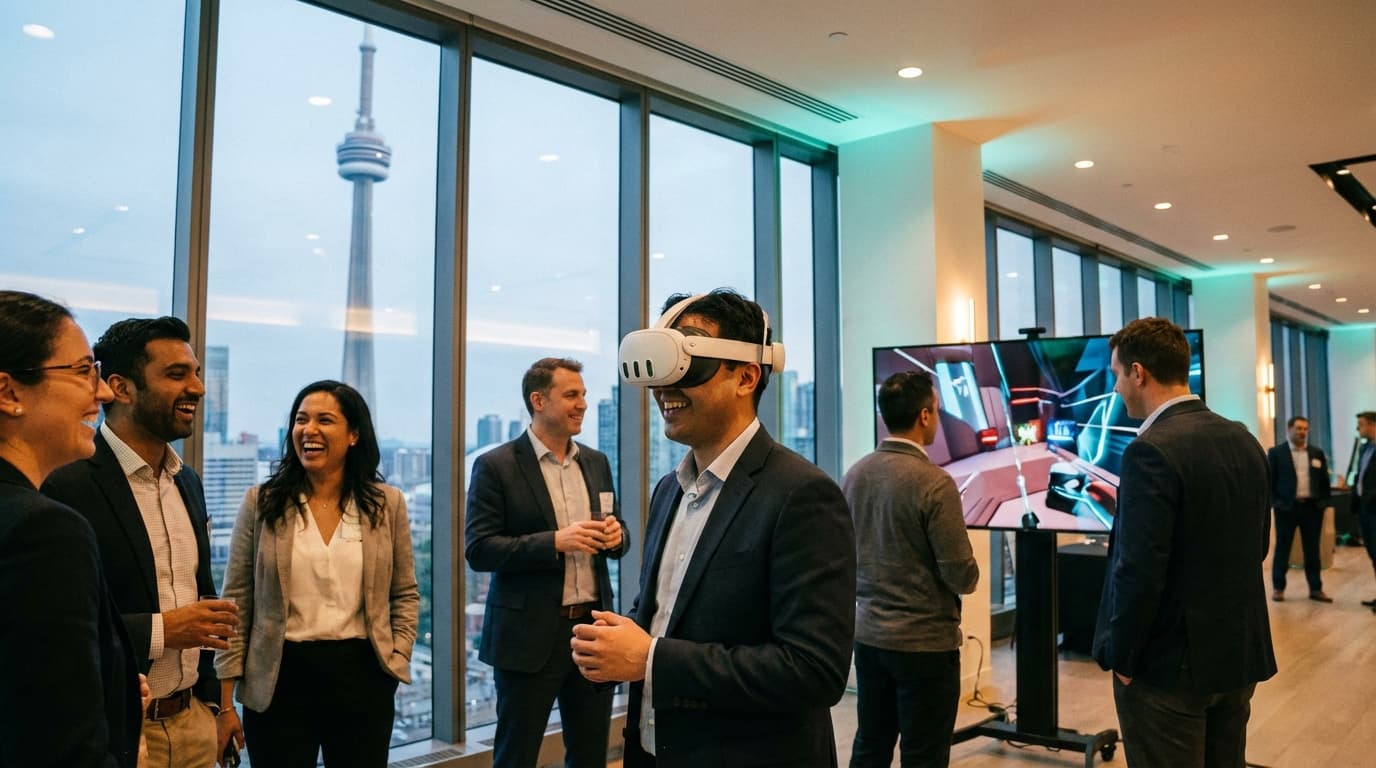
A successful corporate event strategy isn't about finding the trendiest vendor; it's about executing a framework that accounts for venue constraints, attendee demographics, and engagement flow. The most effective team building activities Toronto checklist prioritizes three operational realities: logistical feasibility (power/space), accessibility (physical/skill), and throughput (guests per hour). If you ignore these, you don't get a team building event—you get a logistics bottleneck.
I have stood in the corner of a ballroom at the Sheraton Centre Toronto watching a "creative workshop" die a slow, painful death. The facilitator was energetic, the materials were expensive, but the team—a mix of introverted developers and extroverted sales reps—simply didn't gel. Half the room was checking emails on their phones; the other half looked like they were serving detention.
As someone who has personally managed over 200 VR events across the GTA, I know that true engagement is fragile. It snaps the moment a guest feels awkward, bored, or unsafe. When we load a nervous CEO into Arizona Sunshine and they end up screaming with laughter, or when a quiet accountant dominates in Cook-Out, that success isn't an accident. It's the result of rigorous planning.
Whether you are looking at VR team building packages or organizing a simple happy hour, this checklist comes from the trenches. It is designed to save you from the awkward silence.
1. The Venue Logistics Audit: Space & Power Realities
Most team building ideas fail because they fight the room. I have seen planners try to jam active stations into narrow corridors in financial district offices, creating fire hazards rather than fun. Before you book a vendor, you need to measure your footprint realistically.
If you are booking a mobile VR activation, the math is rigid. We need a minimum of 6.5 x 6.5 feet (2m x 2m) per standing station. That sounds small until you put four of them in a boardroom on King West. For seated experiences, we can shrink that to 3 x 3 feet, but the principle remains: comfort equals engagement.
The Power Check:
- Standard Outlets: Are they on a shared circuit with the catering coffee makers? I’ve seen a latte machine trip a breaker and kill an entire AV setup at a Liberty Village startup. Always map your circuits.
- WiFi Independence: Multiplayer experiences like Walkabout Mini Golf—the gold standard for social VR—need stable internet. We bring enterprise-grade networking gear because we don't trust venue WiFi, but your checklist should always ask: "Who provides the network?"
- Load-In Constraints: If your event is at a hotel like the Fairmont Royal York, load-in is a logistical operation involving loading docks and union rules. If you are in a walk-up office in Yorkville, we need to know about the elevator dimensions. We bring backup equipment to every event, but we need to know if we're carrying it up three flights of stairs.
2. The Budget Reality Check: What Does "Fun" Cost?
A checklist without a budget column is just a wish list. In the Toronto market, pricing varies wildly, but you usually get exactly what you pay for. When evaluating options, break costs down into "Cost Per Engaged Minute."
- DIY (Trivia/Board Games): $0 - $15 per person. Hidden Cost: High internal labor. You are the MC, the roadie, and the cleaner. If the audio fails, it's on you. Engagement is often hit-or-miss.
- Offsite Venue (Axe Throwing/Escape Room): $40 - $80 per person. Hidden Cost: Transportation. Uber vouchers or a shuttle bus from the office adds up fast. Plus, you lose productivity time in transit.
- Premium Mobile Activation (VR/Casino): $50 - $100 per person. Hidden Cost: Space requirements. However, the ROI is often highest here because the vendor handles 100% of the labor, hygiene, and flow. You pay for the peace of mind that the event will actually work.
3. Accessibility & The "Non-Gamer" Factor
Your checklist must address the skill gap. If your activity requires everyone to be athletic or tech-savvy, you are alienating 30% of your attendees before the event starts. This is a massive blind spot for many corporate social events.
We specifically curate our library to avoid this. When we run Pistol Whip—a cinematic rhythm shooter where you feel like John Wick—it’s intuitive. You see a bullet, you dodge. You see a target, you shoot. There are no complex button combos. On the flip side, Walkabout Mini Golf is perfect for the skeptics. It’s low intensity, beautiful (imagine putting on a pirate cove or a space station), and allows colleagues to chat naturally while they play.
The Nausea Question: If you are considering mobile vr events canada providers, ask them about their motion sickness protocols. If they shrug, run. In 200+ events, fewer than 2% of our guests report discomfort because we strictly curate stationary gameplay with no artificial locomotion. If your vendor puts a first-timer on a virtual roller coaster, they are negligent.
4. Your Essential Team Building Activities Toronto Checklist
This is the vetting matrix I wish every planner used. Compare your options—whether it's VR, axe throwing, or a trivia night—against these operational pillars.
| Evaluation Factor | Mobile VR (Managed) | Offsite Venue (e.g., Axe Throwing) | DIY Office Activity |
|---|---|---|---|
| Setup Logistics | High (We handle 100%). Needs 60-90 mins setup. We come to you. | Low. You just show up. Travel time required for team. | High. You are the roadie, the MC, and the cleaner. |
| Inclusivity | Very High. Curated content for all mobilities. Spectator casting involves everyone. | Medium. Physical requirements exclude some guests. | Variable. Often relies on extroverts; introverts disengage. |
| Hygiene Risk | Managed. UV-C cleaning & silicone swaps between every user. | Shared equipment (axes/vests). Varies by venue standards. | Low, unless sharing food/props. |
| Throughput | High. 2-5 min turns allow 30-40 people to rotate quickly. | Medium. Fixed lanes/rooms limit participation speed. | All-at-once. Good for unity, bad for individual interaction. |
| Cost Model | Flat fee or tiered packages. 50% deposit. | Per-head pricing. Can get expensive for large groups. | Low budget, high internal labor cost. |
5. Throughput & The "Boredom Buffer"
A critical mistake in planning employee engagement activities is ignoring the spectator experience. If you have 40 people and 4 VR stations, what are the other 36 people doing? If the answer is "standing in line," you have failed.
We solve this with spectator casting. We beam the headset view to large TV screens so the crowd sees exactly what the player sees. It turns a solo activity into a spectator sport. Suddenly, the crowd is cheering because they can see the HR Director dodging bullets in real-time. This keeps the energy high and the boredom low.
For large events at venues like the Enercare Centre or huge corporate galas, we structure the flow to keep sessions short—typically 2 to 5 minutes per turn. This ensures everyone gets a try without the line stalling. A repeat booking rate of 40% tells us this flow works.
6. Sample Run of Show (2-Hour Event)
Don't just wing the timeline. A structured flow prevents the "awkward start" and the "fizzled end." Here is a standard run of show for a 50-person cocktail event with VR activation:
- 16:00 - 17:00: Vendor Load-In. (We arrive early to map the room, tape down cables, and sanitize gear).
- 17:00 - 17:30: Doors Open & Food/Drink. Do not start the activity yet. Let people decompress, grab a drink, and chat.
- 17:30 - 17:40: The Catalyst. The CEO or Event Lead welcomes the group. Our staff does a 60-second "hype intro" showing people how to use the gear.
- 17:40 - 18:40: Peak Activation. High-throughput gaming. We rotate guests through Richie's Plank Experience or Beat Saber. The casting screens are active. The energy is highest here.
- 18:40 - 19:00: Cool Down & Networking. As the event winds down, we switch to calmer experiences (like Google Earth VR) for stragglers while the majority return to networking.
- 19:00: Event Ends / Load Out.
7. Food & Beverage Integration (The Greasy Finger Rule)
If you are serving food, your checklist needs a "Greasy Finger Policy." It sounds funny until someone ruins a $400 controller with buffalo wing sauce.
For interactive events, stick to "fork food" or dry snacks (pretzels/nuts) during the active portion of the night. Save the sliders and wings for after the main activity, or ensure there are ample wet-nap stations. From an operator's perspective, we manage this by having a strict "no food in the play zone" zone, but you can help by planning the menu with gameplay in mind. Alcohol is generally fine in moderation—in fact, a glass of wine often helps the initial hesitation—but we reserve the right to cut off anyone who becomes a safety risk to themselves or the hardware.
8. The Hygiene Standard (The Uncomfortable Truth)
Let’s be honest: putting something on your face that a coworker just wore requires trust. If you are hiring a vendor for a trade show booth or a full VR game catalog activation, you need to grill them on hygiene. It isn't enough to just "wipe it down."
Ask these specific questions:
- Do you use medical-grade silicone face covers? (Foam is a bacteria sponge; never accept foam).
- Do you swap covers between every single user?
- Is there a UV-C sanitization step?
I have personally cleaned 40 headsets at midnight after a 300-person gala. I know exactly what it takes to reset a station to a clinical standard. We use antibacterial wipes and UV-C sanitization for every piece of gear, every time. It’s why an HR Director from a major financial services firm told us, "Best team event we've ever organized. Everyone was talking about it for weeks." They weren't talking about the hygiene—they were talking about the fun—but the hygiene is why they felt comfortable enough to have that fun.
The Operator's Perspective: Why Plan B Matters
There is a specific moment at every event that tells me we did our job right. It’s usually about 45 minutes in. The appetizers have been eaten, the initial awkwardness has faded, and the "serious" professionals have dropped their guard. I recall a specific Bar Mitzvah in North York where the parents were initially hesitant to put on the headsets. By the end of the night, we had to gently tell the dad he couldn't play another round because the venue was closing.
That transition—from skepticism to immersion—only happens when the logistics are invisible. The guests don't see the backup batteries, the sanitized masks, or the network switches. They just see the fun. When vetting your next team building activity, ask the vendor for their "Plan B." If the internet cuts out, do they have offline LAN capability? If a headset breaks, is there a spare in the case? The difference between a professional operator and a hobbyist is that the professional expects things to go wrong and has already packed the solution.
If you're ready to stop guessing and start planning a guaranteed win for your team, let us handle the logistics.
Bring the 'Wow' Factor to Your Next Toronto Event
From the Financial District to the GTA suburbs, VRPlayin brings full-service mobile VR directly to your team. We handle the setup, the hygiene, and the staffing so you can focus on your guests.
SEE TEAM BUILDING PACKAGES