I recently watched an HR director at a Financial District firm try to pitch her executive team on an offsite event. She brought spreadsheets. They brought skepticism. Getting internal buy-in for corporate events is an uphill battle. Executives want minimal operational friction, while staff want to avoid forced icebreakers and clock-watching. This exact dynamic is why I put together this team building activities Toronto case study.
After facilitating over 200 corporate events across the GTA—and personally cleaning 40 headsets at midnight after a 300-person gala—I know exactly what works, what fails, and how to justify the budget to a CFO. You need concrete data to prove to leadership that your proposed event will deliver actual engagement. We are going to look past the generic brochures and break down the operational realities of corporate entertainment.
The Direct Recommendation: Why Managed VR Beats the King West Bar Crawl
When comparing group offsite ideas, my strongest recommendation is fully managed mobile vr team building. I have repeatedly watched the quietest Bay Street analysts suddenly start barking strategic orders at their VP, leveling the corporate hierarchy in minutes.
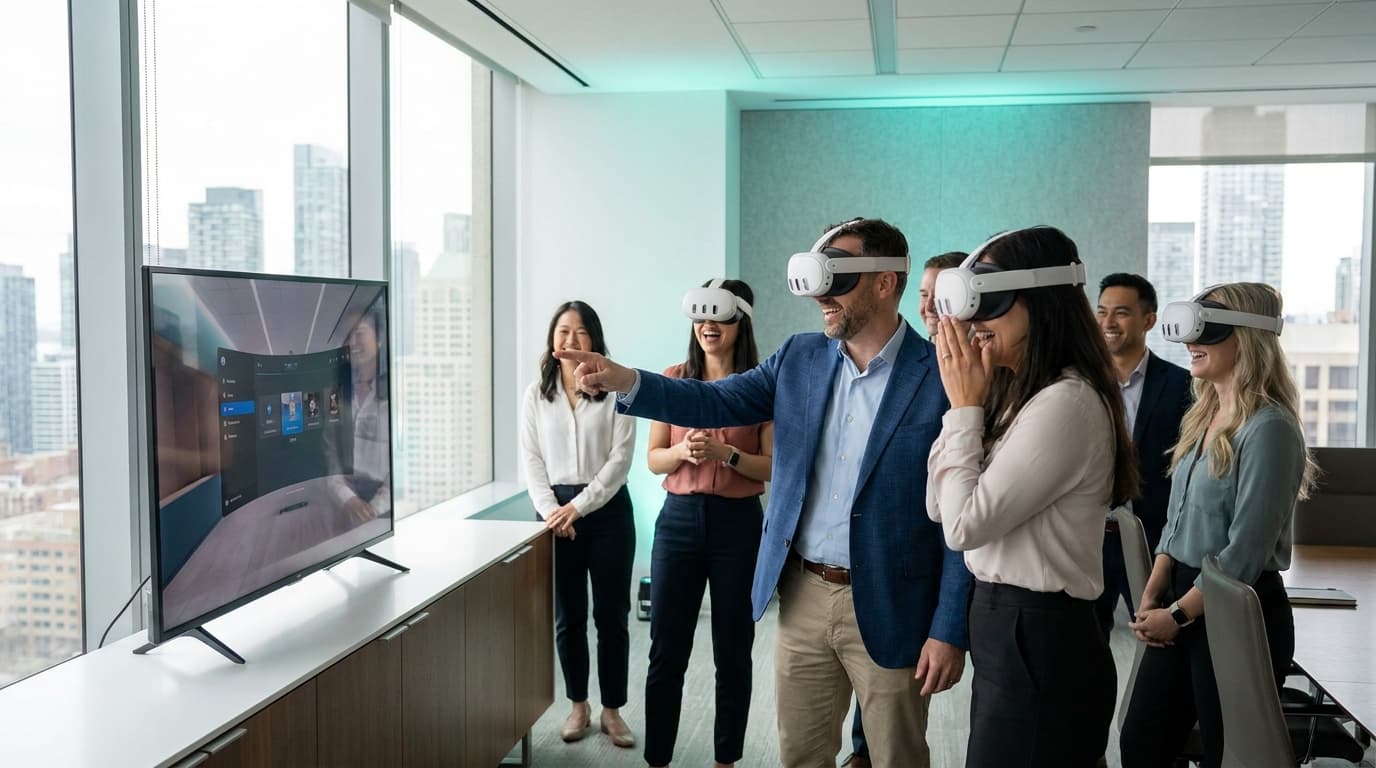
Traditional offsites require renting buses, fighting downtown traffic, and hoping the weather holds up. With mobile VR, we bring Meta Quest 3 Business Edition headsets directly to your office, hotel ballroom, or event venue. We handle the physical setup, run the casting software, and tear everything down seamlessly.
When you drop a nervous executive into Beat Saber, the dynamic of the room shifts instantly. Beat Saber is the world's most popular VR game for a reason: you slash neon blocks to the beat of adrenaline-pumping music. It is a single-player, medium-intensity experience that requires zero prior gaming knowledge. When the crowd energy builds around our 55-inch spectator casting TVs, you get organic high-fives and genuine cheering. It is the exact opposite of a mandatory trust fall.
The Mobile VR Events Canada Comparison Framework
When presenting your plan to leadership, you must show that you evaluated alternatives. Corporate event planners usually weigh fully managed mobile VR against DIY rentals or traditional group outings. Here is the unvarnished operational breakdown based on data from our 200+ events.
Traditional Outings (Escape Rooms, Axe Throwing)
Moving 40 staff members to a facility in Liberty Village is a logistical nightmare. You lose 45 minutes just coordinating rideshares and dealing with stragglers. Furthermore, physical activities often sideline older staff members or those with mobility restrictions. Escape rooms also typically cap out at 6 to 8 players per room, instantly fracturing your larger team into isolated silos. Participation rates drop before the event even begins.
DIY VR Rentals
You rent five headsets in mail-order boxes to save a fraction of the budget. You spend your Tuesday night trying to figure out how to cast the gameplay to a boardroom monitor. During the event, you act as full-time IT support, wiping down sweaty foam inserts while your colleagues complain about spotty Wi-Fi. By taking the DIY route, you completely sacrifice your own ability to participate in the event.
Fully Managed Mobile VR
We arrive 60 to 90 minutes before your event starts. Our trained facilitators map the safety boundaries and hook up the casting TVs. We use medical-grade silicone face covers that are replaced between every single user, backed by UV-C sanitization wands and antibacterial wipes. You actually get to drink your coffee and network with your colleagues while we manage the queues, the software, and the hardware.
Venue Readiness Checklist: Scaling from a Boardroom to the MTCC
One of the biggest hurdles in getting executive buy-in is answering inevitable logistics questions. You need concrete answers about the physical space. Use this checklist to verify your venue, whether you are hosting at the Metro Toronto Convention Centre or an Artscape Daniels Launchpad studio.
- Space Clearances: We require a minimum of 6.5 x 6.5 feet (2m x 2m) per standing station to ensure safe, collision-free movement. Seated or stationary experiences need only 3 x 3 feet. We always run a virtual or in-person site assessment with you during the planning phase.
- Power Requirements: We utilize extended battery straps on our headsets so players are not tripping over thick cords. We simply need standard 110V wall outlets nearby to run our charging hubs and spectator casting TVs.
- Staffing Metrics: Our average corporate group size is 25 to 40 guests. Sessions run 2 to 5 minutes per turn. We calculate and provide the exact number of facilitators required to keep the queue moving fluidly so nobody is standing around bored.
- Wi-Fi Capabilities: Single-player experiences run completely offline. Multiplayer games require internet access. Corporate firewalls and captive portals frequently block gaming traffic, which is why we deploy our own 5G enterprise routers to ensure lobbies never drop.
A Team Building Activities Toronto Case Study in Action
Executives often worry that VR is an isolating experience—that people will put on a headset and completely ignore the room. Let me share a scenario from a recent 40-person legal firm gathering in Yorkville. We deployed Acron: Attack of the Squirrels!
This game is a masterclass in asymmetric multiplayer engagement, perfect for large groups and spectator involvement. One person puts on the VR headset and becomes a giant, ancient tree tasked with defending golden acorns. Meanwhile, up to eight other colleagues pull out their own iPhones or Androids, enter a secure lobby code, and play as squirrels trying to rush the tree and steal the acorns.
Suddenly, a single VR station transforms into a screaming, highly competitive nine-person activity. The VR player is physically turning and tossing virtual boulders while eight lawyers furiously tap their phones to flank them.
"Even our senior partners who 'don't do video games' were laughing and high-fiving in VR." — Executive Assistant, Toronto Law Firm.
That specific dynamic is why we maintain a 40% repeat booking rate. We bridge the gap between heavy gamers and people who still use flip phones, keeping the entire room engaged simultaneously.
Handling the Executive Pushback: "But We Are Not Gamers"
When you pitch corporate social events centered around technology, someone will inevitably object: "Half our accounting department has never played a video game. They will just stand there confused."
Our most popular experiences require zero gaming skill. If a guest can point, grab, and throw a ball in the physical world, they can navigate our setups. When a skeptic approaches the station, my facilitators immediately load them into Job Simulator. It is a brilliant, low-intensity parody of everyday jobs in a world where robots have replaced humans. You throw staplers over cubicle walls and burn virtual hot dogs. It requires zero gaming experience and delivers pure, chaotic fun.
To push communication skills, we deploy Keep Talking and Nobody Explodes. One player wears the headset to look at a complex ticking time bomb, while their colleagues frantically flip through a physical, printed paper manual to feed them defusal instructions. It mimics high-stakes project communication perfectly.
The second major objection is motion sickness. CFOs fear a room full of nauseous employees. We solve this through strict, unyielding content curation. We only run zero-nausea experiences for corporate groups—stationary gameplay with no artificial locomotion or artificial turning. In over 200 events, fewer than 2% of our guests report any discomfort. If a guest shows early signs of unease, our facilitators are trained to spot it instantly and switch them to a comfortable, seated viewing experience. You can browse our full VR game catalog to see exactly how we cater to the uninitiated.
Budgeting and Finalizing the Vendor Shortlist
The final slide of your internal pitch deck is always the budget. We operate on a model of absolute transparency. We offer tiered packages based on your total group size, the event duration (typically 2 to 3 hours), and the precise number of stations required to maintain engagement.
To secure a booking, we require a 50% deposit, with the balance due on event day. We accept standard corporate invoicing, credit cards, and direct e-transfers. While our headquarters are in Toronto, we regularly travel across Canada, calculating fair distance and parking fees upfront so your accounting department is never hit with a surprise invoice.
And if a headset fails mid-event? We bring fully charged backup hardware to every single booking. Our technicians can swap a headset and reconnect to the casting TV in under two minutes, ensuring zero downtime for your team. You bring the people; we deliver a flawless technical execution.
Bring Hassle-Free Mobile VR to Your Next Offsite
Stop trying to coordinate transportation across downtown traffic for your staff. We bring the equipment, the trained facilitators, and the crowd energy directly to your office or venue with zero friction.
SEE TEAM BUILDING PACKAGES