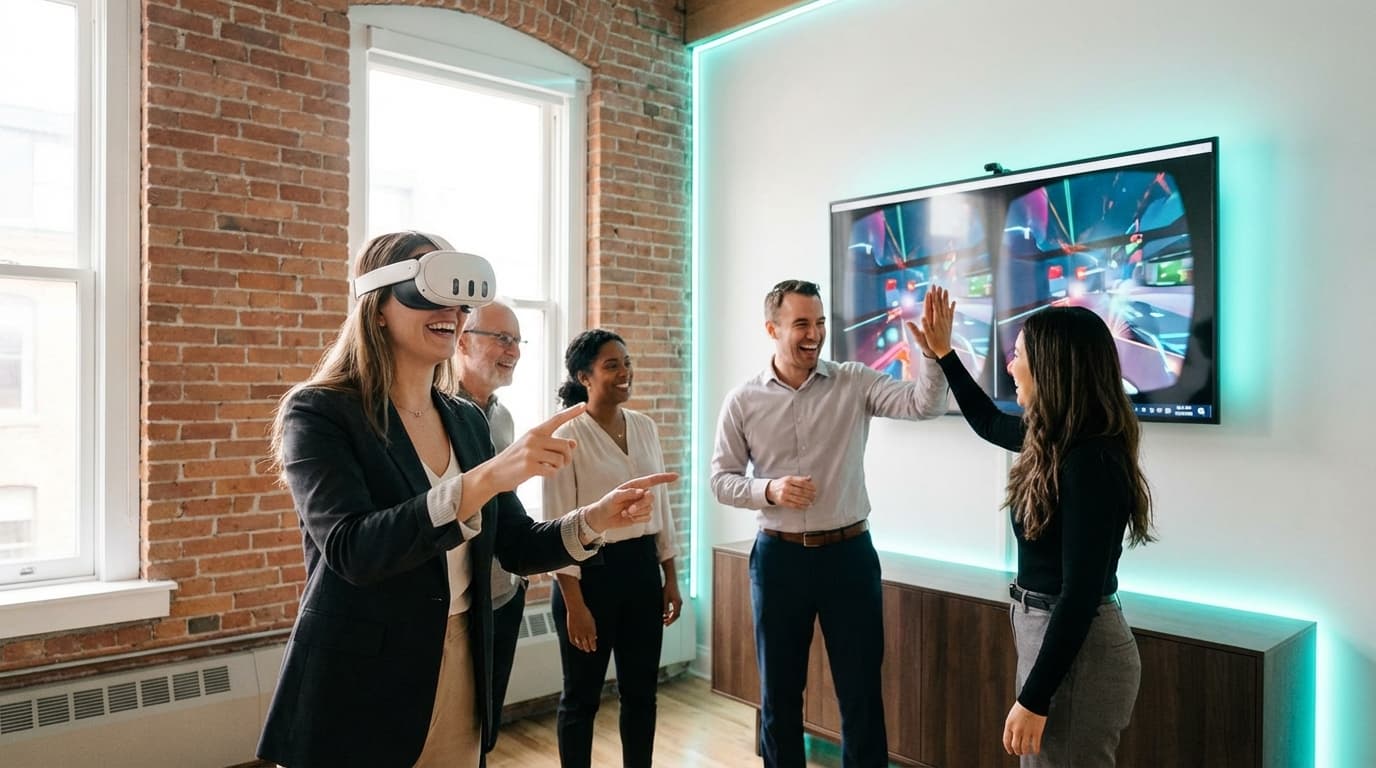
To ensure venue availability and high employee participation, your team building activities toronto booking timeline must begin exactly eight weeks before your targeted event date. Lock in your venue and vendors by week five, integrate your AV and catering by week four, launch internal promotions by week three, and finalize technical walkthroughs exactly seven days prior.
I have walked into enough King West office parties to recognize the exact moment a corporate event goes sideways. The HR director is sweating near the catering table, watching 40 senior analysts politely nurse their drinks while actively avoiding the mandatory icebreaker game. Forced small talk, trust falls, and generic trivia do not build rapport; they build resentment. After running 200+ events across the Greater Toronto Area, I know what actually changes that dynamic: managed, high-energy entertainment where participation feels entirely organic.
But pulling off an event that gets your skeptical CFO screaming with laughter requires a flawless execution schedule. You cannot book premium experiences on three days' notice, ignore building logistics, and expect a smooth rollout. Here is the exact, battle-tested timeline we use to guarantee operational success.
Weeks 8 to 6: Launching Your Team Building Activities Toronto Booking Timeline
Securing a premium space like Evergreen Brick Works, The Globe and Mail Centre, or a specialized Financial District boardroom means beating a 3-to-4 month waitlist. Securing your real estate is the absolute first step, because your physical footprint dictates your entire entertainment strategy.
A typical corporate booking for 40 to 60 guests requires a two-month runway to ensure you get the exact Thursday or Friday afternoon you want. If you are hosting the event internally in your own office, do not skip this step. You still need to secure the largest communal areas well in advance. Book the all-hands space, block the date on the executive calendar, and map out your floor plan. Mobile VR setups require specific dimensions, so knowing whether you have a massive cafeteria or a segmented cluster of meeting rooms will define the types of activations we can run.
Week 5: Locking Down Team Building Ideas That Actually Work
When evaluating team building ideas, event planners consistently fail to account for mixed comfort levels. A massive mistake is choosing an activity that forces introverts onto a metaphorical stage to perform. This is where professionally facilitated mobile VR events change the corporate dynamic.
Instead of forcing everyone into the spotlight, we curate environments with layered participation. Our most popular experiences require zero gaming skill. Point, grab, throw—that is the entire learning curve. When a team of Bay Street accountants loads into Cook-Out, and the quietest analyst turns out to be the only one who can coordinate sandwich orders under the pressure of a ticking clock, actual communication barriers break down.
We also utilize asymmetric multiplayer mechanics to scale participation exponentially. Take a game like Acron: Attack of the Squirrels!. One player wears the Meta Quest 3 Business Edition headset to control a giant tree defending golden acorns, while up to eight other colleagues join the exact same match using their own smartphones to play as mischievous squirrels. It turns a single 6x6-foot VR station into a massive 9-person battleground. The extroverted sales director flails wildly as the tree while the introverts strategize via their phones from the sidelines. Nobody is left out.
By week five, you should be signing contracts. We require a 50% deposit to lock in your booking, ensuring our hardware and expert facilitators are fully reserved for your specific timeframe. We accept credit cards, e-transfers, and corporate invoicing to make the procurement process seamless.
Week 4: Aligning Catering and AV Logistics
Here is an operational secret most planners learn the hard way: your catering menu can ruin your interactive entertainment. I have seen companies serve saucy ribs and greasy finger foods right next to a VR station. It is a disaster for the hardware and slows down player rotation because guests have to wash their hands before touching the headsets.
By week four, finalize a "dry" catering menu. Think skewers, charcuterie boards, dry-rubbed appetizers, and fork-friendly dishes. Keep the sticky sauces away from the tech zone.
This is also the week to align AV (Audio/Visual) integration. We bring dedicated casting monitors for every VR station so the crowd can watch the gameplay, but if your venue has massive built-in projectors or digital walls, we want to use them. In week four, we coordinate with your in-house AV tech to ensure we have the correct HDMI drops and audio routing to push our gameplay feeds directly to your venue's primary screens, maximizing the spectator experience.
Week 3: Internal Promotion and Handling Skepticism
Three weeks out is the exact right time to send the calendar invites. Send them any earlier, and people forget; send them any later, and calendars are already booked with client meetings.
This is also when skeptics will raise concerns. Address them immediately in your event communications so nobody opts out prematurely. People will inevitably ask about motion sickness. After executing over 200 events, our data shows that fewer than 2% of guests report any discomfort. We curate zero-nausea experiences strictly for corporate events—meaning stationary gameplay with no artificial locomotion. Our facilitators are trained to spot early signs of hesitation and switch a user to more comfortable content within 15 seconds.
You will also face questions about hygiene. I have personally deep-cleaned 40 headsets at midnight after a 300-person gala to ensure the gear was flawless for a 9:00 AM breakfast session. We do not compromise on cleanliness. We use medical-grade silicone face covers that are replaced between every single user. We utilize UV-C sanitization wands, antibacterial wipes, and provide standalone hand sanitizer stations at every setup.
By addressing these factors upfront, your corporate social events transition from mandatory obligations to highly anticipated rewards.
Week 2: Tournament Bracketing and Final Headcounts
With 14 days to go, your RSVPs should be locked. This is when we transition from high-level planning to structured play mechanics. If your team is highly competitive, free-play isn't enough; you need a tournament bracket.
For teams that love problem-solving, we map out schedules for Keep Talking and Nobody Explodes. This is the ultimate corporate communication test. One player is in VR staring at a ticking time bomb covered in complex wires and symbols. The rest of the team sits around a physical boardroom table, frantically flipping through a 20-page printed defusal manual. They have to communicate perfectly to defuse the bomb before time runs out. By week two, we take your final headcount and build a custom leaderboard to track which department communicates best under pressure.
7 Days Out: The Venue Readiness Checklist
A week before the event, execution logistics take priority. Mobile VR events require specific physical parameters to operate safely. Do not leave these details to the morning of the event. Whether you are hosting at the Metro Toronto Convention Centre or a private office in Liberty Village, your space must be prepared.
Use this mandatory venue readiness checklist for your final walkthrough:
- Floor Clearance: Map out exactly 6.5 x 6.5 feet (2m x 2m) of completely unobstructed floor space per standing VR station. If you only have a 3 x 3 foot area available, notify us immediately so we can switch the curation to seated experiences.
- Power Requirements: Verify dedicated 110v wall outlets within 15 feet of the activation area. We run high-draw gaming laptops and cannot daisy-chain power bars from the DJ or catering stations. We prefer standard 15-amp circuits dedicated solely to our gear.
- Network Security: Multiplayer experiences require stable internet access. If your corporate network blocks external devices or utilizes complex captive portals, we must confirm firewall exceptions with your IT team in advance. If corporate security is too tight, we simply bring our own enterprise 5G cellular routers.
- Freight Elevators and Access: Getting 200 pounds of pelican cases up to a 40th-floor Scotia Plaza office requires pre-booked freight access. Passenger elevators will turn our technicians away. Ensure loading dock access, freight elevator permissions, and security clearances are finalized.
- Union Regulations: If you are at a major venue like MTCC or Enercare Centre, verify union rules regarding third-party vendors carrying in equipment. We have navigated these frequently, but your venue coordinator needs to have our arrival on their daily sheet.
Event Day Execution: Managing the Room
The difference between a gimmick and a successful event relies entirely on facilitation. We do not just drop off equipment and leave. Our trained staff manages the room, guides people into the experiences, adjusts head straps for perfect clarity, and ensures hardware functions flawlessly. We bring backup headsets to every single event so that if a piece of hardware misbehaves, we swap it out in under 60 seconds. Zero downtime.
When the event starts, we establish the "watercooler moment" using our casting TVs. We frequently open with Beat Saber—the world's most popular VR game where players slash blocks to an aggressive rhythmic beat. It is easy to learn, medium intensity, and instantly gets the heart rate up. Watching your stoic vice president wildly slash at neon cubes while the entire department cheers at the television screen dictates the high-energy vibe for the rest of the session.
This structured chaos works. As an Office Manager at a top Toronto consulting firm recently told us: "Setup was seamless, the staff was professional, and our team had an absolute blast. It was the first time our engineering team and marketing team actually hung out together for three hours."
The Teardown and Post-Event (Minutes 120-165)
A standard session lasts two to three hours, with each guest rotating through three to five-minute turns depending on the total headcount. We keep the lines moving fast. Once the final high score is recorded and the CEO has been thoroughly defeated by the summer intern, our teardown process begins.
Within 30 to 45 minutes, we pack the hardware, roll up the cables, sanitize the area, and leave your boardroom exactly as we found it. Event planners love this system because the logistical burden is entirely removed from their plate. Once the event is done, you go home. We maintain a 40% repeat booking rate precisely because we handle the heavy lifting from load-in to load-out.
Your planning timeline dictates your execution reality. Start eight weeks out, finalize your catering and space early, secure VR team building packages that bridge the gap between introverts and extroverts, and confirm your technical requirements a full week in advance. By the time your team puts on the headsets, your only job should be deciding who you want to challenge next.
Need Help Hitting Your Event Timeline?
Skip the logistical headache. We bring the hardware, manage the space, and handle the facilitation for your mobile VR team building event so you can actually participate with your team.
SEE TEAM BUILDING PACKAGES