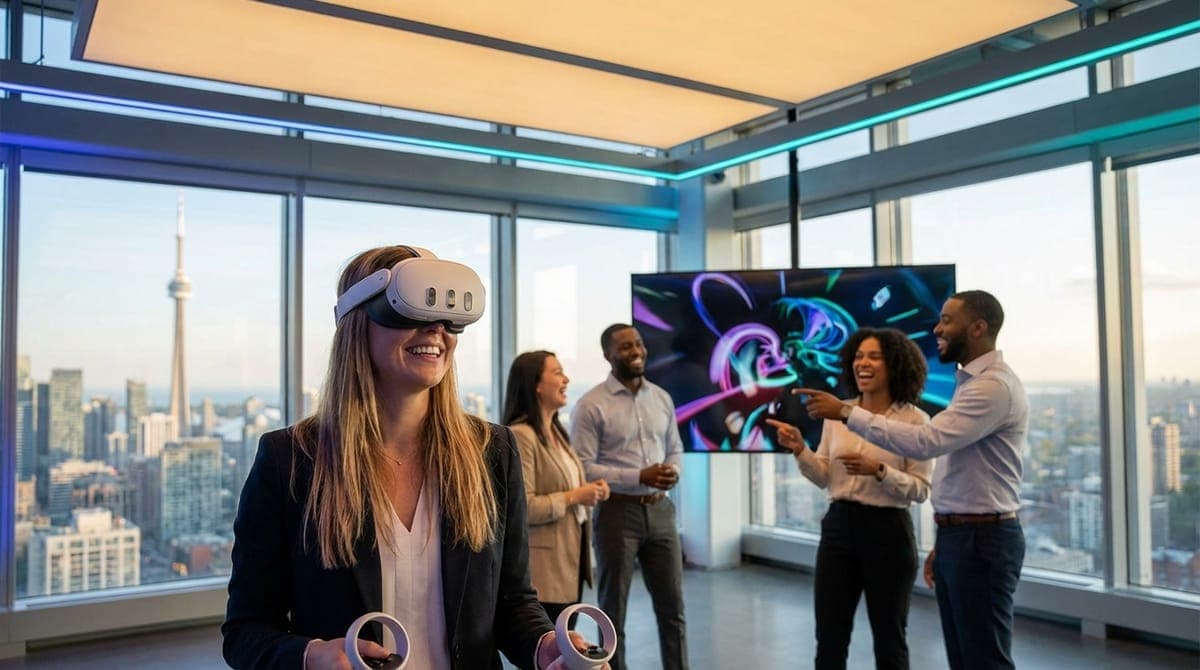
Sober socials tech entertainment replacing open bar isn't just a trend piece I read in a magazine; it is the operational reality I see on the ground every week in Toronto. Companies are realizing that handing a drink to an employee and hoping they talk to each other isn't a strategy—it's a liability. By swapping passive consumption for active VR participation, organizations are seeing engagement rates spike from the usual "show up and leave" crowd to teams that actually stay past the scheduled end time.
The Shift: Sober Socials Tech Entertainment Replacing Open Bar
We need to be honest about the traditional corporate mixer. You rent a space in the Financial District, you put a few thousand dollars behind the bar, and you pray that people actually mingle. But having run 200+ events across the GTA, I can tell you exactly what usually happens. The executives cluster in one corner, the sales team takes over the bar, and the shy accountant—who is brilliant but introverted—stands by the shrimp cocktail checking their watch.
The open bar used to be the default social lubricant. But the workforce has changed. Gen Z drinks significantly less than previous generations—studies show a 20% decline in per capita alcohol consumption for this demographic. Parents need to drive home to Mississauga or Oakville and can't afford a hangover the next morning. And HR departments are increasingly wary of the liability that comes with unlimited alcohol service.
This is where corporate social events are pivoting. The goal isn't to stop people from having fun; it's to change the source of the dopamine. Instead of a chemical buzz, we’re seeing companies opt for the adrenaline rush of active gameplay.
I recently managed an event for a law firm at a venue near King West. They specifically requested a "dry" event because their previous holiday party had resulted in some... unfortunate HR incidents. They were terrified everyone would be bored. Two hours later, I was cleaning sweat off headsets because the senior partners were in a heated competition to see who could slice the most blocks in Beat Saber. The energy in the room was higher than any cocktail party I’ve attended, and nobody had to worry about what they said to the boss after three martinis.
Engagement Mechanics: Why Active Play Beats Passive Drinking
The fundamental flaw with the open bar model is that it is passive. It requires nothing of the guest other than attendance. High-tech entertainment, specifically mobile VR team building, demands presence. You cannot be checking emails on your phone when you are trying to defuse a bomb or defend a tree from squirrels.
When we deploy our Meta Quest 3 units, we aren't just giving people a video game; we are giving them a shared task. That shared task creates a psychological safety net. It removes the pressure to make small talk because you have something immediate to talk about.
The Asymmetric Multiplayer Solution
One of the biggest misconceptions I hear is that VR is isolating—that you stick a headset on someone and they disappear. If that happens, you’ve hired the wrong operator.
Take Acron: Attack of the Squirrels! This is a staple in our rotation for large groups. It’s an asymmetric multiplayer game, which is a fancy way of saying different players have different roles.
- The VR Player: One person wears the headset and becomes a giant, sentient tree protecting a pile of golden acorns.
- The Mobile Players: Up to 8 other guests pull out their actual smartphones, scan a QR code, and join the game as squirrels.
Suddenly, one VR station is entertaining nine people simultaneously. The squirrels are coordinating attacks—"You go left, I'll distract the tree!"—while the VR player is physically spinning around trying to grab them. I’ve seen entire departments at huge banks in the TD Centre screaming instructions at each other. You don't get that level of interaction from a glass of wine.
High-Stakes Communication: Keep Talking and Nobody Explodes
For teams that need to work on communication, we deploy Keep Talking and Nobody Explodes. This is the ultimate stress-test for office dynamics.
The player in the VR headset sees a ticking time bomb covered in complex modules (wires, keypads, mazes). They cannot see the manual. The other teammates have the manual (printed or on tablets) but cannot see the bomb. They must talk each other through disarming it before the timer hits zero.
I’ve watched soft-spoken interns take command of a room, guiding a frantic VP through a wire-cutting sequence with surgical precision. It reveals leadership qualities you didn't know existed, and the collective cheer when the clock stops at 0:03 is louder than any toast.
The "Icebreaker" Myth: Real Connection Requires Vulnerability
Every event planner asks for icebreakers. Usually, this means awkward name tags or forced conversation prompts. But real connection happens when people let their guard down. In a corporate setting, everyone has their armor on. The CEO has to look authoritative; the junior associate has to look competent.
VR bypasses that armor. It is inherently a little bit silly. You have a plastic brick on your face and you are waving your arms at invisible objects. When the Director of Marketing misses a golf putt in virtual reality and laughs about it, the hierarchy flattens.
Socializing in Walkabout Mini Golf
For groups that want low intensity, Walkabout Mini Golf is the gold standard. It supports 1-4 players per group, but we often cast it to a large TV so spectators can heckle (supportively). The hook here isn't high-octane action; it's the physics and the pacing. The courses are beautiful—from pirate coves to space stations—and the physics are incredibly realistic.
It creates the perfect cadence for conversation: putt, chat, move to next hole, chat. It mimics the flow of real golf but without the greens fees or the rain. We find this works exceptionally well for networking events where the goal is conversation, but guests need a focal point to reduce social anxiety.
Operational Blueprint: A Sample 3-Hour Run of Show
Planners often struggle to visualize how VR fits into a timeline. Unlike a band that plays a set, VR is continuous. Here is a typical "Sober Social" run of show we used for a 50-person tech company event in Liberty Village last month.
- 4:30 PM - VRPlayin Team Arrival: We arrive for setup. We map the play space, set up casting TVs, and sanitize all equipment.
- 5:30 PM - Doors Open & Passive Play: Guests arrive. We have "Walkabout Mini Golf" running on the screens. It’s low pressure. Early birds can jump in and hit a few balls while eating appetizers.
- 6:15 PM - The Energy Shift: Once the room is full, we switch the main station to "Beat Saber." Our staff identifies the most enthusiastic guest to go first (there is always one). The music starts pumping. The leaderboard appears on the TV.
- 6:45 PM - Team Challenges: We switch the second station to "Acron." We get groups of 8 playing together. This is peak engagement time. Noise levels are high, laughter is constant.
- 7:30 PM - The Tournament Finals: We recall the top 3 scorers from the Beat Saber leaderboard for a "Final Boss" showdown. The whole room watches. The winner gets a small prize (usually a gift card provided by the company).
- 8:30 PM - Teardown: We pack up quietly while guests finish dessert.
Notice the arc: It starts chill, builds to high energy, facilitates group play, and ends with a shared spectator moment. A bar doesn't offer a narrative arc; it just offers a tab.
The Financial Case: The Liberty Village Comparison
Let’s talk numbers, because eventually, you have to justify the budget to finance. An open bar at a premium Toronto venue is a variable cost that spirals quickly. A VR activation is a fixed cost.
Here is a direct comparison based on a real quote for a 75-person event lasting 3 hours:
| Cost Category | Traditional Open Bar Model | VR Entertainment Model |
|---|---|---|
| Consumables | $6,750 ($30/hr per person x 3 hrs) | $0 (Included) |
| Staffing/Gratuity | $1,350 (20% mandatory gratuity) | $0 (Staff included in package) |
| Bartender Labor | $600 (2 staff x $100/hr min) | $0 (Included) |
| Equipment/Setup | $0 (Usually included) | $2,500 - $3,500 (Depending on package) |
| TOTAL COST | ~$8,700 + HST | ~$3,000 + HST |
| ROI Outcome | Lower productivity next day, liability risk. | Team bonding, video content for social, 100% productivity next day. |
Even if you add a premium mocktail station or fancy sodas to the VR model (approx. $1,500), you are still coming in significantly under the cost of a full open bar, with zero risk of someone driving home unsafe. That is a CFO-friendly argument.
Expert Insight: Handling the Motion Sickness Fear
I’ve run over 200 events, and the number one question I get from cautious HR directors is: "Is everyone going to throw up?" It’s a fair question because early VR (from 2016) was rough. But the technology in the Meta Quest 3 is vastly superior, with higher refresh rates (90Hz to 120Hz) that match human perception.
More importantly, it’s about curation. At VRPlayin, we have a strict rule for corporate events: Zero Artificial Locomotion. We do not run games where the character walks continuously while the player stands still—that is what causes vestibular disconnect (nausea). We only run:
- Room-Scale: You physically walk to move (like Space Pirate Trainer).
- Stationary: You stand or sit in one spot (like Beat Saber).
- Teleportation: You blink from spot to spot instantly (like Walkabout Golf).
Because of this curation, fewer than 2% of our guests report any discomfort. And our facilitators are trained to spot it instantly. If someone looks wobbly or flushes pale, we have them out of the headset and into a chair with water in under ten seconds. We don't just bring gear; we bring operational safety protocols.
High Energy Without the Hangover
Sometimes you don't want chill networking; you want hype. You want the team to feel energized. Alcohol provides a depressant effect that masquerades as energy for about an hour before people get sluggish. Active VR gaming provides actual endorphins.
Beat Saber: The Crowd Pleaser
If you haven't seen Beat Saber in action, imagine a Jedi knight playing the drums. It is the world’s most popular VR game for a reason. You have a red saber and a blue saber, and you slash blocks to the beat of the music. It is medium intensity, meaning it gets the heart rate up.
At a recent event at the Metro Toronto Convention Centre, we had a line around our booth specifically for this. We set up a leaderboard (something we can do for any corporate event). The competitive element kicked in immediately. We had a guy from a logistics company come back four times to beat his boss’s score. By the end of his turn, he was out of breath, laughing, and high-fiving people he’d never met. That is the "energy" planners are paying for.
Space Requirements Are Lower Than You Think
A common objection I hear is, "We don't have room for this." If you have room for a dance floor that nobody uses, you have room for VR.
- Standing Station: We need about 6.5 x 6.5 feet (2m x 2m). This is enough room for someone to swing their arms without hitting a spectator.
- Seated Station: Experiences like "I Expect You To Die" (a puzzle game) need only 3 x 3 feet.
- Power & Internet: We need standard 15-amp outlets within 20 feet of the play area. While we can bring enterprise networking gear, a solid Wi-Fi connection helps for casting to the TV screens.
- Setup Time: We arrive 60-90 minutes before the event.
- Teardown: We are gone in 30-45 minutes.
We handle everything. We bring the TVs for casting, the stands, the sanitization stations (medical-grade silicone covers and antibacterial wipes between every user), and the staff to run it. You point us to the corner of the boardroom or the banquet hall, and we turn it into an arcade.
Employee Engagement Activities That Actually Work
The shift toward sober socials isn't about being anti-alcohol; it's about being pro-engagement. It’s about recognizing that getting a custom quote for an interactive experience yields a better return on investment than a bar tab. It creates memories that aren't fuzzy the next day.
When you look at the feedback from these events, nobody says, "I really appreciated the brand of vodka." They say, "I can't believe Sarah from Accounting is that good at mini-golf," or "I finally beat the CEO at Beat Saber." Those are the moments that build culture.
You don't have to eliminate the bar entirely if you don't want to. But stop making it the main event. Give your team something to do, something to laugh at, and something to conquer together. I promise you, the energy in the room will be unlike anything you’ve seen at a standard mixer—and I’ll be there to wipe down the headsets when you’re done.
Ditch the Hangover, Keep the Fun
Planning your next Toronto corporate social? Let us design a custom VR activation that gets your team moving, laughing, and connecting—zero alcohol required.
SEE TEAM BUILDING PACKAGES