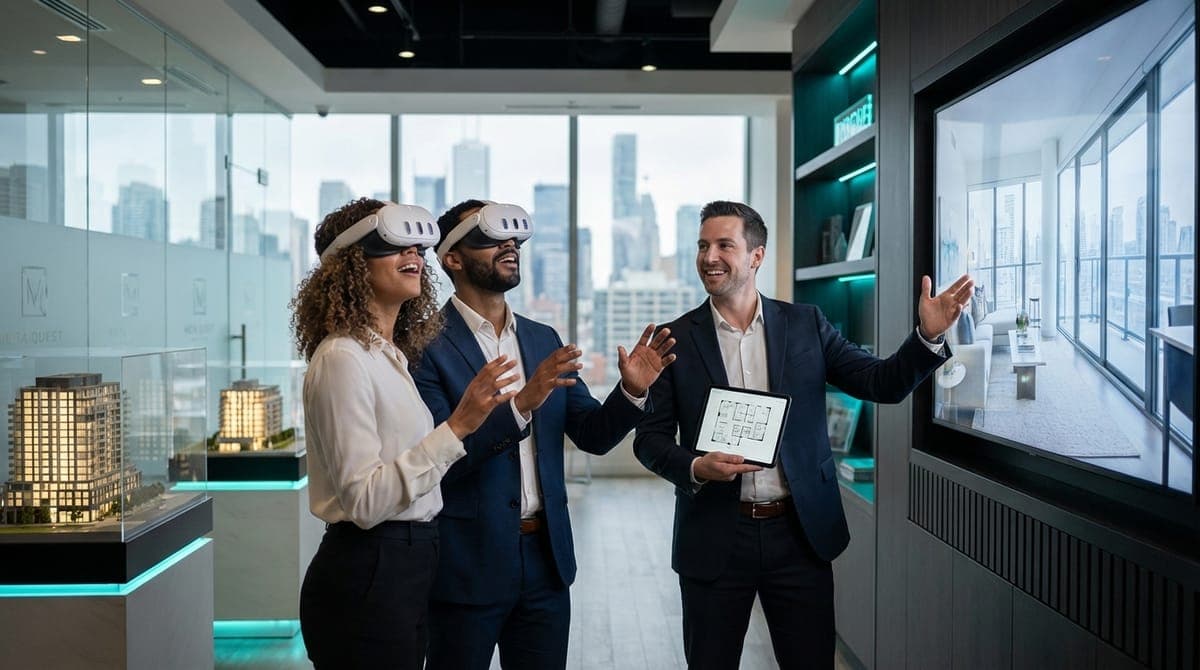
Real estate VR for selling unbuilt condos in Toronto is the strategy of using mobile Virtual Reality headsets to transport potential buyers inside a property that doesn't exist yet, bypassing the emotional disconnect of 2D floor plans. By allowing clients to walk through a 1:1 scale model of a unit, developers can create a sense of psychological ownership and spatial awareness that significantly increases conversion rates for pre-construction sales.
But simply buying a headset isn't a strategy. It's just hardware. To actually move units, you need an operational plan that accounts for human psychology, hygiene, and technical limitations.
The Blueprint Problem: Why Imagination Kills the Sale
I have stood in the corner of over 200 events across the GTA, watching people react to Virtual Reality. Whether it's a nervous CEO at a holiday party or a skeptical investor at a trade show, the reaction is always the same: until the headset goes on, they don't get it.
In the Toronto real estate market, you are asking buyers to drop nearly a million dollars based on a glossy brochure and a miniature plastic model sitting under glass. That is a massive ask. I’ve seen couples argue over room dimensions in sales centers in Liberty Village because they simply couldn't visualize what 700 square feet feels like. One thinks it’s a closet; the other thinks it’s a ballroom.
This is where the "Presentation Centre" model fails. It relies entirely on the buyer's imagination. And frankly, most people have terrible imaginations. They look at a blueprint and see lines, not a life.
When we bring mobile VR experiences to a launch event, we aren't just showing a video. We are putting the client inside the living room. We are letting them walk to the window and see the view. We are closing the gap between "concept" and "keys in hand."
The Strategic Advantage of Real Estate VR Selling Unbuilt Condos in Toronto
Why is this specific to our market? Because Toronto buyers are fatigued. They have attended dozens of launch events. They are cynical about square footage claims. By deploying high-end mobile VR, you aren't just showing a unit; you are demonstrating innovation.
However, the execution matters. Many developers mistake "Virtual Reality" for "360-degree video." These are not the same thing, and knowing the difference will save you thousands of dollars and countless headaches.
360 Video vs. 6DOF: The Difference Between Looking and Living
360 Video (3DOF): This is what most budget-conscious firms use. The user puts on a headset and is stuck in a static bubble. They can look left, right, up, and down, but they cannot move. If they try to lean forward to inspect the granite countertop, the entire world moves with them. It feels artificial and frequently induces motion sickness (nausea) because the visual input (movement) disagrees with the inner ear (stationery).
Six Degrees of Freedom (6DOF): This is the standard we use at VRPlayin with the Meta Quest 3. In a 6DOF environment, the user can physically walk around the room. They can crouch down to look at the baseboards. They can lean over the balcony railing. This is crucial for "Real Estate VR Selling Unbuilt Condos Toronto" campaigns because it mimics actual human movement. When a client walks three steps physically, they move three steps virtually. This eliminates nausea and creates "Presence"—the neurological trick that convinces the brain they are actually there.
The "Trojan Horse" Strategy: Using Games to Drive Foot Traffic
Here is the reality of running a booth at the Enercare Centre or a pop-up at the Metro Toronto Convention Centre: people are bored. They have seen fifty kiosks with the same pop-up banners and the same bowls of mints. If you just have a sign that says "View Condo VR Tour," you will get the serious buyers, sure. But you will miss the crowd.
The most successful real estate activations I’ve managed didn't start with the condo. They started with energy. We use what I call the "Trojan Horse" strategy. We set up four stations. Two are dedicated to your architectural visualization (the sales tool). The other two? They are pure adrenaline.
We typically deploy Beat Saber for this. It is the world's most popular VR game for a reason. Guests slash blocks to the beat of the music. It is high energy, medium intensity, and incredibly loud visually. When someone is playing Beat Saber, a crowd forms. People stop to watch. They laugh. The energy in your booth spikes.
This creates "Dwell Time." In event marketing, dwell time is the primary KPI. The longer they stand at your booth watching someone play a game, the more chances your sales team has to strike up a conversation. Once they are in the booth, laughing and holding a headset, the transition is seamless. "That was fun, right? Want to see what the penthouse looks like?" You have already broken the ice. You have already overcome the friction of putting the headset on. Now you just switch the content.
The Family Factor: Distraction as a Sales Tactic
For family-oriented developments—think townhomes in Markham or Vaughan—we use Acron: Attack of the Squirrels!. This is an asymmetric multiplayer game where one person is in VR (as a tree) and up to eight people play on their phones (as squirrels). This is gold for keeping a family occupied. The kids are screaming with laughter trying to steal acorns, while the parents have 10 uninterrupted minutes to talk serious numbers with your agents. It turns a chaotic family outing into a controlled sales environment.
Logistics of Luxury: Medical-Grade Hygiene is Non-Negotiable
I cannot stress this enough: you cannot sell a luxury product with dirty equipment. If you are selling a $1.5 million pre-construction condo in Yorkville, you cannot hand a client a headset that feels sweaty or looks greasy. It immediately devalues your brand.
In my experience running 200+ events, hygiene is the number one objection from high-net-worth individuals. They do not want to put something on their face that a stranger just wore.
At VRPlayin, we treat this like a clinical procedure. We do not use the stock foam facial interfaces that come with the headsets; they act like sponges for sweat and makeup. Instead, we retrofit every unit with medical-grade silicone face covers.
Our Protocol:
1. Removal: Between every single user, the headset is wiped down.
2. Sanitization: We use hospital-grade, alcohol-free antibacterial wipes. (Alcohol wipes damage the lenses over time, causing blurriness—a rookie mistake).
3. UV-C Treatment: For prolonged events, we utilize UV-C cleaning boxes for controllers.
4. The Performance: We clean the device in front of the guest. When a potential buyer sees me vigorously cleaning the device before offering it to them, their posture changes. They relax. They feel taken care of.
We recently supported a gala at The Carlu where the dress code was black tie. We had 300 guests. Because our hygiene protocol was visible and rigorous, we had women in full makeup and men in tuxedos lining up to try the experience. If we had just used a generic foam face pad? Zero chance.
The Sales Enablement Factor: Casting is King
One of the biggest mistakes I see developers make when trying to DIY their VR is forgetting about the agent. If you put a client in a headset and the agent can't see what they are seeing, the sales pitch dies. The client says, "Wow, look at this kitchen," and the agent is standing there blind, nodding awkwardly.
Our setup always includes spectator TV casting. We cast the view from the Meta Quest 3 Business Edition headset directly to a large screen TV via Chromecast or direct link. This allows your sales agent to stand next to the client and guide the tour. "If you look to your left, you'll see the quartz waterfall island we were discussing."
This turns the VR headset from a solitary isolation chamber into a shared sales tool. It also draws in bystanders who can see the gameplay or the condo interior on the screen, creating a "line-up effect." In the event world, a line creates a line. If people see others waiting, they assume it's worth waiting for.
Environmental Hazards: The Glass Wall Problem
Toronto event venues love glass. The Globe and Mail Centre, The Carlu, various hotel ballrooms—they all feature floor-to-ceiling windows. For a standard cocktail party, this is beautiful. For a VR activation, it can be a disaster if you don't know the hardware limitations.
Modern headsets like the Quest 3 use "Inside-Out Tracking." They use cameras on the headset to look at the room and calculate position. Here is the problem: Infrared (IR) light from the sun blinds these cameras. Furthermore, highly reflective glass surfaces confuse the sensors; the headset sees the reflection of the floor in the window and thinks the floor has tilted sideways. This causes the view to spin or "drift," which instantly makes your potential buyer nauseous.
An experienced operator knows to position the stations away from direct sunlight or to use darker drapes during the day. We also map the "Guardian Boundary" away from mirrors and glass. If you try to run this yourself and place the station next to a south-facing window at 2 PM, your equipment will fail. We scout these sightlines during our pre-event site visit.
Borrowing Energy from Corporate Team Building
Real estate launches can often feel stiff. There is a lot of standing around holding wine glasses. The smartest developers are now borrowing tactics from VR team building packages to inject life into these events.
We often facilitate corporate team building in Toronto, and the goal is always to break down barriers and get people talking. The same logic applies to a condo launch. You want strangers to interact. You want a buzz in the room.
For example, setting up a station with Walkabout Mini Golf creates a low-intensity social hub. It’s the gold standard for social VR. The physics are perfect, the courses are beautiful, and it allows for relaxed play. At a recent event, we had investors "playing through" a course while discussing ROI. It removes the pressure of the hard sell and builds a relationship first.
Furthermore, don't underestimate the need for internal hype. Before the public launch, consider using VR for your own internal sales kick-off. These constitute some of the most effective corporate social events we run. Getting your sales team excited about the technology ensures they are confident advocates when the doors open to the public.
Technical Reality: What You Need for a Seamless Event
If you are planning a launch, you need to know the operational constraints. I’ve seen planners try to shove a VR station into a broom closet. It doesn't work.
- Space: We need a minimum of 6.5 x 6.5 feet (2m x 2m) per standing station. If you want a 4-station setup, we need a dedicated footprint of roughly 15x15 feet to allow for safe buffers.
- Power: The Meta Quest 3 is mobile, but for an event lasting 4+ hours, we need power for our casting TVs and our charging docks. We bring extended battery straps that double the playtime, but we still cycle headsets.
- Internet: Multiplayer experiences need rock-solid internet. Venues like the Metro Toronto Convention Centre can have spotty WiFi. We assess this during planning and can bring enterprise-grade networking gear if the venue's infrastructure is shaky.
- Throughput Calculation: In a typical 3-hour event, one station can process about 20 people comfortably (assuming 5-7 minute demos and 2 minutes for hygiene/turnover). If you are expecting 500 guests and want 20% engagement, you need at least 5 stations. Do not undersupply, or you will have frustrated VIPs waiting in line.
We handle the setup, the teardown, and the technical troubleshooting. Your team doesn't need to know how to pair a controller or reset a guardian boundary. We do that. Your team just needs to sell.
Expert Insight: The "Midnight Cleaning" Reality
Here is something only an operator knows: the success of a VR event is determined in the last hour, not the first. At the beginning of the night, everyone is fresh. By hour three, the headsets are running hot, the batteries are draining, and the face pads need constant rotation.
I have personally cleaned 40 headsets at midnight after a gala, prepping them for an 8 AM start the next day. Why does this matter to you? Because when you hire a vendor, you aren't paying for the headset. You are paying for the person who knows exactly when to swap the battery so the screen doesn't go black in the middle of a client's tour. You are paying for the obsession with uptime. In 200+ events, we have maintained a 4.9-star rating because we obsess over these invisible details.
It’s not just about mobile vr team building or gaming; it's about reliability. When a client is about to sign a pre-construction agreement, technology failure is not an option.
Practical Takeaway for Developers
If you are developing your own VR content for a future launch, ask your rendering team to optimize for mobile chipsets (specifically the Snapdragon XR2 Gen 2 in the Quest 3). Many architects build massive, heavy files meant for $5,000 PC towers. Those files will stutter on a standalone headset.
To get that buttery smooth, nausea-free experience that sells condos, the content needs to be optimized for mobile from day one. If you nail the optimization, the hardware disappears, and all that's left is the dream of the home.
Ready to turn your blueprints into an experience buyers can feel? Get a custom quote for your next presentation centre opening or sales event.
Launch Your Project with Confidence
Don't let your next development launch be just another cocktail party. Differentiate your brand and engage buyers with a managed VR activation.
GET A REAL ESTATE LAUNCH QUOTE