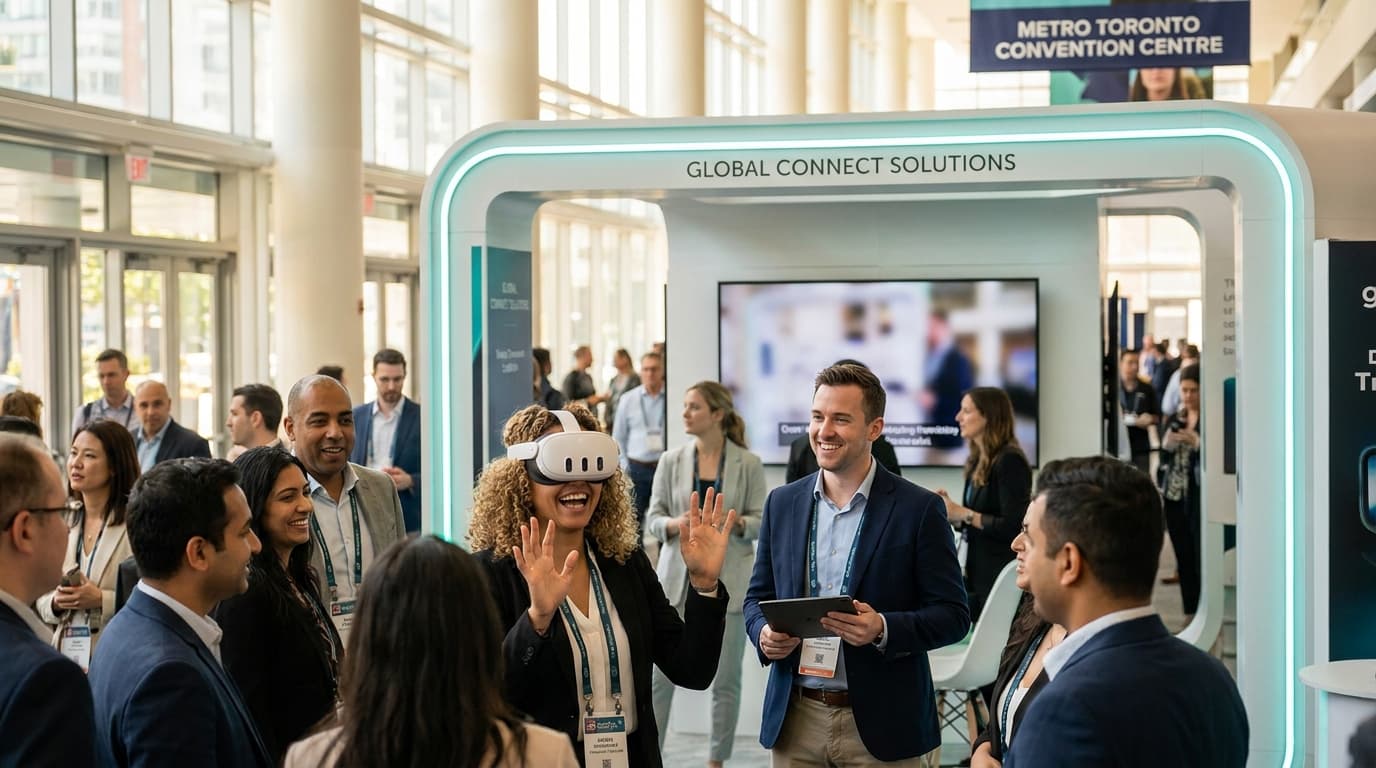
When compiling your list of questions before booking trade show booth ideas, prioritize space requirements, hygiene protocols, hardware reliability, and exact mechanics for lead capture. The right entertainment shouldn't just draw a crowd; it must facilitate qualified sales conversations for your reps on the floor.
I have spent enough time hauling pelican cases through the loading docks of the Metro Toronto Convention Centre to know exactly how most corporate booths fail. A marketing director invests $20,000 in floor space, wraps everything in expensive vinyl, and rents an espresso cart or a generic spinning prize wheel. Fast forward to 1:00 PM, and the sales team is handing out lattes to junior coordinators who just want a free caffeine fix, while the actual decision-makers walk right past.
If you want to pull senior executives out of the aisles and into a captive conversation, you need a different strategy. But execution is everything. Before you hire any vendor, you need to strip away the marketing fluff and interrogate their operational reality.
The 7 Crucial Questions Before Booking Trade Show Booth Ideas
1. How exactly do you transition a player into a qualified sales lead?
Vendors will always promise a massive crowd. But a crowd of unqualified leads blocking your booth is worse than no crowd at all. You need to ask how the vendor plans to bridge the gap between their entertainment and your sales pipeline.
We specifically engineer our trade show VR activations to create a predictable rhythm of engagement. When an attendee approaches, they shouldn't just put on a headset and disappear into their own world. We use spectator TV casting so the crowd can see exactly what the player is doing. This creates a natural bottleneck where your sales development reps (SDRs) can work the audience watching the screen.
Consider the mechanics of a high-energy game like Pistol Whip. The hook is simple: it is a cinematic rhythm shooter where you dodge bullets to an EDM beat. When a VP of Logistics takes off the headset after three minutes of ducking and weaving, their heart rate is up and their adrenaline is peaking. That physiological spike is the exact moment your SDR hands them a branded water bottle, scans their badge, and casually asks about their supply chain bottlenecks. High arousal states lead to immediate, memorable conversations.
2. What is your mathematical throughput for a 60-minute rush?
Planners constantly ask how we handle volume. If you are expecting a massive rush during the morning break after a keynote, the math has to work. Hope is not a strategy. Ask your vendor to break down their queue management.
With an average session of 2-5 minutes per turn, processing 100 people in a single hour requires military precision and at least five VR stations. Here is exactly what that 60-minute sprint looks like at a bustling booth:
- Minutes 0-15 (The Surge): Attendees flood out of a keynote. Our facilitators intercept them, instantly assessing mobility and gaming comfort. Non-gamers are directed to zero-nausea, stationary experiences.
- Minutes 15-30 (The Spectator Hook): All five stations are full. We load players into Fruit Ninja 2. The hook: Classic fruit-slicing with dual swords. Simple, satisfying, and leaderboard-competitive. A crowd of 20 people forms to watch their colleagues flail around on the spectator TVs. Your sales team works this perimeter.
- Minutes 30-45 (The Leaderboard Battle): The competitive element takes over. We track high scores on a physical whiteboard. Attendees start texting their coworkers in other halls to come beat their score, generating organic foot traffic.
- Minutes 45-60 (The Hot Swap): Batteries drain, but the crowd doesn't notice. Because our setup allows for continuous power cycling, technicians hot-swap battery straps while the player views the final score screen. The line keeps moving.
3. How do you guarantee hygiene during a 9-hour expo?
Trade show floors are hostile environments for technology, and hundreds of people sharing wearables can be a biological nightmare if handled poorly.
I have personally cleaned 40 headsets at midnight after a 300-person gala, and I can tell you that consumer foam face pads are entirely unacceptable for corporate events. They soak up sweat and ruin the experience. Ask your vendor what specific materials they use.
At VRPlayin, we use medical-grade silicone face covers that are wiped down and replaced between every single user. Our technicians run UV-C sanitization wands over all equipment and manage mandatory hand sanitizer stations before anyone touches a controller. If your vendor hesitates when you ask about their antibacterial protocol, or relies on cheap disposable paper masks that ruin immersion, find another vendor immediately.
4. What is your hardware redundancy and offline capability?
If a vendor shows up to the Enercare Centre with consumer-grade straps and no backup plan, their operation will be dead by lunch. You must ask about battery management and offline capabilities.
We run Meta Quest 3 Business Edition headsets with extended battery straps. More importantly, we bring physical backups and trained technicians who can swap hardware within minutes. Zero downtime is the baseline requirement.
Furthermore, you need to ask about connectivity. The WiFi at the Toronto Congress Centre is notoriously congested during a heavy tech expo. If a vendor relies entirely on cloud-based games, your activation will crash. While multiplayer experiences require internet, our core single-player experiences run completely offline. If you require networked leaderboards, we verify the venue's ethernet drops during planning and can deploy our own enterprise networking gear.
5. What is your strategy for non-gamers and tech skeptics?
The biggest misconception about incorporating VR into your brand activation solutions is that it only appeals to a younger, tech-heavy demographic. In reality, your most valuable interactions will often be with older executives who have never touched a gaming console.
Ask the vendor how they curate for non-gamers. You do not need to memorize complex controller layouts; if you can point, grab, and throw in real life, you can play our most popular corporate titles.
We also curate zero-nausea experiences strictly designed for corporate crowds. We use stationary gameplay with no artificial locomotion. Across our 200+ events, fewer than 2% of guests report any discomfort. Our facilitators are trained to spot early signs of hesitation and switch the user to a highly comfortable, ambient experience—like a breathtaking deep-sea diving simulation—immediately.
6. What is the exact physical footprint required for safety?
We assess your floor plan long before we arrive on site. A common mistake in evaluating interactive booth experiences is miscalculating the physical footprint. You cannot cram a dynamic VR setup into a space meant for a popup banner.
You need a minimum of 6.5 x 6.5 feet (2m x 2m) per standing, active station. This includes the safety boundary to ensure players do not punch your expensive acrylic displays, knock over your iPad stands, or accidentally hit a passing attendee.
If you only booked a standard 10x10 booth and still want to accommodate two stations plus a lead capture podium, we pivot to seated or stationary experiences. These require only 3 x 3 feet per user, allowing us to safely maximize your high-value square footage without compromising the visual draw.
7. How do you handle venue union rules and drayage?
This is the hidden killer of trade show budgets. Venues like the Metro Toronto Convention Centre operate strictly under union labor rules. If your vendor doesn't know how to navigate this, you will be hit with unexpected drayage fees and severe setup delays.
Ask if their equipment requires forklift assistance from union labor, or if it can be hand-carried. We package our entire mobile VR setup in modular, heavy-duty Pelican cases that our technicians can legally wheel in themselves as hand-carry items, bypassing exorbitant material handling fees. We also design our spectator TV stands to be assembled without power tools, strictly adhering to standard exhibitor union exemptions. A seasoned vendor saves you thousands of dollars before the exhibition doors even open.
Finalizing Your Trade Show Vendor Selection
When you are writing the checks for space on Bay Street or out in Mississauga, you cannot afford passive entertainment. The vendor you hire must understand that they are an extension of your sales operation.
Demand transparency on hygiene. Map out the precise physical footprint. Calculate the throughput based on the 2-5 minute average playtime. Ensure the content is curated to eliminate motion sickness, bypass the need for gaming skills, and sidestep costly venue union traps. By asking these seven hard operational questions upfront, you protect your investment and guarantee that your booth actually drives the high-value conversations your sales team needs to hit their revenue targets.
Turn Booth Traffic Into Qualified Leads
Stop handing out swag that ends up in the hotel trash bin. Bring a managed, high-throughput VR experience to your next expo and give your sales team the energetic crowd they actually want to talk to.
GET A CUSTOM QUOTE