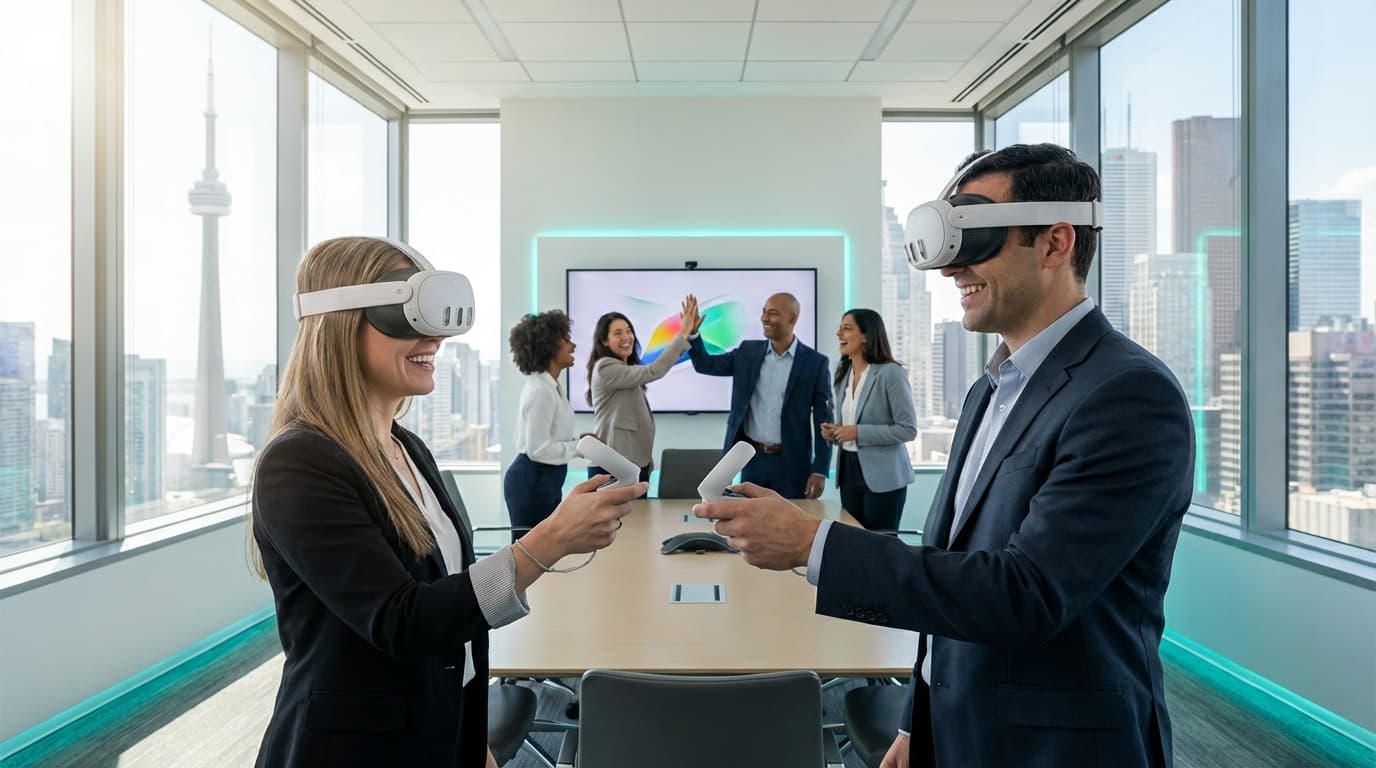
When compiling a checklist of questions before booking team building activities, Toronto planners usually miss the actual operational landmines: participation barriers, hidden space constraints, and non-player engagement. You need to know exactly how a vendor handles guests who aggressively opt out, the specific square footage required per person, and whether the activity secretly relies on extroversion.
I have watched enough HR directors nervously chew their nails while half their Bay Street accounting team actively avoids an escape room puzzle to know that corporate events run on extremely thin margins of error. You spend weeks coordinating schedules, fighting for budget approvals, and hyping up the afternoon, only to watch the skeptics cluster by the catering table while three loud extroverts dominate the entire room.
After facilitating 200+ mobile VR events across the Greater Toronto Area—from massive galas at the Fairmont Royal York to intimate law firm boardrooms—I can tell you exactly where these well-intentioned afternoons fall apart: the vendor vetting stage. If you aren't grilling your entertainment partners about execution mechanics, hardware contingencies, power draws, and audience management, you are setting yourself up for an expensive, awkward afternoon. Here is exactly what you should be asking.
Essential Questions Before Booking Team Building Activities Toronto Planners Must Ask
The standard list of "what's on the menu?" and "where do we park?" is not going to save your offsite. You are hiring an external vendor to manage human behavior, which means you need to interrogate their operational framework.
How Do You Engage the Guests Who Refuse to Participate?
The biggest flaw in standard team building ideas is the "all or nothing" participation model. If someone doesn't want to bowl, they sit on a hard plastic chair and look at their phone. If they don't want to do the ax-throwing lane, they wait at the bar.
A professional vendor should have a dedicated psychological strategy for the audience. At VRPlayin, we solve this using spectator TV casting. We don't just set up headsets; we route the live 1080p gameplay feeds directly to 50-inch monitors or your boardroom projectors. When we run an event in a MaRS Discovery District suite, the energy isn't just coming from the person in VR—it comes from the fifteen colleagues shouting directions at them from the couches.
This completely removes the pressure to participate immediately. Skeptics get to watch, laugh, and realize the experience is safe and highly controlled before they ever touch a Meta Quest 3 headset.
"I had three senior VPs who swore they 'didn't do video games' spending 45 minutes screaming directions over a virtual mini-golf tournament. The spectator setup completely changed the room's dynamic—the people watching were having just as much fun as the people playing." — Director of Culture, Bay Street Financial Firm
What Are the Exact Technical, Power, and Spatial Footprints?
Do not accept vague answers about "needing a bit of room." A vendor who doesn't respect spatial and electrical planning will bottleneck your entire event.
If you are planning mobile vr events canada, the math is rigid. We require a minimum of 6.5 x 6.5 feet (2m x 2m) per standing station to ensure complete physical safety, mapped out with digital guardian boundaries. If your venue is tight, seated or stationary experiences only require a 3 x 3 foot footprint.
But space is only half the battle. You must ask about lighting and power. Inside-out tracking headsets like the Meta Quest 3 rely on external cameras to read the room. If your venue is a glass-walled atrium flooded with direct noon sunlight, the cameras will blind. If it's a pitch-black nightclub environment, the headsets lose tracking. We require standard, even indoor lighting. For power, we don't just run off batteries; we bring high-capacity Anker power banks and require standard 15-amp circuits to run the spectator TVs and keep our charging hubs operational.
How Do You Handle Drastically Different Skill Levels?
This is where amateur operators fail. You cannot hand a complex simulation with a steep learning curve to a 55-year-old executive who hasn't played a video game since Pac-Man and expect them to enjoy it. The software must adapt instantly to the user.
When you browse our full VR game catalog, you will see we curate specifically for non-gamers. For mixed crowds, we rely heavily on Walkabout Mini Golf. Up to four players can putt through beautiful environments ranging from pirate coves to space stations. The pacing is incredibly relaxed, making it perfect for networking, and the mechanics require zero gaming skill—you literally just point the controller, grip, and swing.
For deep team building, we deploy Keep Talking and Nobody Explodes. This is an asymmetric communication game: one person is in VR looking at a ticking time bomb, while their colleagues are outside of VR frantically flipping through a physical, printed manual to shout defusal instructions. It forces active listening, clear communication, and immediate trust.
For the adrenaline-seeking sales team, we pivot to Pistol Whip. It is a cinematic, high-intensity rhythm shooter where the player gets to feel like John Wick, dodging obstacles to an EDM beat. It requires no button memorization, just physical movement, making it a massive crowd-pleaser that looks incredible on the spectator monitors.
Expert Insight: I have personally cleaned 40 headsets at midnight after a 300-person gala, and I'll tell you the secret to a packed floor isn't the hardware—it's the facilitation. A good technician watches a nervous attendee hesitate, immediately loads up a low-intensity, stationary experience like a virtual nature walk, and gets them comfortable within twenty seconds. When the junior developers want adrenaline, we instantly pivot them into a multiplayer shooter. Our average session length is curated to 3-5 minutes per turn, keeping the line moving fast and energy high across an average group size of 25-40 guests.
Comparison Table: Evaluating Corporate Event Formats
When comparing your options, look at the structural differences in how the event is managed. With a 40% repeat booking rate, we see clients abandon traditional offsites for managed mobile VR because of these exact operational differences.
| Event Factor | Traditional Offsite (Escape Rooms / Courses) | Mobile VR Team Building |
|---|---|---|
| Cost Structure | Per-head pricing. Unused tickets for no-shows are lost budget. | Tiered packages by time/stations. Bob calls in sick? Everyone else gets more playtime. |
| Staffing & Facilitation | Minimal guidance after an initial 5-minute rules brief. Often leads to self-directed frustration. | Active facilitation. Techs physically guide users, load games, and coach gameplay the entire time. |
| Risk Factors | High physical requirements. Often requires expensive bus transport and liability waivers. | Stationary gameplay options. Zero travel required (we build the arena in your office). |
| Spectator Value | Zero. If you aren't playing, you're sitting in a lobby waiting. | High. Gameplay is cast to TVs, turning the activity into a live spectator sport for the whole room. |
What is the Vendor's Protocol for Hygiene and Physical Comfort?
If a vendor cannot immediately detail their sanitization process, end the conversation and hang up the phone. We use Meta Quest 3 Business Edition hardware fitted with medical-grade silicone face covers. These covers are aggressively wiped down with antibacterial wipes between every single user. For full resets, we utilize Cleanbox UV-C sanitization technology for the equipment and provide dedicated hand sanitizer stations. We treat hygiene as a medical protocol, not a casual afterthought.
You also need to ask about the physical comfort of the attendees. Motion sickness is a common fear, but the reality is dictated entirely by the software chosen by the operator. We strictly curate zero-nausea experiences for corporate environments, focusing on 1:1 room-scale movement or stationary gameplay without artificial locomotion (meaning you don't "walk" with a joystick). Across over 200 events, fewer than 2% of our guests report any discomfort. If someone does feel off, our trained facilitators spot the early signs, remove the headset, and offer a seated, comfortable alternative.
Hidden Fees: Are We Paying for Empty Seats or Idle Time?
The final operational question revolves around the financial structure of the event. Traditional venues operate on a strict per-head model. If you book an ax-throwing lane for 30 people and flu season wipes out 8 of your attendees, you are still paying for those 8 empty spots. That is wasted corporate budget.
Mobile VR events should operate on a block-time and station-rental model. When you hire VRPlayin, you are renting the hardware, the footprint, and the expert facilitators for a set duration (e.g., a 4-station setup for 3 hours). If 40 people show up, we rotate them through quickly. If 25 people show up, they just get longer sessions and more turns. Your ROI remains identical, and you never pay an "absentee tax." Ask your vendor exactly how no-shows impact the final invoice.
Do Not Book an Event Without Operational Clarity
Your team's time is incredibly expensive. Pulling 40 professionals out of their daily workflow to participate in a mandatory activity is an investment of thousands of payroll dollars before you even pay the entertainment vendor. You cannot afford to hope the event runs smoothly on the day of.
Ask the hard questions about square footage, network contingencies, spectator inclusion, UV-C hygiene protocols, and non-gamer accessibility. Force vendors to explain exactly how they will handle the quiet employee in the back of the room who absolutely doesn't want to play. If they don't have a confident, documented answer for that specific person, they do not have the experience required to run your corporate event.
If you want a vendor who manages every technical detail—from the 15-amp power draws to sanitization to dynamic crowd facilitation—so you can actually enjoy the event yourself with a drink in your hand, our VR team building packages offer the most reliable, inclusive format available today. Do your research, vet your partners strictly, and ensure your next corporate afternoon actually builds trust instead of awkwardness.
Bring Managed Mobile VR to Your Next Toronto Team Offsite
Stop worrying about who will and won't participate. Let our experienced facilitators turn your boardroom or event space into a high-energy, fully inclusive VR experience. We handle the setup, hygiene, and game curation—you get the credit for an amazing afternoon.
SEE TEAM BUILDING PACKAGES