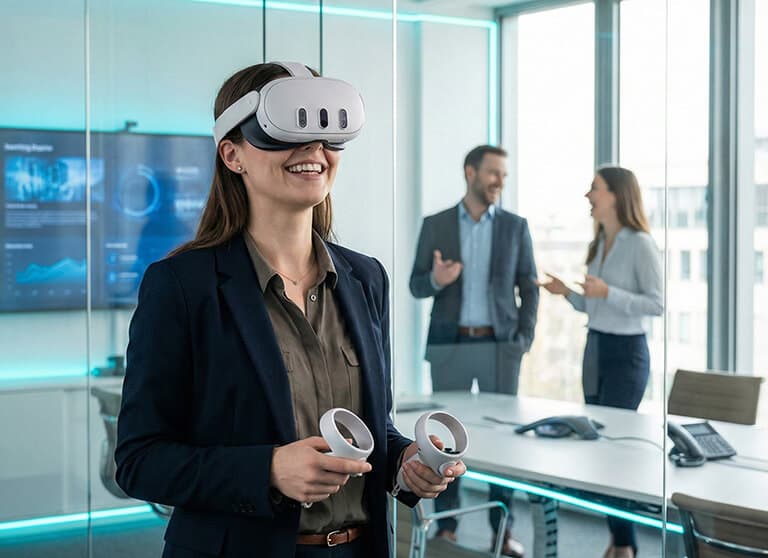
Picture this: you're planning a team event for 40 people at your Financial District office. Someone suggests a VR arcade. Sounds fun — until you start working out the logistics. Which arcade fits 40 people at once? (Most don't.) How do you get everyone there during lunch? (You don't — you lose the whole afternoon.) What about the three people who drove to work and now need parking downtown? And the two remote employees coming from Mississauga?
We've been on the other side of this equation for 200+ events across Toronto, and the honest truth is: dragging a team to a VR venue creates more problems than it solves. Here's the full breakdown of mobile VR versus visiting an arcade — including the tradeoffs most people don't think about until it's too late.
The Side-by-Side Comparison
| Factor | VR Arcade Visit | Mobile VR (We Come to You) | |---|---|---| | Logistics | Coordinate transportation, parking, arrival times for everyone | Zero travel — we set up in your existing space | | Capacity | Most arcades cap at 10-15 simultaneous players | We scale stations to your group size | | Privacy | Shared space with other customers | Fully private, your team only | | Branding | Their space, their logo, their aesthetic | Add your branding, theme, or company colours | | Duration Control | Fixed time slots (usually 60 min) | Flexible — run as long as you need (typically 2-3 hours) | | Game Selection | Whatever they have installed | Custom lineup from 24+ curated experiences | | Hygiene Standards | Varies by venue | Medical-grade silicone covers swapped between every user, UV-C sanitization | | Staff | General employees, shared across groups | Dedicated trained facilitators for your event only | | Spectator Engagement | Limited — others wait their turn | Large TV screens casting VR view, smartphone-based multiplayer | | Equipment Reliability | Hope for the best | We bring backup equipment to every event — zero downtime |
The table tells part of the story. The rest is in the details.
The Real Cost of "Just Going to an Arcade"
Let's run the numbers for a 40-person team in Toronto.
The Arcade Route
- Admission: $40-60 per person × 40 = $1,600 - $2,400
- Transportation: Ubers/taxis from office to venue for those who didn't drive = $15-30 per person for roughly half the group = $300 - $600
- Parking: For those who drove, downtown Toronto parking runs $20-30 = $100 - $150
- Lost productivity: Travel time (30 min each way minimum) + waiting for stragglers + the inevitable "where are you?" texts = 1-2 hours of billable time per person
- Food/drinks: Most arcades have a bar or snack counter with event markup = $400 - $800
Total: $2,400 - $3,950 plus the productivity loss, which for a 40-person team at even modest billing rates, easily adds another $2,000-$4,000 in opportunity cost.
The Mobile VR Route
- Flat-rate package: Includes all equipment, setup, facilitators, teardown, and custom game lineup
- Transportation: Zero — we come to you
- Parking: Zero — that's our problem, not yours
- Lost productivity: Zero travel time — the event happens where your team already is
- Food/drinks: Order from your preferred caterer to your own space at normal rates
Pro tip: If budget is a concern, compare the total cost — not just the per-person ticket price. Once you factor in transportation, parking, and lost work time, mobile VR is frequently the same price or less than an arcade visit. And your team keeps those two hours.
The Logistics Nobody Thinks About (Until It's Too Late)
We've fielded hundreds of calls from event planners who initially wanted to book a VR arcade and then switched to mobile after realizing the logistics. Here are the issues that come up most:
Getting 40 People to the Same Place at the Same Time
This sounds simple. It isn't. Your team is scattered across the Financial District, King West, and Liberty Village. Some work from home. Some drove from Markham or Vaughan. The "let's all meet at the arcade at 2pm" plan turns into a 45-minute window of people arriving in waves while the early arrivals stand around.
With mobile VR, your team walks from their desk to the boardroom. Event starts on time. Every time.
The Capacity Problem
Most Toronto VR arcades have 6-10 stations. Your 40-person team can't all play simultaneously. At best, you're looking at groups of 6 waiting 30-40 minutes between turns. That's a lot of dead time in a space that probably doesn't have great seating or activities for the people waiting.
We bring enough stations and game variety to keep everyone engaged simultaneously. Acron: Attack of the Squirrels puts 9 people in one game (1 VR player + 8 on phones). Cook-Out runs 4 players at a time with quick 5-minute rotations. Spectator TV casting means even the people between turns are watching and cheering.
The Venue Compatibility Question
Not every space works for VR, and arcades have already solved this. Fair point. But the space requirements for mobile VR are more modest than most people expect:
- Standing station: 6.5 × 6.5 feet (2m × 2m) per player
- Seated/stationary games: 3 × 3 feet per player
- Power: Standard wall outlets
- Internet: Only needed for multiplayer; single-player games run offline
A standard boardroom for 20 people can comfortably fit 3-4 VR stations. A larger event hall handles 6-8. We assess your space during the planning call and recommend the optimal layout. Check our FAQ for detailed space requirements.
"But Is the Hardware Actually the Same?"
Yes. We use the Meta Quest 3 Business Edition — the same commercial-grade hardware used in premium VR arcades. Business Edition means enterprise device management (fast user switching, centralized control), extended battery straps for uninterrupted gameplay, and higher-spec lenses than consumer models.
We also bring high-performance gaming PCs for select tethered experiences when the event calls for it. The hardware isn't a compromise — it's the same kit (or better) as what you'd find at a dedicated venue.
Pro tip: Ask any VR arcade what headset they're running. If it's older than Meta Quest 3, you're actually getting better hardware with a mobile provider than you would at their location. The VR hardware cycle moves fast, and not every arcade keeps up.
Brand Control and Privacy
Here's something that matters more than people initially realize: at a VR arcade, you're a guest in someone else's space. Their branding is on the walls. Their music is playing. Other groups might be in the next room. Your company holiday party happens against a backdrop of neon signage and someone else's logo.
Mobile VR is your event, in your space, with your rules. We've done events where companies:
- Added their logo to the welcome display
- Themed the game selection around a product launch
- Set up the VR stations alongside their own catering and decor
- Ran the event as part of a larger conference agenda
For corporate social events and VR team building packages, this control over the environment makes a meaningful difference in how the event feels and how your brand is perceived.
Privacy is the other factor. Your team event is private. No strangers walking through. No competing groups being loud in the next bay. No one outside the company sees your CFO flailing at virtual sandwiches. What happens in VR stays in VR.
The Honest Tradeoffs
We'd be doing you a disservice if we pretended mobile VR is better in every single way. Here's where arcades have a genuine edge:
- Walk-in readiness: An arcade is already set up. No setup time needed. For very small groups (under 8), a quick arcade visit can be simpler.
- Purpose-built space: Arcades are designed for VR — optimal lighting, tuned play areas, sound systems. Your boardroom might have fluorescent lights and a low ceiling.
- Variety of high-end setups: Some arcades have racing simulators, haptic vests, or full-body tracking that a mobile provider can't replicate.
For small, casual outings — a team of 5-6 grabbing lunch and playing VR for an hour — an arcade can be the right call. The math shifts when you hit 15+ people, need a private experience, or want the event at a specific location.
A Real-World Comparison: Two Teams, Two Approaches
Last November, two Toronto companies each planned VR events for ~35 people during the same week.
Team A booked a popular VR arcade on King West. They reserved a 90-minute block. Fourteen people arrived on time; the rest trickled in over 20 minutes. The arcade had 8 stations shared with another group in the adjacent area. Each person got roughly 15 minutes of play time. The event coordinator spent most of the session managing logistics. Total cost including transportation: approximately $2,800.
Team B booked mobile VR in their Bay Street boardroom. We arrived 75 minutes early and set up 4 VR stations plus a spectator TV. The team walked in at 2pm. By 2:05, twelve people were actively playing (4 in VR headsets, 8 on phones via Acron). We ran for 2.5 hours with continuous rotations managed by our facilitators. The coordinator spent the event participating, not managing. Total cost: comparable to Team A, with zero transportation expenses.
The VP of People & Culture from Team B called us the following week to book their Q1 event: "We've booked VRPlayin three times now. Each event, they bring something new and the team loves it."
What the Setup and Teardown Actually Looks Like
This is the part people worry about — will our office be disrupted? Here's the reality:
Before your event:
- Our crew arrives 60-90 minutes before the scheduled start
- We set up all VR stations, TV screens, sanitization stations, and signage
- Quick space check and equipment testing
- We brief any on-site coordinators on the flow
During your event:
- Trained facilitators manage all rotations, headset handoffs, and troubleshooting
- Medical-grade silicone face covers are replaced between every user — no exceptions
- Backup equipment is on-site and ready for immediate swap if anything hiccups
- We handle everything; you participate
After your event:
- Full teardown in 30-45 minutes
- All equipment packed and removed
- Your space returned to its original state
We've set up in venues ranging from 54th-floor boardrooms overlooking Bay Street to warehouse lofts in Liberty Village to the grand ballroom at the Fairmont Royal York. If the space has a power outlet and enough room to swing your arms, we can make it work.
Pro tip: Book your event for mid-afternoon (2-4pm) if possible. It avoids the lunch rush, gives us a clean setup window in the morning, and means your team ends the workday on a high note rather than trying to refocus after lunch.
How to Decide: Arcade or Mobile?
Use this quick framework:
Go to an arcade if:
- Your group is under 10 people
- You want a casual, no-planning-required outing
- You specifically want experiences that require fixed installations (racing rigs, full-body tracking)
Book mobile VR if:
- Your group is 15+ people
- You need a private, branded experience
- You want the event at your location (office, venue, conference)
- You need flexible timing (more than a 60-minute slot)
- You don't want to deal with transportation logistics
For most corporate events, team builders, and office parties in the 20-60 person range, mobile VR is the clear winner. You get better engagement, zero logistics headache, full brand control, and your team doesn't lose two hours of their day getting there and back.
Browse our full VR game catalog to see what your group could be playing, or get a custom quote and we'll plan the whole thing for you.
Ready to Upgrade Your Office Party?
Get a quote for a Mobile VR Activation today and see how easy it is to transform your space.
GET MY CUSTOM QUOTE