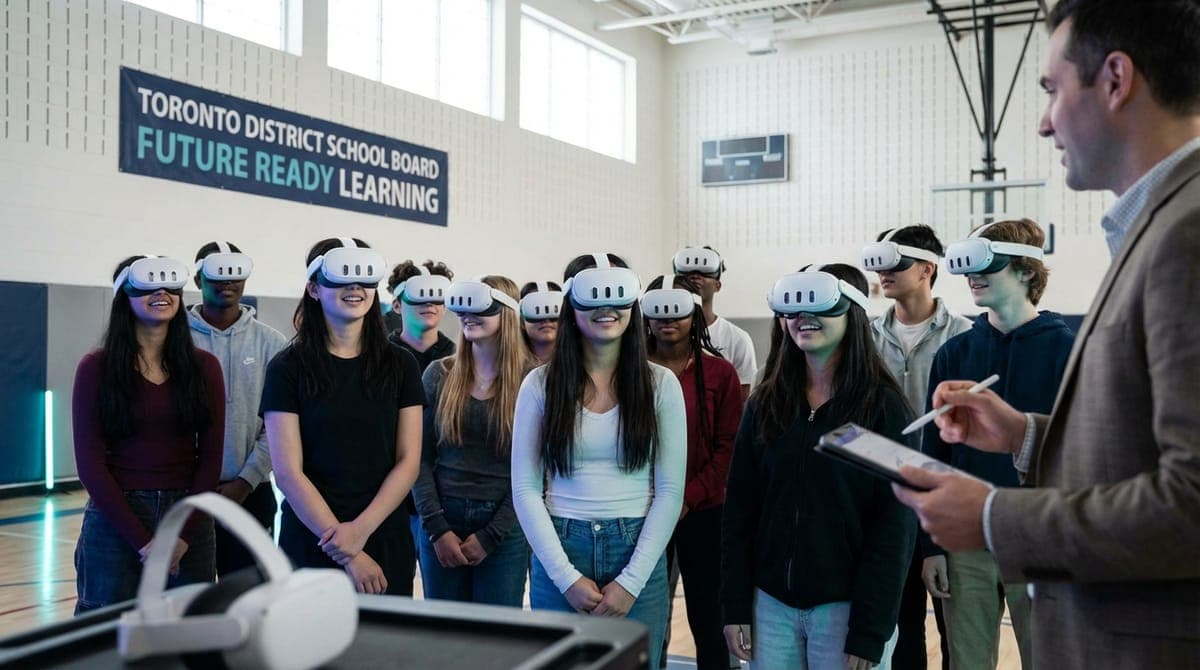
Organizing field trips without bus? Mobile VR for Toronto schools represents the most efficient way to deliver high-impact experiential learning directly to your gymnasium or library. This model eliminates transportation costs and logistical headaches instantly. By bringing the technology to you, we turn any 6.5 x 6.5-foot space into a virtual destination, ensuring 100% participation with zero travel time.
Field Trips Without Bus, Mobile VR, and Toronto Schools vs. The Logistics Nightmare
I have organized over 200 events across the GTA, from high-stakes product launches at the Metro Toronto Convention Centre to rowdy holiday parties in Liberty Village. But if there is one group that stresses over logistics more than a corporate event planner, it’s a school administrator.
You want to give the students a memorable experience, but reality hits hard: the cost of bus rentals, the struggle to get parent volunteers, the mountain of permission slips, and the paralyzing fear of getting stuck in traffic on the Don Valley Parkway while 30 teenagers get restless.
We built our mobile model specifically to kill that pain point. We don’t ask you to come to a facility. We bring the facility to you. We load in 60-90 minutes before the first bell rings, set up our enterprise-grade networking gear, sanitize every inch of hardware, and are ready to roll the moment the students walk in.
Whether it’s a reward day for the Grade 8 graduating class or a stress-buster for the faculty during a PD day, the principle is the same as our corporate social events: maximum engagement, minimum friction.
Safety First: Medical-Grade Hygiene in the Gym
In a post-2020 world, putting a device on your face that someone else just wore sounds terrifying to some people. As someone who has personally cleaned 40 headsets at midnight after a 300-person gala, I take this seriously.
When we bring VR to a school, we don't just wipe things down with a damp cloth. We use the exact same protocol we use for our high-end corporate clients in the Financial District:
- Medical-Grade Silicone: The interface that touches the face is non-porous silicone, which is replaced or thoroughly sanitized between every single user.
- UV-C Sanitization: We utilize UV-C light technology to disinfect equipment.
- The "2% Rule": In our data from 200+ events, fewer than 2% of guests report motion sickness. Why? Because we curate the content. We don’t put first-timers in roller coasters. We put them in stationary, 1:1 movement experiences that trick the brain comfortably.
Your school nurse will be happier with our hygiene station than they are with the cafeteria.
The Content: It’s Not Just "Video Games"
When we discuss field trips without bus mobile vr toronto schools, the immediate assumption is often that we’re just letting kids play zombies for an hour. While zombie survival is an option (and a popular one), the mechanics of modern VR offer incredible opportunities for teamwork, spatial reasoning, and social interaction.
Here are the specific experiences that consistently work for student groups and faculty teams alike:
1. The Equalizer: Acron: Attack of the Squirrels!
Intensity: Medium | Players: 1 VR + 8 Mobile Devices
This is the secret weapon for large groups. Usually, VR is isolating—one person in the headset, everyone else watching. Acron flips that.
One player is in the VR headset playing as a giant, sentient tree. Their job is to protect their acorns. Up to eight other students join the game using their own smartphones or tablets (or devices we provide) as squirrels. The squirrels have to work together to outsmart the tree.
I’ve seen quiet students who usually sit on the bleachers suddenly taking charge as the "lead squirrel," shouting strategy to their classmates to flank the VR player. It turns a solo station into a 9-person team activity. It’s better than dodgeball because nobody gets hit in the face.
2. The Energy Burner: Beat Saber
Intensity: Medium | Players: 1 per station (Spectator friendly)
You can’t talk about VR without Beat Saber. It is the world’s most popular VR game for a reason. Players slash glowing blocks to the beat of the music using dual lightsabers. It sounds simple, but it is incredibly satisfying and gets the heart rate up immediately.
For schools, we set up spectator casting. We bring large screens so everyone waiting in line can see exactly what the player is seeing. It turns the gameplay into a performance. We often run "high score tournaments" throughout the day. It’s competitive, active, and requires zero prior gaming knowledge.
3. The Social Hub: Walkabout Mini Golf
Intensity: Low | Players: 1-4 per group
This is the gold standard for social VR. If you have a Student Council or a small group of student leaders, this is where they bond. The physics are perfect—it feels exactly like real mini-golf—but the courses are set in pirate coves, space stations, and gothic castles.
It’s low stakes. The pace allows for conversation. It’s effectively a digital version of the networking we see when we run VR team building packages for banks, but applied to student leadership groups.
Faculty & Staff: Why Teachers Need This More Than Students
We often get booked for the students, but the most surprising feedback comes from the staff. Teaching is high-stress. We’ve all seen the statistics on burnout.
While we specialize in corporate team building in Toronto, the mechanics of engagement are identical for school faculty. We recently ran an event for a teaching staff in Mississauga during a PD day. The Principal was skeptical—he thought it was just "toys."
Thirty minutes in, that same Principal was playing Space Pirate Trainer, dodging lasers and laughing harder than he probably had all semester. His Vice Principal told me afterward, "I haven’t seen him smile like that since September."
Employee engagement activities aren't just for tech startups in King West. Investing in a couple of hours of VR for your staff provides a genuine mental break that a standard lunch catering platter just can’t achieve. It’s active recovery.
Space & Technical Requirements (It’s Easier Than You Think)
I’ve set up in the basement of the Fairmont Royal York and in cramped breakrooms in Scarborough. Schools actually offer some of the best venues for mobile VR because you have space.
To run a successful "field trip" on-site, here is the reality of what we need:
- Space: We need 6.5 x 6.5 feet (2m x 2m) of clear space per standing station. A standard basketball court can easily accommodate a large-scale setup with 10+ stations while leaving plenty of room for spectators.
- Power: Standard wall outlets. We bring the extension cords and power bars.
- Internet: This is the big one. School WiFi can be restrictive. Firewalls often block gaming servers. That is why we discuss this during the planning phase. If your IT department can’t whitelist our devices, we bring our own enterprise-grade networking gear to create a local loop or dedicated hotspot. We don’t rely on hope; we rely on hardware.
- Flow: For a group of 30 students, we typically run 4-6 stations. With a rotation time of 5-8 minutes per turn, everyone gets multiple tries within an hour. We manage the queue, the hygiene, and the technical support. The teachers just need to supervise behavior—we handle the tech.
The Economics of Staying Put
Let’s look at the numbers. If you are planning a trip to a venue like the Rec Room or a science center for 50 students:
- Bus rental: $400 - $800+
- Admission tickets: $20 - $30 per student
- Travel time: 2 hours lost
- Admin time: 10+ hours
When you book a mobile VR experience, you are paying for the service, not the transit. The budget goes 100% toward the activity. Plus, we can cycle through larger groups. In a 3-hour session, we can easily rotate through 60-80 students if the flow is managed correctly.
This brings the "cost per engaged minute" down significantly compared to external venues where students might spend half the time waiting in line or eating lunch.
Bringing "Bay Street" Quality to the Classroom
There is a difference between buying a couple of consumer headsets for the AV club and hiring a professional activation company. When you hire VRPlayin, you are getting the same hardware—Meta Quest 3 Business Edition with extended battery straps—that we use for full VR game catalog showcases at major trade shows.
You are getting facilitators who know how to troubleshoot a controller pairing issue in 30 seconds flat because they’ve done it a thousand times. You are getting a team that knows how to talk to a hesitant user and make them feel like a pro within 60 seconds.
We recently did an event at a community center near Yorkdale. A parent came up to me and said, "My son usually hates these group activities, he gets anxious. I’ve never seen him high-five so many people." That’s the power of mobile vr team building—it levels the playing field. In VR, physical stature or social hierarchy doesn't matter. It only matters if you can slash the beat or sink the putt.
Practical Takeaway
If you are a teacher, admin, or parent council member looking to plan the next event, start by auditing your space. If you have a gym, a cafeteria, or even a wide hallway, you have a VR venue. Measure out a few 8x8 squares. If they fit, we fit.
Don’t default to the bus because "that’s what we always do." The bus is a vehicle, not an experience. Bring the experience to you.
If you’re ready to see how this would look in your specific school layout, get a custom quote and let’s map out a floor plan that works.
Bring the Field Trip to Your Gym
Save the bus budget and maximize engagement. We handle the setup, hygiene, and facilitation for a seamless school event.
GET A CUSTOM EVENT QUOTE