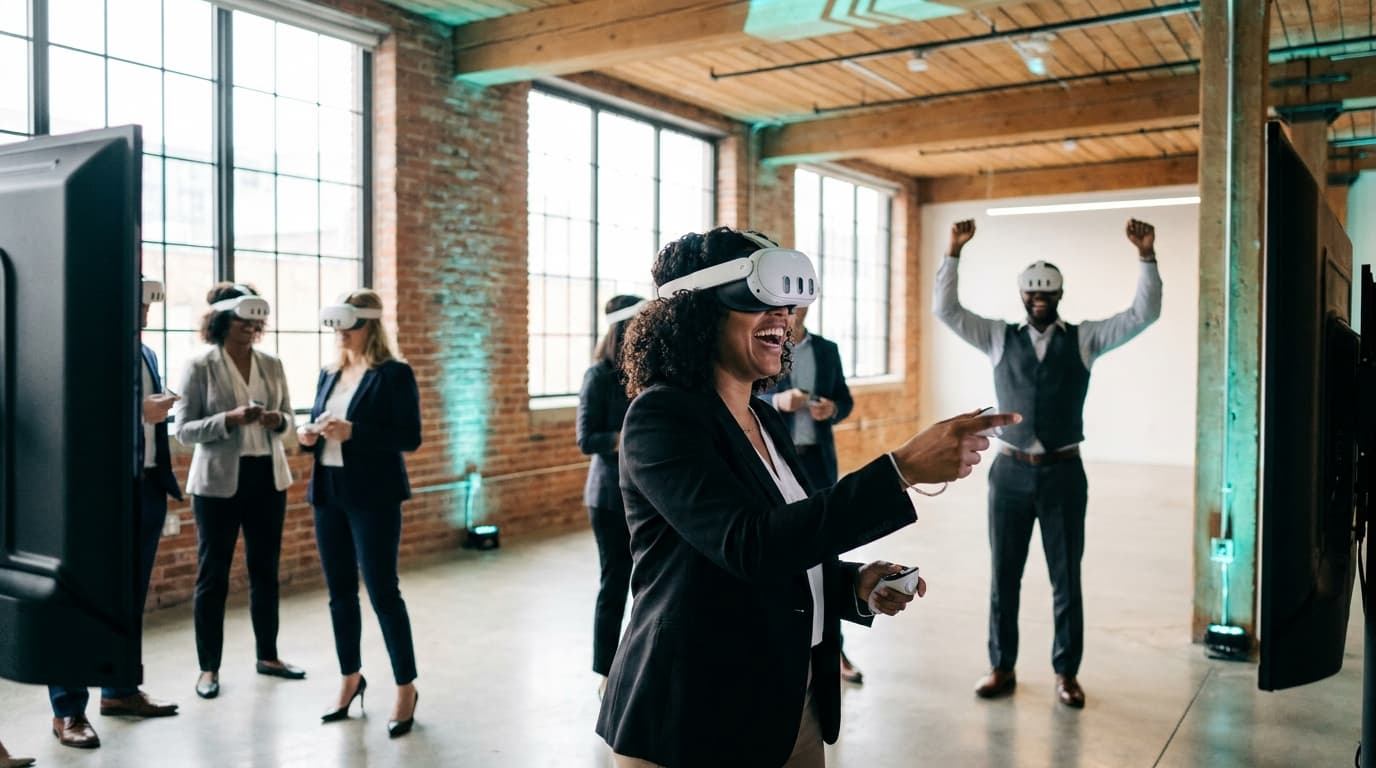
An event entertainment planning checklist for small groups must prioritize space mapping, pacing, and frictionless participation. For groups of 20 to 50 guests, you need to map exact square footage per activity, assign specific stakeholder roles, and choose entertainment that encourages quick two-to-five minute rotations to prevent social bottlenecks.
A 300-person gala is mostly crowd control. You open the doors, point people toward the bar, and let the sheer volume of attendees generate energy. But a 30-person corporate social in a King West loft? That requires surgical precision. In a small group, awkwardness has nowhere to hide. If the entertainment flops, or if there is a 20-minute gap where nobody knows what they are supposed to be doing, the entire room feels it. I have run over 200 VR events across Toronto, and the hardest environments are rarely the massive trade show floors at the Enercare Centre. The real test of an operator is the intimate off-site where half the team actively avoids group activities and the CEO is nervously hovering by the catering station.
Here is the exact blueprint we use to sequence and execute entertainment for 20 to 50 guests without a single awkward silence.
Space and Power: The Foundation of Your Event Entertainment Planning Checklist for Small Groups
Never trust a venue floor plan without measuring it yourself. What looks like a massive corner boardroom in the MaRS Discovery District shrinks rapidly once you add catering tables, coat racks, and 35 human beings.
When building out your event logistics, map out the literal footprint of your entertainment first, because it dictates the flow of the entire room. For our mobile VR setups using Meta Quest 3 hardware, we require a minimum of 6.5 x 6.5 feet (2m x 2m) per standing station to ensure physical safety and properly trigger the headset's Guardian boundary systems. Seated experiences require 3 x 3 feet. You also need to factor in buffer zones for 50-inch spectator TVs. Watching coworkers blindly flail at virtual objects is a massive part of the entertainment value, so you want to position the TVs where a small crowd can gather without blocking high-traffic paths to the bar or exits. Furthermore, lighting matters: inside-out headset tracking fails in pitch-black rooms and direct sunlight, so we require ambient, even indoor lighting.
Power draw is the other silent killer of small events. Do not run three catering warmers and a four-station VR entertainment rig on the same 15-amp circuit in an older Yorkville event space. You will trip the breaker mid-event. We require dedicated power circuits and schedule 60 to 90 minutes for setup before the first guest even walks through the door. This window is specifically to test power stability, calibrate floor tracking levels, and run internet failovers. If an experience requires Wi-Fi, we confirm venue network restrictions—like strict corporate firewalls—weeks in advance and bring our own 5G enterprise networking gear as a backup.
Curating Event Planning Ideas for the "Non-Gamer" Majority
Small group entertainment lives and dies by participation rates. If you pitch complex, high-skill activities as your primary event planning ideas, you will instantly lose the introverts and the skeptics. You have to lower the barrier to entry so far that saying "no" feels silly.
This is why we specifically curate our full VR game catalog for non-gamers. In a group of 40 corporate employees, maybe five are hardcore console gamers. The rest need instant, intuitive gratification. I routinely watch executives who swear they "hate video games" spend 15 minutes cackling inside Job Simulator. The game features hilarious parodies of everyday office dynamics in a world where floating CRT-monitor robots have replaced all humans. It is pure chaotic fun that requires zero gaming skill—you literally just point, grab, and throw virtual staplers at your robot boss or aggressively drink digital coffee.
For groups heavily focused on networking, Walkabout Mini Golf is our gold standard for social VR. Up to four players can putt through beautiful, larger-than-life courses ranging from tropical pirate coves to zero-gravity space stations. The mechanics mirror real mini-golf perfectly: if you know how to hold a putter, you know how to play. The low-intensity pacing allows guests to chat, network, and joke around while playing.
To keep energy high, we also deploy asymmetrical games like Keep Talking and Nobody Explodes. One person is in the headset looking at a complex ticking time bomb, while their colleagues in the real world frantically flip through physical, printed manuals to shout defusal instructions. It turns a single-player VR headset into a frenetic, hilarious team exercise. We keep rotations tight across all games—usually two to five minutes per turn—so nobody feels trapped in the headset and the physical line keeps moving.
The Pre-Event Stakeholder Briefing Template
A seamless event requires clear delegation. When multiple people think they are in charge, nothing gets done, and vendors end up asking the wrong person for the Wi-Fi password. Here is the exact stakeholder briefing template we use to align our technicians with internal planners and venue staff for intimate groups.
The Event Producer (Internal Planner)
This is your internal corporate point person. Their responsibilities include:
- Managing the run-of-show timeline and communicating hard start times.
- Processing the 50% deposit to secure the booking and acting as the final financial sign-off on event day.
- Serving as the final decision-maker for room volume levels, background music, and lighting adjustments once the event is live.
The Entertainment Vendor Lead (VRPlayin Technician)
This is the senior technical operator running the hardware on the floor. Their responsibilities include:
- Executing the load-in, technical testing, and spatial boundary drawing.
- Monitoring guests for comfort. In our 200+ events, fewer than 2% of guests report any motion sickness because our technicians are trained to spot early signs—like a guest standing unnaturally still—and switch them to stationary content immediately.
- Managing backup hardware. We always bring spare pre-charged headsets and controllers so a dead battery never causes downtime.
The Venue Point of Contact
The facility manager or venue coordinator. Their responsibilities include:
- Securing loading dock access and clearing Certificates of Insurance (COIs), which are highly regulated at premium Toronto venues like the Fairmont Royal York or Sheraton Centre.
- Controlling the HVAC system. VR gets warm quickly; we always ask the venue to drop the room temperature by two degrees (Celsius) an hour before guests arrive to keep the play area cool.
The Internal Hype Champion
This is the most important unofficial role for small group dynamics. Their responsibility is simple:
- Be the pre-selected first person in the group to try the activity, breaking the ice for the skeptics and setting a fun, relaxed tone for the rest of the team.
Executing Mobile VR Events Canada-Wide: On-Site Flow
Running mobile vr events canada-wide has taught me that the physical flow of the room dictates the vibe for corporate social events.
You do not want a single, rigid line forming like a theme park ride, which actively kills networking. You want a lounge atmosphere. Position your entertainment stations near the social hubs, but strictly out of physical bottlenecks. Use those spectator TVs to cast the gameplay outward. When a quiet accountant from a Bay Street firm starts screaming with laughter because they dropped their virtual sandwich in a kitchen simulator, the crowd around the TV will naturally do the heavy lifting of engaging the rest of the room. The physical audience is just as important as the virtual player.
This brings up the harsh operational reality of high-turnover entertainment: hygiene. At a 40-person event, a single headset might change hands 30 times in two hours. You cannot rely on a quick wipe down with a generic cloth. We use medical-grade silicone face covers that are physically swapped out between every single user, backed by UV-C wand sanitization and specific antibacterial lens wipes that will not degrade the optical glass. It takes a trained technician exactly 15 seconds to swap the silicone, sanitize the lenses, and adjust the extended battery strap for the next guest. I have personally stood in the corner of a venue cleaning 40 headsets at midnight after a massive buyout. If your vendor is not sweating the hygiene details at that level, your guests will notice, and they will silently hesitate to participate.
Teardown and Post-Event Realities
Teardown logistics require the same professionalism as load-in. We require 30 to 45 minutes for teardown, packing up our Meta Quest 3 hardware, TVs, and networking gear into custom protective Pelican hard cases while the stragglers finish their drinks. We do this quietly and efficiently, ensuring we do not disrupt the final networking moments of your gathering or block the exit doors with our transit carts.
Nailing these logistics is how you build a reliable event program. We maintain a 40% repeat booking rate for our VR team building packages precisely because we remove the operational friction from the planner's plate. An Executive Assistant from a major Toronto law firm recently sent us a note saying: "Even our executives who 'don't do games' were laughing and high-fiving in VR." That only happens when the underlying logistics, from power mapping to hygiene protocols, are flawless.
Start your planning by mapping the literal floor space. Assign clear roles to your venue coordinator and vendor lead. Choose low-barrier, high-engagement entertainment. When you execute those fundamentals, the awkwardness evaporates, and genuine team connections happen naturally.
Keep Your Small Group Entertained and Engaged
Skip the awkward silences and predictable icebreakers. We bring turnkey, socially engaging mobile VR setups directly to your Toronto office or venue for corporate socials and team building.
GET A CUSTOM QUOTE