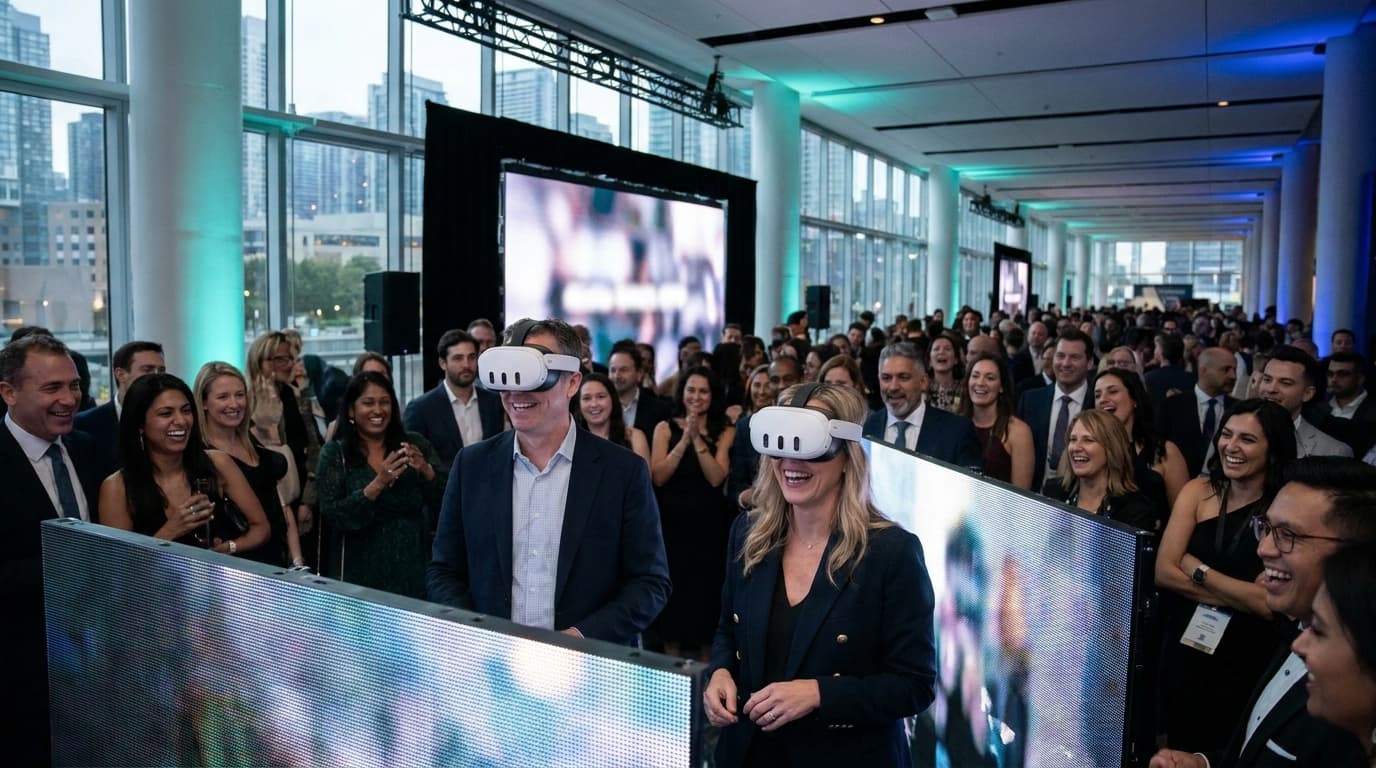
When you cross the 150-guest threshold, an event entertainment planning checklist for large groups becomes a strict mathematical formula: maximize throughput, mandate spectator casting, and engineer zero-downtime hardware logistics. For events of this scale, planners must calculate exact turnover times—aiming for 2 to 5 minutes per turn—while ensuring that guests waiting in line remain actively entertained through live casting and structured host engagement.
I have personally cleaned 40 VR headsets at midnight after a 300-person corporate gala at The Carlu, and I can tell you exactly what separates a good event from an operational disaster. Large-scale events break flimsy entertainment concepts. When you pass 150 attendees, you are no longer just managing fun; you are managing mathematics, crowd flow, power distribution, and human attention spans. The nervous CEO does not want to wait 45 minutes to try an activity, and your marketing director will absolutely notice if a vendor's setup becomes a bottleneck that drains the room's energy.
We have run 200+ events across the Greater Toronto Area. We know that the difference between an empty trade show booth and one with a line around the corner comes down to execution fundamentals. If you are organizing a massive corporate gathering, this is the exact blueprint you need to keep the energy high and the logistics invisible.
The Spatial Math of an Event Entertainment Planning Checklist for Large Groups
Amateur vendors cram equipment into corners. Experienced operators design for traffic flow. When we execute corporate social events at massive venues like the Metro Toronto Convention Centre or the Enercare Centre, our first step is mapping the exact physical footprint required for safety, visibility, and high-volume queuing.
For mobile VR activations, a standing experience requires a strict minimum of 6.5 x 6.5 feet (2m x 2m) per station. This is non-negotiable. If a guest is throwing a virtual sandwich or swinging a digital putter, they need a safe, clearly defined boundary. You also need to account for vertical clearance; venues with low chandeliers or drop ceilings under 8 feet are a hazard for attendees raising their arms in victory. However, if you are working with a tight Financial District boardroom, you do not have to abandon immersive entertainment. We curate specific seated and stationary experiences that require only a 3 x 3 foot footprint.
Your space assessment must heavily account for the spectator zone. At a 150-person event, only 4 to 8 people might be playing at any given second, leaving 142 people watching. You must design your floor plan so the crowd forms a natural horseshoe around the active participants, with clear sightlines to the spectator TVs.
Venue Tech Specs: Power Loads and Local Wi-Fi
I once saw a generic photobooth vendor crash an entire ballroom's power grid at the Fairmont Royal York because they plugged into the same 15-amp circuit as the caterer's industrial coffee urn. When planning for large groups, your checklist must include hardware power demands.
At VRPlayin, a standard 4-station setup requires a dedicated 15-amp circuit to run the Meta Quest 3 charging docks, spectator TVs, and casting routers. Do not share this circuit with the DJ, the lighting crew, or the bar staff.
Furthermore, never rely on venue Wi-Fi for live casting. Large crowds act as giant bags of water that absorb RF signals, and 500 guest smartphones pinging the network will instantly clog the venue's bandwidth, causing your entertainment streams to stutter or crash. Professional vendors bring their own local 5GHz or Wi-Fi 6 routers to create a closed, offline network specifically for casting headsets to TVs with zero latency.
Digital Waivers and Queue Management Logistics
If a guest spends 45 seconds signing a liability waiver at the VR station, you have lost 45 seconds of gameplay. Multiply that by 150 guests, and you just wasted nearly two hours of paid event time on paperwork.
For large-scale events, queue management and onboarding must happen before the guest steps up to play. We deploy QR codes on high-top tables around the venue and at the bar, allowing guests to scan, read, and sign digital waivers on their own smartphones while sipping a cocktail.
For premium events, we utilize SMS pager systems. Instead of forcing your VP of Sales to stand in a physical line for 20 minutes, they join a digital queue. They can continue networking, eating, and enjoying the gala until they receive a text message saying, "Your VR station is ready in 2 minutes. Please report to the blue mat." This preserves the flow of the room and eliminates the unsightly visual of a massive, impatient line.
Throughput and Timing: Beating the Bottleneck
The single most critical metric in any comprehensive corporate event planning guide is throughput. If your entertainment takes 15 minutes per guest, only 16 people will participate in a four-hour window per station. The rest will walk away out of boredom.
Through our operational data, we have engineered our software curation to maximize turnover without sacrificing the experience. For large galas, we lock gameplay into 2 to 5 minute sessions per turn. This ensures continuous movement, high energy, and the opportunity for every interested guest to play. To make this work, you must select content that requires zero gamer skills. Point, grab, throw—that is the entirety of the learning curve.
Consider Cook-Out: A Sandwich Tale. This is our number one most requested game for breaking the ice. It drops 2 to 4 players into a multiplayer fairytale kitchen where magical creatures cause havoc. Teams must immediately delegate chopping, assembling, and serving. When a team of 40 accountants from Bay Street loads in, and the quiet analyst turns out to be the only one who can coordinate sandwich orders under pressure, that is the exact moment trust actually forms. It is fast, chaotic, and cycles players efficiently.
For networking events where conversations need to happen alongside the activity, we deploy Walkabout Mini Golf. This is the gold standard for social VR. It offers beautiful courses ranging from pirate coves to space stations, moving at the perfect pace for guests to chat, sip a drink, and putt. Because the mechanics mimic real life exactly, we spend zero time explaining controls, moving the line faster.
Spectator Engagement: The TV Casting Requirement
Spectator engagement is not optional; it is a strict requirement for large-scale event success. The entertainment must be just as fun for the people watching as it is for the people playing. This is why we mandate spectator TV casting for large groups. Using Meta Quest 3 hardware, we wirelessly cast the player's first-person view to 50-inch or larger monitors facing the crowd.
But a screen is not enough. You need an MC or a trained facilitator to actively bridge the gap between the digital world and the physical audience. The goal is to make the crowd feel invested in the outcome of a 3-minute minigame.
Host Announcement Script for Seamless Crowd Engagement
If you are running the microphone or having a facilitator manage the line, use this exact script framework to maintain high energy during transitions:
[Mid-Game - Calling the Action]
"Alright folks, let's look at the screen! Sarah from Marketing is currently holding off three angry werewolves with a ketchup bottle in Cook-Out. She needs backup! Jason, you're on chopping duty, do not let that sandwich burn! Let's hear it for the logistics team, keeping the kitchen alive!"
[Game Concludes - The Transition]
"And time! Massive round of applause for our kitchen crew, they survived the dinner rush with a high score of 4,200! Incredible effort. Alright, Sarah, Jason, pass those headsets over to our VRPlayin technicians for a quick wipe down."
[Managing the Line - Prepping the Next Group]
"While we do a 30-second sanitization and swap the medical-grade face covers, who do we have next? I need four volunteers who think they can beat a 4,200 score. David from Sales, I see you hiding by the bar, get up here! We have three stations open and ready to go in exactly 20 seconds. Step right up to the glowing blue mats!"
This script does three critical things: it validates the players who just finished, alerts the room that hygiene protocols are actively happening, and creates social pressure for the next group to step up quickly, eliminating dead air.
Hardware Logistics and Uncompromising Hygiene
Operating mobile VR events Canada-wide has taught us that scale demands redundancy. Equipment failure is not an excuse you can give to a VP of Sales who paid for premium entertainment. We bring backup equipment to every single activation. If a headset drops a connection or a battery fails, our trained technicians swap the hardware within minutes. Zero downtime.
Let's talk about the reality of a 200-person event: people sweat. Hygiene is routinely the biggest unspoken objection planners face when booking wearable tech. As an operator who handles these setups daily, I can assure you that standard cleaning wipes are insufficient for a high-volume corporate crowd.
We utilize medical-grade silicone face covers that are physically removed and replaced between every single user. Behind the scenes, our technicians use UV-C sanitization and antibacterial treatments on all equipment. We arrive 60 to 90 minutes before your event starts to build out hand sanitizer stations and ensure every wire is taped down. We tear down in 30 to 45 minutes after the event ends. It is an airtight operational loop.
Motion sickness is another concern that requires rigorous operational control. In over 200 completed events, fewer than 2% of our guests have reported any discomfort. We achieve this by curating zero-nausea experiences exclusively. We ban artificial locomotion—meaning the player's digital body only moves when their physical body moves. If an attendee shows early signs of hesitation, our facilitators are trained to instantly switch them into a calmer, seated application.
Curating for Skeptics, Introverts, and Adrenaline Junkies
Not everyone wants to flail their arms in front of their boss. A vital part of your entertainment strategy must include quiet, collaborative options for the introverts in your organization, while still offering high spectacle for the thrill-seekers.
For the reserved guests, we deploy Puzzling Places. This experience is remarkably grounding. One to four players sit comfortably and work together to assemble stunning 3D jigsaw puzzles of real-world historical landmarks. It is low intensity, fosters calm collaboration, and naturally pulls in the executives who insist they "don't do games."
On the opposite end of the spectrum, when we need to generate a massive crowd reaction in under 90 seconds, we boot up Richie's Plank Experience. We place a physical wooden plank on the floor of your venue. In the headset, the guest rides an elevator 80 stories up and is asked to walk the plank. The psychological thrill is immense, the crowd reactions are deafening, and the turnover is blindingly fast.
After a recent activation in Yorkville, an Executive Assistant at a major law firm told us, "Even our executives who 'don't do games' were laughing and high-fiving in VR." The VP of People & Culture at a prominent SaaS company noted, "We've booked VRPlayin three times now. Each event, they bring something new and the team loves it." That is why we hold a 40% repeat booking rate and a 4.9-star Google rating.
The Master 150+ Guest Checklist Summary
To guarantee success at your next large-scale event, ensure your vendor or internal team checks off these non-negotiable operational requirements:
- Spatial Footprint: 6.5 x 6.5 ft per standing station, 8+ ft ceiling clearance.
- Spectator Zone: Dedicated horseshoe viewing area with clear sightlines to screens.
- Throughput Guarantee: 2 to 5 minute maximum gameplay loops for fast turnover.
- Queue Management: Digital SMS waitlists and QR code waivers to eliminate physical lines.
- Power & Network: Dedicated 15-amp circuits and private offline 5GHz casting routers.
- Spectator Casting: Minimum 50-inch TVs casting real-time gameplay to the crowd.
- Active Facilitation: Trained MCs using structured scripts to drive engagement and transitions.
- Medical-Grade Hygiene: UV-C sanitization and swappable silicone covers between every user.
- Curated Libraries: A mix of high-adrenaline spectacle and low-intensity collaborative options.
Finalizing Your Strategy
Planning entertainment for large groups requires confronting the logistics of space, time, and human behavior. Whether you are transforming a ballroom at the Fairmont Royal York or setting up a dynamic activation at the Steam Whistle Brewing hall, success lies in the details.
You must map your footprints precisely, mandate content that cycles players every 5 minutes, enforce strict hygiene protocols, and ensure your vendor acts as an active crowd facilitator rather than a passive equipment rental service.
Take these metrics and apply them to your next vendor negotiation. Demand clear throughput timelines, insist on spectator engagement, and never compromise on hygiene. If you need help executing this level of precision for your team, explore our VR team building packages and let us handle the heavy lifting. We will see you on the floor.
Ready to Flawlessly Entertain Your 150+ Guest Roster?
Stop worrying about long lines, tripped breakers, and bored spectators at your next massive corporate gala. We bring the Meta Quest 3 hardware, the medical-grade hygiene protocols, and the expert facilitators directly to your Toronto venue.
GET A CUSTOM QUOTE