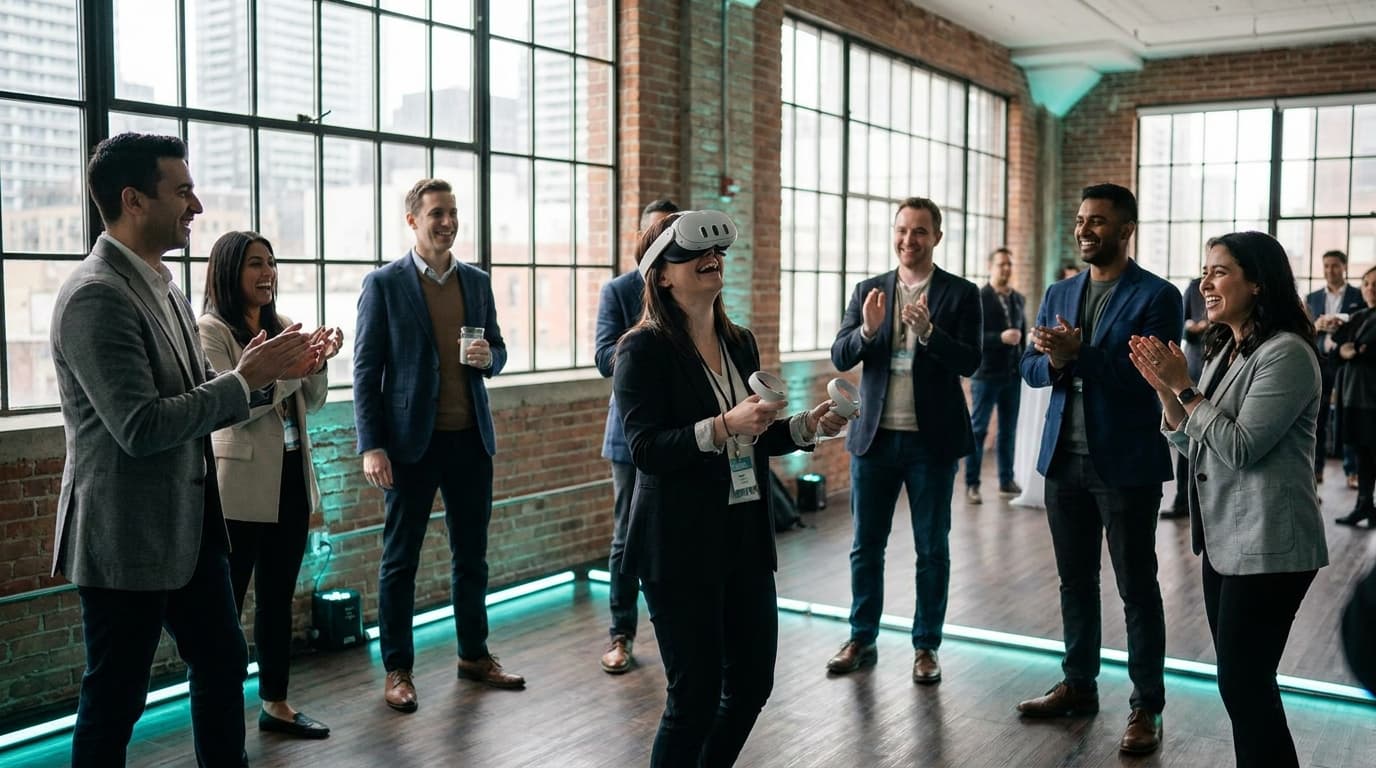
You are standing in the middle of the Enercare Centre. The caterers are 20 minutes behind, the AV team is missing a critical HDMI cable, and the CEO just asked if the interactive booth is functional. I have been the vendor standing next to you, looking at my watch as the doors open. After executing 200+ mobile VR events across the GTA, I know exactly where activations fail. If you are building your event entertainment planning checklist, cost Toronto interactive activations with zero margin for error. Vendors do not fail because their game concepts are bad; they fail because of throughput math, hidden venue costs, and space constraints.
I have seen the nervous Bay Street executive who ended up screaming with laughter in a virtual zombie apocalypse, and I know exactly what logistical framework made that moment happen smoothly. Here is the unvarnished, operational playbook for planning and pricing interactive event entertainment in Toronto.
The Event Entertainment Planning Checklist: Cost Toronto Benchmarks
Corporate event budgets require hard numbers, not vague ranges. The final invoice for interactive entertainment hinges on the number of active stations, the duration of the booking, and hidden venue logistics. Here is a realistic breakdown of what you will spend on mobile VR in the Toronto market:
- The $1,500 – $2,000 Tier (The Boardroom Standard): Ideal for a 3 to 4 hour Friday afternoon social in the Financial District. This covers two fully staffed Meta Quest 3 stations, a dedicated technical facilitator, 4K casting TVs on tripod stands, and basic travel within the downtown core.
- The $2,500 – $3,500 Tier (The Corporate Offsite): Built for 100+ guests at venues like Steam Whistle Brewing or The Carlu. This covers four active stations, two to three staff members, dedicated enterprise Wi-Fi networking gear, and custom game curation to match a specific event theme over 4 to 6 hours.
- The $4,000+ Tier (The Convention Dominator): Designed for multi-day trade shows at the Metro Toronto Convention Centre (MTCC). This includes six or more stations, custom brand integration inside the VR environments, heavy throughput management, and a dedicated on-site technical director.
Hidden Toronto Venue Costs Planners Forget
Your invoice from VRPlayin isn't the only cost. When finalizing your budget, you must factor in the venue's operational fees:
- Power Drops: Venues like the MTCC or Enercare Centre use exclusive providers like Showtech. A standard 15-amp circuit drop for an activation booth will add $150–$300 to your budget. Do not assume you can just plug into a wall.
- Drayage and Loading Docks: Navigating the loading bays at major convention centers adds hours to load-in and load-out times. Some venues charge drayage fees (handling freight from the dock to the booth), which can add $100+ per trip.
- Union Labor Regulations: If you are planning an event at a unionized venue, be aware that you may not be allowed to run your own extension cords or mount your own TVs. Always confirm if union labor is required for activation setup.
The 60-30-14 Day Operational Checklist
Stop treating interactive entertainment as an afterthought. Use this timeline to ensure flawless execution:
- 60 Days Out (The Floorplan Lock): Allocate exactly 6.5 x 6.5 feet (2m x 2m) of empty, walkable space per standing VR station. Add an extra 2 feet of depth for the spectator TV and staff footprint. Do not let the venue push your activation into a high-traffic catering corridor.
- 30 Days Out (The Insurance & Power Audit): Request the Certificate of Insurance (COI) from your vendor. Toronto venues are notoriously strict; they will want to be listed as additional insured on a minimum $2M to $5M liability policy. Simultaneously, submit your electrical requirements to the venue.
- 14 Days Out (The Lighting & Wi-Fi Check): VR headsets like the Meta Quest 3 rely on infrared tracking. If your event is at the Globe and Mail Centre at 2:00 PM, direct sunlight hitting the floor will blind the headset cameras. Confirm the lighting situation and determine if enterprise Wi-Fi routers need to be deployed to bypass the venue's notoriously throttled guest networks.
The Math of Interactive Entertainment Planning: The Queue Calculator
The single biggest mistake planners make is underestimating throughput. If you have 150 guests and two VR headsets, your guests will spend the entire evening standing in a frustrating line. Our average session per guest is 3 to 5 minutes. That rapid cycle is what keeps the energy high in the room.
Here is the exact queue and throughput calculator we use for our operations:
The 2-Headset Setup (25-40 Guests)
Throughput: 24 to 40 guests per hour. This fits perfectly into a medium-sized office space or a small private dining room in Yorkville. Guests can cycle through quickly, grab a drink, and come back for a second round without waiting longer than 10 minutes.
The 4-Headset Setup (100-150 Guests)
Throughput: 48 to 80 guests per hour. When you are hosting a holiday party, this is your baseline. Four stations create a natural hub of activity. We cast the gameplay to spectator TVs so the crowd can watch their colleagues navigate the virtual world, turning a single-player game into a highly engaging spectator sport.
The 6-Headset Setup (200+ Guests)
Throughput: 72 to 120 guests per hour. If you are running a brand activation at a major tech conference, throughput is everything. Six headsets allow us to cycle a massive volume of attendees without bottlenecking the aisles.
Do not just take my word on the impact of proper throughput scaling. As one Marketing Director at a recent tech conference noted: "Our booth had a line around the corner the entire conference. VRPlayin made us the talk of the show."
Better Event Planning Ideas: Curation Over Complexity
The fastest way to kill the momentum of corporate social events is by forcing non-gamers into complex simulations. The executives in suits don't want to memorize twelve controller buttons. Our most popular experiences require zero gaming skill. Point, grab, throw — that is the entire learning curve.
Consider how different games serve different event goals:
- Beat Saber (1 player, Medium intensity): Slash glowing blocks to the beat of adrenaline-pumping music. It is the world's most popular VR game for a reason. Easy to learn, visually spectacular on the spectator screens, and highly addictive. This is our primary weapon for drawing massive crowds at trade shows.
- Keep Talking and Nobody Explodes (2-6 players, High communication): One person in VR is staring at a ticking time bomb. The rest of the team is frantically reading a physical defusal manual, shouting instructions. We use this heavily for team building sessions where communication under pressure is the objective.
- Puzzling Places (1-4 players, Low intensity): Assemble stunning 3D jigsaw puzzles of real-world historical landmarks. It is calming, collaborative, and perfect for older demographics or wellness-focused offsites.
A common objection from HR managers reviewing our full VR game catalog is motion sickness. We curate zero-nausea experiences only for corporate events — utilizing stationary gameplay with no artificial joystick locomotion. In our 200+ events, fewer than 2% of guests report any discomfort. Furthermore, our staff are trained to spot early signs of hesitation and pivot the guest to a seated, comfortable experience immediately.
The Midnight Teardown: An Operator's Insight
Let me tell you what happens when the lights go up after a 300-person gala. While the catering staff is clearing glasses, my team is executing a rigorous teardown that ensures absolute safety and hygiene for the next day. We use medical-grade silicone face covers on all headsets that are rigorously wiped down or replaced between every single user. We deploy UV-C sanitization wands alongside antibacterial wipes. Hand sanitizer stations are integrated into every play boundary.
I have personally cleaned 40 headsets at midnight after a massive corporate buyout. I know that commercial hardware requires meticulous maintenance, battery rotation schedules, and software updates to perform flawlessly. We do not cut corners on hygiene, because your guests' comfort is the entire foundation of our business.
The Final Polish
When you build your entertainment checklist, prioritize vendor transparency. Demand exact space requirements, verify their throughput math based on your guest count, and insist on a hygiene protocol. Interactive activations fail when they are treated as a whimsical add-on. Treat them as a logistical science, plan your budget around the real costs of operating in Toronto, and you will turn skeptics into your biggest advocates.
Plan Your Next Corporate Event Without the Guesswork
Stop stressing over space constraints, hidden venue costs, and throughput math. Let our team handle the logistics, setup, and execution of mobile VR for your next corporate social or team building offsite.
GET A CUSTOM QUOTE