It’s 2:00 PM on day two of a trade show at the Enercare Centre. The initial rush is over, and the floor is quieting down.
You have spent $25,000 on floor space, another $10,000 on custom fabrication, and $3,000 on branded stress balls. You watch a qualified lead—badge reading "Director of Operations"—walk past your booth. You make eye contact for exactly 0.8 seconds. They grab a stress ball without stopping and vanish into the aisle toward the food court. You have just paid roughly $200 for a lead that didn’t even break stride.
This is the standard trade show loop: high cost, low dwell time. Most exhibitors try to fix this with louder graphics, aggressive sales reps, or a fishbowl business card drop. But after running over 200 VR events across the GTA, from the Metro Toronto Convention Centre to boutique pop-ups in Yorkville, I can tell you the math changes entirely when you put a headset in the mix.
We don't just see a bump in interest. We see a fundamental shift in physics. A standard booth visit is 30 seconds. A VR booth visit creates a play-loop of setup, gameplay, and cooldown that averages 5 minutes. When it comes to dwell time hacking, VR trade show engagement offers a unique physiological advantage: it physically anchors the prospect to your brand.
This post isn't about why VR is "cool." It is about the operational mechanics of turning a 10x10 booth into a lead generation engine.
The Spectator Effect: Why TV Casting Matters More Than the Headset
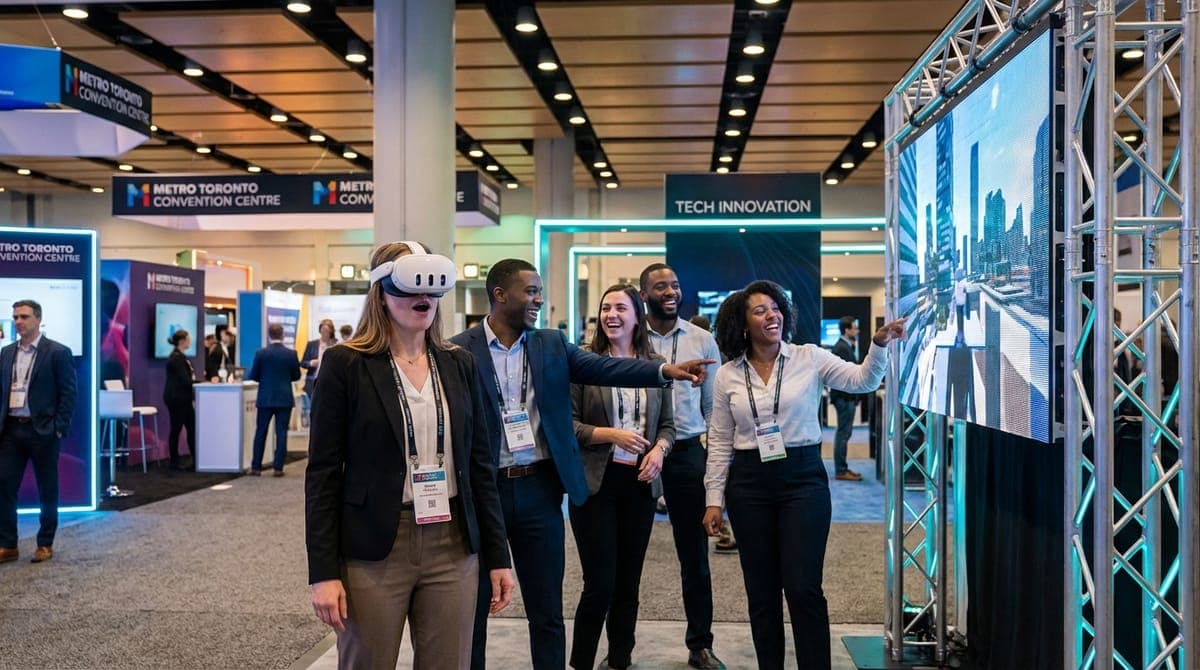
Here is the mistake most rookies make: they think the VR experience is for the person inside the headset. It’s not. The person in the headset is already captured; they aren't going anywhere for at least three minutes. The VR experience is actually bait for the twenty people walking down the aisle behind them.
We use Meta Quest 3 Business Edition headsets, but the most important piece of hardware we bring to a trade show is the 55-inch 4K TV on the stand. We cast the gameplay directly to that screen. When someone is flailing their arms playing Beat Saber—slashing through neon blocks to the rhythm of a heavy bass track—they look ridiculous in the best possible way. Humans are herd animals. When we see someone acting strangely or having fun, we stop to look.
I recall an event at a tech conference near the Toronto Congress Centre where a single player in Beat Saber created a semi-circle of 15 spectators. That semi-circle blocked the aisle. People had to squeeze through, saw the crowd, and stopped to see what the fuss was about. The booth staff didn't have to chase leads; the leads were stuck in a traffic jam created by our game.
Technical Note on Casting
Do not rely on the venue's default Wi-Fi for casting. At the MTCC or Sheraton, the signal interference is massive. We use dedicated Wi-Fi 6E routers (TP-Link AXE5400 or similar) creating a local loop between the headset and a Chromecast Ultra hardwired to the TV. If the casting lags, the spectator effect dies.
The Pincer Maneuver: The Sales Handoff Script
Having a crowd is useless if you don't work it. This is where your sales team executes the "Pincer Maneuver." While the "pilot" is in VR, their colleagues are usually standing by, holding their bags or cheering them on. These colleagues are unguarded, laughing, and stationary.
Most sales reps don't know what to do here. They either ignore the friend or pitch them too hard. Here is the script we train our clients to use:
- The Approach: Sidle up to the colleague watching the screen.
- The Icebreaker: "He's actually doing better than the guy from [Competitor Company] did ten minutes ago." (Instantly builds rapport and competition).
- The Pivot: "Does your team usually get this competitive back at the office?"
- The Discovery: "What are you guys working on this quarter that’s stressing you out enough to need to slash boxes with lightsabers?"
By the time the player takes the headset off, the sales rep has already qualified the colleague. The player emerges with an endorphin high, sees their friend chatting amiably, and is immediately receptive to the conversation. It is a soft entry that converts to a hard lead.
The Mechanics of "Acron": Turning One Station into a Crowd
If Beat Saber is the hook, Acron: Attack of the Squirrels! is the net. This is my absolute favorite tool for corporate social events and trade shows because it solves the "isolation problem" of VR.
In most VR games, one person plays while others watch. Acron is different. It’s an asymmetric multiplayer game. One player is in the VR headset acting as a giant, sentient tree protecting golden acorns. Up to eight other people pull out their actual smartphones (iOS or Android), scan a QR code, and join the same game as squirrels trying to steal the acorns.
Think about the logistics of this for dwell time hacking vr trade show engagement:
- Throughput: You are engaging 9 people simultaneously with a single 6.5 x 6.5-foot footprint.
- Barrier to Entry: Zero. Everyone has a phone. There’s no "I don't want to mess up my hair" objection for the squirrel players.
- Energy: The VR player is shouting at the squirrels; the squirrels are shouting at each other. It creates noise, and on a trade show floor, noise equals curiosity.
We ran this setup for a client in Liberty Village who wanted to showcase their networking capabilities. By getting strangers to play together—one in the headset, four on phones—we forced interaction. People who hadn't spoken all conference were suddenly coordinating attacks on the "tree." By the time the round ended, they were exchanging business cards.
The Booth Blueprint: Where to Put the Zone
Physical layout dictates success. A common failure mode is tucking the VR station in the back corner of the booth because you are afraid of it "taking over." If you hide the VR, you hide the bait.
The Corner Trap: If you place the VR station deep in the booth, prospects feel like they are entering a trap. They won't walk in.
The Aisle Edge: The play space needs to be right on the carpet line. The player should be safe, but visible. The TV screen needs to face the flow of traffic. If traffic flows from left to right, angle the TV 45 degrees so it catches the eye of the approaching walker. We use stanchions or branded floor tape to mark the "Slash Zone." This safety perimeter actually increases desire—it looks like a VIP area.
Hygiene as a Competitive Advantage (The Theater of Cleanliness)
You cannot discuss high-traffic VR without discussing the elephant in the room: hygiene. In a post-2020 world, nobody wants to put a sweaty, mystery-sponge on their face. If you get this wrong, your dwell time hack becomes a reputation hazard.
We treat our stations like a clinical environment. This isn't marketing speak; this is standard operating procedure for every one of the 200+ events we’ve managed. We use medical-grade silicone face covers that are non-porous and wipeable. Between every single user—no exceptions—our facilitators perform a 3-step sanitation protocol: wipe down the headset interface, sanitize the controllers, and check lenses for fog/smudges.
This visible act of cleaning is actually part of the show. When attendees see a uniformed staff member meticulously sanitizing the gear with UV-C light or industrial wipes, it signals quality. It tells the prospect, "This company pays attention to details." I have had HR Directors explicitly tell me they booked us for their internal VR team building packages specifically because they saw how obsessively we cleaned the gear at a public expo.
The Content Cure: Why "Cool" Doesn't Always Mean "Good for Booths"
A common mistake is picking a game that takes 20 minutes to learn. You do not want a complex RPG. You want "pick up and play." We curate our library specifically for employee engagement activities and trade show throughput.
Walkabout Mini Golf is the gold standard here for lower-intensity interactions. It’s intuitive—everyone knows how to hit a ball with a stick. It’s low intensity, meaning executives in suits don't have to worry about sweating through their dress shirts. It allows for conversation during gameplay. If your goal is to have a 5-minute chat with a VIP prospect while they are engaged, you put them in a round of mini-golf on a space station. It lowers their guard. It’s hard to be defensive and "sales-resistant" when you’re trying to sink a putt on a pirate ship.
Conversely, for pure adrenaline and draw, we stick to Beat Saber. The mechanics are instant: Red saber hits red block, blue saber hits blue block. No buttons to memorize. We can get a user from "Hello" to "Wow" in under 45 seconds.
The ROI of Motion (Or Lack Thereof)
Let’s address the nausea concern. The quickest way to kill your dwell time is to make your potential client vomit. In our data across thousands of users, fewer than 2% report discomfort. Why? Because we refuse to run experiences that use "artificial locomotion" (using a joystick to walk while your body stands still) at corporate events.
For trade shows, we only use Room-Scale or Stationary experiences. In Beat Saber, you stand still, and the blocks come to you. In Walkabout Mini Golf, you teleport. This disconnect between inner ear and eye is eliminated. We vet every experience for comfort. If we aren't 100% sure it’s nausea-free, it doesn't go on the menu. This gives you the confidence to put your CEO or your biggest prospect in the headset without crossing your fingers.
Expert Insight: The Leaderboard Hook
Here is the secret weapon that only experienced operators use: The High Score Board. It sounds analog, but it is psychologically devastating. We bring a physical whiteboard or a digital display to track the top scores of the day.
I once worked a three-day expo where a VP from a competing firm came back to our booth four times. Not because he wanted our product, but because "Dave from Accounting" beat his score in Space Pirate Trainer. He brought his colleagues to watch him reclaim the title. He spent a total of 45 minutes at our booth over three days. That is 45 minutes of branding exposure, plus the contact info for his entire team, all driven by a simple competitive urge. It converts a one-time visitor into a repeat visitor.
Turning Traffic into Teams
The principles that make VR work for trade shows—high engagement, shared experience, spectator appeal—are the exact same ones that drive effective corporate team building toronto events. Whether you are trying to stop traffic at a booth or connect a disjointed team at the office, the goal is to break the ice and get people moving.
If you are planning your Q3 or Q4 strategy, consider how mobile vr team building can fit into your internal culture as well as your external marketing. The hardware is the same; the result is always higher engagement.
Closing Thoughts: The Cost of Being Boring
Dwell time hacking isn't about trapping people against their will; it’s about offering value in exchange for their time. A brochure offers low value. A 5-minute trip to a neon-soaked rhythm dimension offers high value.
If you are heading to your next trade show, do the math on your square footage. Every square foot that isn't engaging a customer is wasted budget. Even if you don't use VR, find a way to create a spectator loop. Give people something to watch, something to do, and a reason to stay. But if you want to guarantee the crowd—and you want the technical confidence that comes from 200+ successful Toronto events—you know who to call.
Turn Your Booth Into the Main Event
Stop chasing leads and let them come to you. We handle the setup, the hygiene, and the crowd management so your sales team can focus on closing.
GET A TRADE SHOW QUOTE