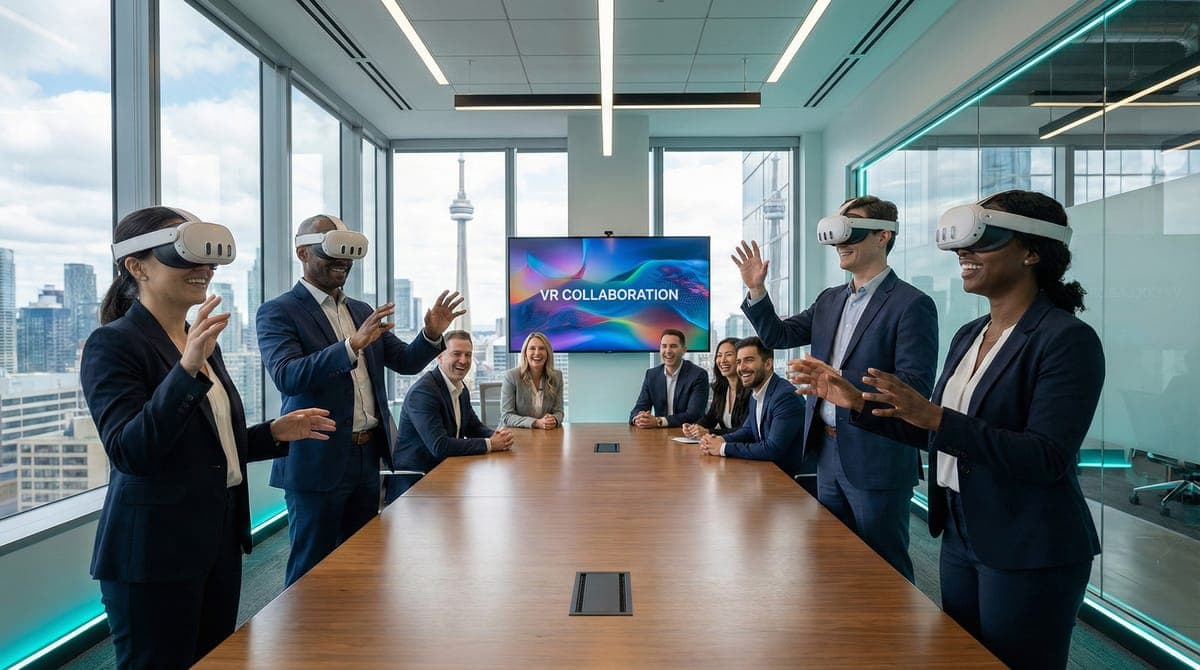
If you are looking for a cure for slide deck fatigue in your quarterly meeting, a VR breakout session is the active recovery protocol you have been missing. By physically engaging attendees in short, high-intensity immersive experiences, you trigger a dopamine release and heart rate increase that counteracts the sedative effects of prolonged sitting, resulting in a visible energy reset when the presentation resumes.
I know the look. I’ve seen it a thousand times.
It’s 2:15 PM in a windowless conference room at the Sheraton Centre Toronto. The VP of Finance is on slide 47 of a 90-slide deck about Q3 fiscal projections. Half the room is checking emails under the table; the other half is dissociating, staring at a stain on the carpet. The energy in the room isn't just low; it's subterranean.
Then, we open the doors.
We wheel in the Meta Quest 3 stations. Ten minutes later, that same VP of Finance is wearing a headset, screaming instructions to her junior analysts who are frantically trying to defend a virtual tree from squirrels. The room is loud. People are laughing. The blood is moving.
I have personally run over 200 of these events across the GTA. I’ve cleaned headsets at midnight after galas and set up tracking boundaries in cramped King West startups. I can tell you with absolute certainty that the "quarterly meeting slump" is biological, and you can't fix it with more coffee. You have to physically wake people up.
Here is the operational reality of why corporate social events masquerading as meetings fail, and how a strategic VR breakout session actually fixes the retention problem.
The Physiology of the "Reset": Why Beat Saber beats Espresso
There is a specific reason we almost always deploy Beat Saber for mid-meeting breakouts. It isn't just because it's the world's most popular VR game. It's because it is a physiological cheat code.
Beat Saber involves slashing glowing blocks to the rhythm of high-tempo music. It requires zero explanation: Red saber hits red block, blue saber hits blue block. But crucially, it is physical. It forces players to squat, reach, and swing.
In a typical quarterly meeting, your attendees' heart rates settle into a resting slump. Blood pools in the legs. Oxygen flow to the brain slows down. This is why "slide deck fatigue" sets in. It’s not just boredom; it’s biology.
When we put an attendee into Beat Saber for just one 4-minute song, their heart rate elevates. They get a hit of dopamine from the "success" of hitting blocks. They take off the headset slightly out of breath and grinning. In over 200 events, I have never seen someone take off a headset after a round of Beat Saber and look sleepy. It’s impossible.
The Operator's Take: For a breakout session, we keep the turns short—3 to 5 minutes per person. This keeps the line moving and ensures high throughput. With just two stations, we can cycle through a team of 20 people in under an hour, or run concurrent stations for larger groups. The goal isn't a marathon gaming session; it's a shot of adrenaline.
Solving the "Wallflower" Problem with Asymmetric VR
One of the most valid objections I hear from HR Directors is: "What about the people who don't want to wear a headset?"
It's a fair point. In any group of 40 people, you'll have 5 who are dying to try VR, and 5 who are terrified they'll look silly. If you only cater to the gamers, you alienate the rest of the room. This defeats the purpose of VR team building packages.
This is where we deploy Acron: Attack of the Squirrels!.
This game is the secret weapon for inclusive meetings. Here is the mechanic: Only one person wears the VR headset. They play as a giant, stationary tree. Their job is to throw debris at squirrels trying to steal their acorns.
Here is the genius part: Up to eight other people join the game using their own smartphones. They play as the squirrels.
Suddenly, a single VR station isn't a solitary experience; it's a 9-person party game. The skeptics don't have to put on a headset; they just pull out their iPhones. I vividly remember an event at a law firm in the Financial District where the Managing Partner was the "Tree," and eight summer associates were the "Squirrels" working together to distract him. The power dynamic shifted instantly. The associates were yelling strategies, the Partner was laughing his head off, and the hierarchy dissolved for 10 minutes.
Logistics: Fitting a Theme Park into a Boardroom
You might be thinking, "We don't have space for this. Our breakout room is the size of a closet."
I've set up VR stations in crowded trade show booths at the Enercare Centre and in narrow hallways at the Chelsea Hotel. We don't need a gymnasium.
- Space Requirements: For a standing, active game like Beat Saber, we need a safety zone of 6.5 x 6.5 feet (2m x 2m). That is roughly the size of two office cubicles.
- Seated Options: For stationary experiences, we need even less—about 3 x 3 feet.
- The Tech: We use Meta Quest 3 Business Edition headsets. They are wireless. There are no trip hazards, no massive PCs to lug around, and no base stations to drill into the walls.
Because we operate on a "We Come to You" model, we handle the spatial geometry. We arrive 60-90 minutes early, scan the room, set the digital boundaries, and test the casting equipment. If you have a corner of a boardroom cleared, you have a VR arcade.
The "Nausea" Myth vs. Reality
Let’s address the elephant in the room. If you played VR in 2016, you might remember feeling woozy. That is a dealbreaker for a corporate meeting.
Here is the data: In 200+ events with thousands of guests, our reported discomfort rate is under 2%.
Why? Because we curate ruthlessly. We do not allow "artificial locomotion" games (where your body is still, but your eyes say you are running) at corporate events. We stick to 1:1 movement or stationary games.
Take Walkabout Mini Golf. It is exactly what it sounds like. You look down, you see a putter, you hit a ball. Your inner ear and your eyes agree on what is happening. It is zero-intensity, highly social, and safe for the CEO who just ate a heavy catered lunch. It’s also incredibly intuitive. If you know how to hold a stick, you know how to play. This is usually where we start the older demographics or the non-gamers.
Operator Insight: The Magic of Casting
Here is something generic event planners miss: VR is boring if you can't see what the player is seeing.
If you have 30 people in a room and one person waving their arms in silence, it’s awkward. That’s why our setup always includes spectator TV casting. We cast the headset’s view to a large screen (or plug into your boardroom's projector).
This transforms the activity from "solitary play" to "spectator sport." When a player misses a block in Beat Saber or misses a putt in Walkabout Mini Golf, the room groans. When they pull off a miracle shot, the room cheers. This shared emotional experience is what bonds the team, not the game itself.
I ran an event recently for a tech company in Liberty Village. We had the casting set up on their main presentation screen. A quiet developer, who hadn't said a word all morning, jumped into Space Pirate Trainer. He turned out to be a virtuoso. The entire sales team was standing behind him, cheering his high score. That level of validation does more for company culture than a year of "trust falls."
The Hygiene Standard (Because We Know You're Worried)
Post-2020, you cannot ask an employee to put something on their face that a colleague just sweated in. You just can't.
This is where the difference between a "rental" and a "managed service" becomes obvious. If you rent headsets, you have to clean them. If you hire VRPlayin, I clean them.
We use medical-grade silicone face covers that are non-porous and wipeable. Between every single user, my team wipes down the headset, the controllers, and the strap with antibacterial solution. We also utilize UV-C sanitization for deep cleaning. We treat the hygiene protocol as visibly as the entertainment. When your staff sees us aggressively sanitizing the gear, the "ick factor" vanishes.
Conclusion: Make the Meeting Matter
"Slide deck fatigue" is a polite way of saying your team has checked out. You are paying for their time, but you aren't getting their attention.
A VR breakout session isn't about turning your office into an arcade. It's about respecting your team's physiology. It's about acknowledging that human beings need movement, play, and social connection to function at their peak.
Whether you are huddled in a boardroom in Markham or hosting a gala at the Royal York, the result is the same: You trade 45 minutes of downtime for a team that is awake, laughing, and ready to tackle the rest of the agenda.
One practical takeaway you can use today: Even if you don't book VR for your next meeting, implement the "Physiology First" rule. Every 60 minutes, force the team to stand up and physically move to a different part of the room or switch chairs. The brain follows the body. But if you want them to actually enjoy it, you know who to call.
Wake Up Your Workforce
Don't let another quarterly meeting end in silence. Let's build a custom VR breakout package that fits your schedule, space, and team culture.
SEE TEAM BUILDING PACKAGES