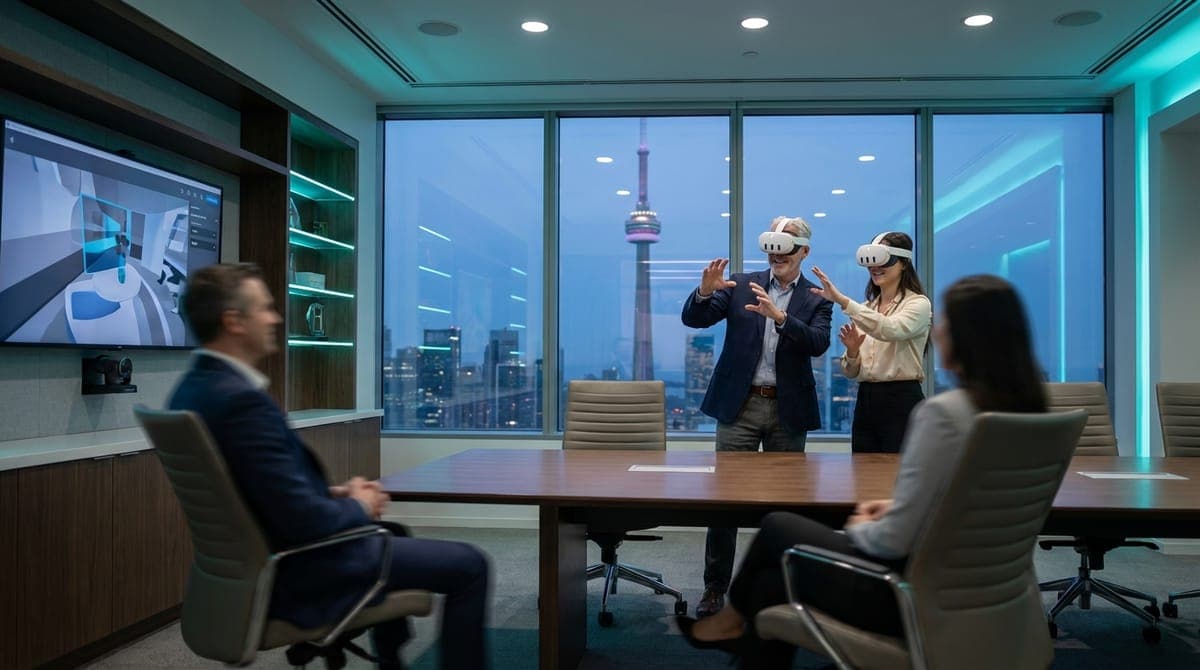
Bridging the generational gap via VR collaboration works because it removes the existing hierarchies and physical limitations of the traditional office. By placing Gen Z digital natives and Boomer industry veterans into a neutral, digital environment where neither has a pre-existing advantage, virtual reality forces teams to rely on communication and trust rather than tenure or technical fluency.
Consider the typical dynamic in a modern office. You have a 23-year-old junior developer in Liberty Village who communicates exclusively in Slack emojis, and a 58-year-old VP who still prefers to print out emails before reading them. When you put them in a standard boardroom for a "team bonding" session, the air gets sucked out of the room. The junior staff feels patronized; the senior staff feels out of touch. I’ve seen it a hundred times.
But I’ve also seen what happens when you put those same two people into a headset. I remember a specific event at a law firm in the Financial District. We had a senior partner—stiff suit, very serious—and a first-year associate. In the real world, the power dynamic was paralyzing. In the headset, however, the partner was a giant tree trying to protect acorns, and the associate was a squirrel launching a strategic assault. For twenty minutes, the hierarchy dissolved. They were just teammates screaming instructions at each other.
After running over 200 events across the GTA, from small startups to massive galas at the Metro Toronto Convention Centre, I can tell you this: VR is the only tool I’ve seen that actually levels the playing field instantly.
Bridging the Generational Gap via VR Collaboration: The "Great Equalizer"
There is a misconception that VR is strictly for the "Fortnite generation." If I had a dollar for every time an event planner asked me, "Will the older crowd actually use this?" I could retire to a nice condo in Oakville. The reality of our VR team building packages often surprises people.
Here is the data from our operations: across 200+ events, the demographic most likely to stay in the headset for a second or third turn isn't the 20-somethings—it's the 45-60 demographic. Why? Because the novelty factor is higher for them, and modern VR hardware like the Meta Quest 3 is intuitive.
We specifically use Walkabout Mini Golf to bridge this gap. This isn't a high-speed shooter; it’s physics-based putting. It’s low intensity, supports 1-4 players, and allows for conversation.
At a recent event for a logistics company near Pearson Airport, we used Walkabout to pair senior managers with new hires. The game mechanics are simple: point, grip, swing. No complex button combos. Because the physics are so realistic, the older generation who played real golf actually had a slight advantage in reading the greens, while the younger generation understood the interface faster. They had to help each other. The Boomer explained the slope; the Gen Z explained the teleportation mechanic. That is organic mentorship, happening in real-time, over a virtual pirate ship course.
Asymmetric Gameplay: The Secret Weapon for Corporate Team Building Toronto
When companies search for corporate team building Toronto, they usually find escape rooms or axe throwing. The problem with those is that they rely on physical ability or extroversion. VR offers something called "asymmetric multiplayer," which is a fancy way of saying "people inside the headset play with people outside the headset."
This is crucial for mixed-age groups. Not everyone wants to be isolated in a headset, and some people (often older skeptics) want to watch before they try.
We use a game called Acron: Attack of the Squirrels! for this exact dynamic. Here is how it works:
- The VR Player (1 person): Plays as a giant, stationary tree. They use their hands to throw boulders and wood chunks to defend their golden acorns.
- The Mobile Players (up to 8 people): Join the same game via a free app on their smartphones. They play as squirrels trying to steal the acorns.
This setup turns a single VR station into a 9-person activity. It uses devices everyone already understands. The Gen Z staff are usually lightning-fast on the phone controls (the squirrels), forcing the person in the VR headset (the tree) to develop a strategy to counter them.
I recall an event at a venue in the Distillery District where a retiring CFO played as the tree. His entire accounting department played as the squirrels. For ten minutes, the whole room was roaring with laughter as the team "attacked" their boss in a safe, game-environment context. It humanized him in a way that a quarterly review meeting never could. As one HR Director from a Financial Services Firm told us later: "Best team event we've ever organized. Everyone was talking about it for weeks."
Motion Sickness and Accessibility: Addressing the Elephant in the Room
You can't talk about employee engagement activities involving technology without addressing the fear of motion sickness or technical complexity. This is often the biggest objection from the 50+ demographic.
Here is the operational reality: In our 200+ events, fewer than 2% of guests report discomfort. That isn't luck; it's curation. We explicitly filter out games with "artificial locomotion" (where the character moves but your body doesn't) for corporate events. We stick to room-scale or stationary experiences.
We also tackle the hygiene concern—which transcends age but is particularly important for post-COVID comfort levels. We don't just wipe things down. We use medical-grade silicone face covers that are replaced and sanitized between every single user, along with UV-C sanitization. Whether we are at a private party in Vaughan or a corporate office on Bay Street, the hygiene protocol is clinical. When a skeptical guest sees me scrubbing a headset with hospital-grade disinfectant before handing it to them, the barrier to entry drops.
High Energy, Low Stakes: Using Beat Saber to Build Trust
Sometimes, collaboration isn't about solving a puzzle; it's about cheering each other on. Vulnerability is a precursor to trust. It is difficult to maintain a rigid professional persona when you are flailing your arms at neon blocks.
Beat Saber is our go-to for this. It’s the world's most popular VR game for a reason. You have two lightsabers, and you slash blocks to the beat of the music. It is medium intensity and highly spectator-friendly because we cast the gameplay to a TV screen so the crowd sees what the player sees.
Why does this help with the generational gap? Because it removes the "expert" status. Unless you are a hardcore gamer, everyone looks equally ridiculous playing Beat Saber for the first time.
At a recent corporate social event, we had a "High Score Challenge." We saw a fascinating trend: the younger staff were cheering the loudest for the older directors. When a senior manager creates a "fail" state in the game, and laughs it off, it signals psychological safety to the rest of the team. It shows that it's okay to try new things and fail—a critical lesson for innovation in any industry.
The Logistics of Mobile VR Team Building
If you are planning mobile VR team building in the GTA, you need to consider the physical space. One reason VR works well for bridging gaps is that it can come to "neutral ground." We have set up in the grand ballrooms of the Fairmont Royal York and in cramped breakrooms in Mississauga industrial parks.
We require a 6.5 x 6.5 foot (2m x 2m) space per standing station. That is about the size of a standard office cubicle. This small footprint means we can deploy these experiences right where the teams work, minimizing the disruption of travel.
However, the "secret sauce" isn't the hardware; it's the facilitation. Our technicians aren't just IT support; they are "fun facilitators." When we see a guest hesitating—usually an older guest worried about looking foolish—our staff is trained to step in, explain the mechanics privately, and guide them through a tutorial until they smile. That first smile is the metric that matters.
Expert Insight: The "Noise Level" Indicator
After running this many events, I don't need to look at survey results to know if the generational bridge is being built. I listen to the noise level. In a segmented office party, you hear hushed pockets of conversation—the interns whispering in one corner, the managers talking shop in another. When VR is working, that changes. You hear a sudden, collective gasp when someone misses a putt in Walkabout Mini Golf. You hear a Gen Z employee shouting, "Look left, look left!" to a Boomer Director in a zombie shooter. When the volume goes up and the conversations start jumping across age brackets, I know the event is a success. I've cleaned headsets at midnight after a 300-person gala, exhausted, but satisfied because I saw those barriers physically break down over the course of three hours.
Practical Takeaways for Your Next Event
If you are looking to use technology to unite a multi-generational workforce, you don't need to overcomplicate it. You just need to follow a few rules that we live by at VRPlayin:
- Curate for the non-gamer: If the game requires dual-stick locomotion or complex inventory management, cut it. Stick to "pick up and play" mechanics.
- Ensure Spectatorship: VR is isolating if you can't see what the player is doing. Always have a TV casting the gameplay so the crowd is involved.
- Mix the Teams Deliberately: Don't let people self-select their groups. Pair the 22-year-old with the 60-year-old. The VR gives them a shared task that bypasses awkward small talk.
Whether you are planning a massive AGM or a small department social, the goal is interaction, not just entertainment. If you want to see our full list of curated experiences that work for these specific dynamics, check out our full VR game catalog.
The generational gap in the workplace is real, but it’s not insurmountable. It just requires a medium that forces everyone to reset their assumptions. Sometimes, that medium is a pair of virtual goggles and a digital mini-golf course.
Get Your Entire Team Talking (and Playing)
From Bay Street boardrooms to industrial breakrooms, we create inclusive events that get Gen Z and Boomers laughing together. Let us handle the tech, hygiene, and facilitation.
SEE TEAM BUILDING PACKAGES