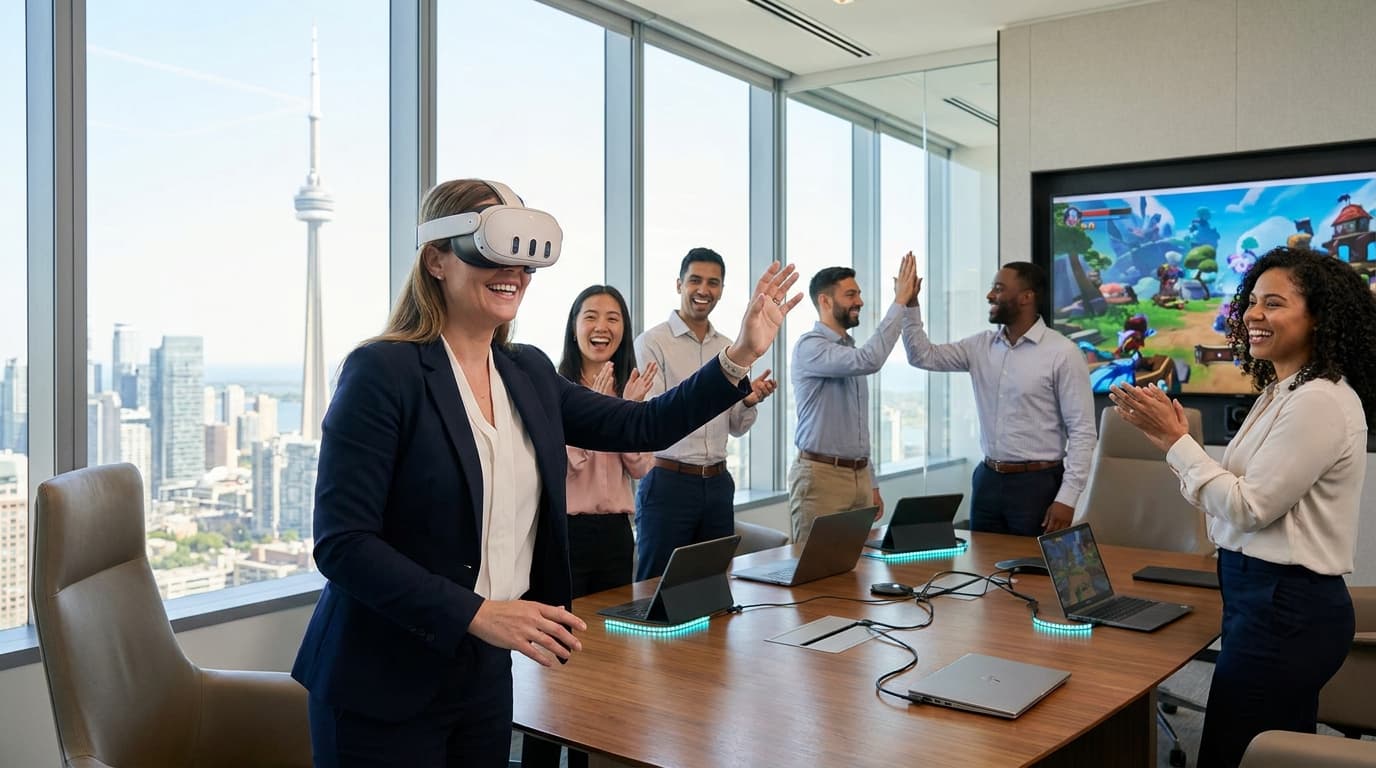
If you're the person tasked with finding the best vr games for team building activities toronto, I know exactly the tightrope you're walking. You need something that excites the younger marketing hires, doesn't terrify the senior accounting partners, and fits seamlessly into an empty boardroom or a rented loft in Liberty Village.
I've personally facilitated over 200 VR events across the corporate scene in this city. I've hauled Meta Quest 3 headsets into the Metro Toronto Convention Centre, mapped complex tracking boundaries in pillar-heavy Yorkville basements, and sanitized 40 sweaty headsets at midnight after a massive tech gala. I can tell you definitively that virtual reality only works as a corporate icebreaker if you nail two things: the specific game mechanics you deploy, and how you manage the 90% of people who are waiting in line.
Let's break down exactly how to structure a VR session that leaves your staff talking about the event for weeks, rather than nervously watching the clock or hiding in the breakroom.
Curating the Best VR Games for Team Building Activities Toronto Offices Actually Want
Most corporate team exercises fail because they force a single interaction style onto a wildly diverse group of personalities. If you schedule a mandatory physical ropes course or an intense escape room, you immediately alienate anyone who feels physically or socially uncomfortable in that environment.
Virtual reality levels the playing field, but only if you use curated, specifically chosen experiences. At VRPlayin, our average corporate group size is 25-40 guests. Out of those groups, usually half claim they are "not gamers." Yet, our repeat booking rate sits at 40%. Why? Because we don't just throw people into random shooters. We use specific game categories designed to build trust.
The Co-Op Heavyweights: Games Where Communication is Mandatory
For actual team building, you need games that force communication between the person in the headset and the people in the physical room. We call this asymmetric VR.
Keep Talking and Nobody Explodes is the ultimate communication stress-test. One person wears the headset and finds themselves trapped in a virtual room with a ticking time bomb. They cannot see the manual. The rest of the team sits at the boardroom table with physical, printed manuals (or PDFs on their phones), frantically trying to decipher the defusal codes based entirely on the VR player's verbal descriptions. When a quiet Bay Street analyst successfully talks a frantic VP through cutting the correct wire with two seconds left, team trust forms instantly.
Cook-Out: A Sandwich Tale (1-4 players) is another powerhouse. It puts up to four players in a virtual fantasy kitchen where you literally have to shout at your coworkers for ingredients. Someone is chopping tomatoes, someone is grilling meat, and you have to physically hand plates to each other in VR to complete orders. It perfectly simulates high-stress project management in a hilarious, low-stakes environment. This is why we focus heavily on VR team building packages that emphasize verbal collaboration over joystick skill.
The Social Icebreaker: Low-Intensity VR
You can't start an event at maximum intensity. Do not bury your team in complex tutorials; your anchor game should be instantly recognizable.
Walkabout Mini Golf (1-8 players) is our gold standard for social VR. The premise requires zero explanation: you hold the controller, point, and putt. The courses range from pirate coves to zero-gravity space stations, providing incredible visual fidelity without demanding rapid physical movement.
Because it's a low-intensity experience, the pace is perfect for networking. Colleagues can literally stand next to each other in the virtual world as avatars, chat about their weekend, and play a relaxed round of golf. It serves as the ultimate gateway drug for non-gamers and older staff members who might be intimidated by faster-paced digital environments.
The High-Energy Spectator Sports
Once your team is comfortable and the drinks are flowing, you need to inject some adrenaline into the room. To flesh out your list of event options, you want single-player games that cast perfectly to a large spectator TV, turning a solo activity into a raucous spectator sport.
Beat Saber is the world's most popular VR game for a reason. You slash colored blocks to the beat of energetic music using virtual lightsabers. It gets the heart rate up, it's incredibly satisfying, and the learning curve is about ten seconds. We see the loudest crowd reactions when a quiet developer hits a perfect combo on a difficult song while their entire department cheers at the TV feed.
Pistol Whip is for the adrenaline chasers. It's a cinematic rhythm shooter where players physically duck, dodge bullets, and return fire to a driving electronic beat through neon environments. Participants come out of this feeling like John Wick. It's an incredible energy booster for the final hour of your event.
The 60-Second Host Script That Keeps 40 Spectators Hooked
The biggest mistake amateur VR facilitators make is completely ignoring the people waiting in line. In a standard corporate setting, guests are playing for 3-5 minutes per turn. If you don't actively engage the spectators, they will wander back to their desks and the event energy will flatline.
Because we use dedicated networking gear to cast what the player sees onto large TVs, our facilitators act as live e-sports commentators. Here is the exact framework script we use to maintain high energy in the room:
"Alright everyone, eyes on the screen! Sarah from HR just cleared level two without missing a single block—let's hear it for her! We have exactly two minutes left on the clock. John, you're up next, I need you stretching those shoulders out right now. Who thinks they can beat Sarah's high score of 45,000? Remember, swinging harder doesn't get you points, it's all about the wide arcs. Ten seconds left Sarah, bring it home!"
This kind of active facilitation transforms solitary gameplay into a shared, highly competitive experience. It's the secret sauce that makes our corporate social events maintain explosive energy from the first minute to the last.
DIY Rentals vs. Managed Mobile VR Events Canada
When planning your event, you essentially have two routes: the stressful DIY rental or a fully managed service.
The DIY Headset Rental Approach
Renting a few consumer headsets from a local tech shop and dropping them on a conference table seems cheap. It's actually a logistical nightmare. You suddenly become the IT support desk. You'll spend the first 45 minutes of your 2-hour event trying to connect headsets to the corporate guest Wi-Fi—only to discover your company firewall actively blocks Meta's gaming servers. You'll struggle to draw guardian boundaries while people walk through the play space, and you'll constantly explain button layouts to impatient executives. Without extra battery straps, consumer headsets die in about 90 minutes. Finally, you have to manage the hygiene yourself, which usually means awkwardly passing a sweaty foam faceplate between coworkers.
The Fully Managed VR Service
This is what we do as a premier provider of mobile VR events. We require 60-90 minutes before your event start time to assess the venue. We establish a minimum safe footprint of 6.5 by 6.5 feet per standing station, moving tables if necessary. We bring our own enterprise-grade routers to bypass your restrictive corporate Wi-Fi. We deploy Meta Quest 3 Business Editions with extended battery packs, and we always bring backup hardware so equipment failure never ruins your momentum.
Most importantly, we manage the queue and the hygiene. We use medical-grade silicone face covers that are swapped and rigorously sanitized with UV-C technology and antibacterial wipes between every single user. You get to actually drink your coffee and participate in your event instead of troubleshooting tech.
Addressing the Two Main Roadblocks: Nausea and Non-Gamers
If you pitch VR to your leadership team, they will inevitably ask two questions: "Will people get motion sickness?" and "What if half our team doesn't play video games?"
The Motion Sickness Reality
We curate zero-nausea experiences specifically for corporate events. We rely entirely on 1:1 room-scale gameplay with zero artificial locomotion. Your physical feet stay planted, and the virtual world moves around you naturally. Across our 200+ completed events, fewer than 2% of guests report any discomfort. Our staff is highly trained to spot early signs of hesitation and can switch a user to a seated, perfectly stable experience within seconds.
The Non-Gamer Advantage
You don't need to know how to navigate a complex Xbox controller to enjoy VR. Our most requested full VR game catalog features titles that rely entirely on intuitive human motion. If you know how to point your finger, grab an object, or swing your arm, you can master these experiences instantly. We deliberately design our lineups so that the senior leadership team can compete directly with the junior staff on completely equal footing.
Proof From the Field
We maintain a 4.9-star Google rating precisely because we execute on these operational details. As the VP of People & Culture at a major Toronto SaaS company told us recently: "We've booked VRPlayin three times now. Each event, they bring something new and the team completely drops their guards."
Choosing the right VR setup requires intimately understanding your team dynamics, your venue constraints, and your logistical limits. Stick to accessible, highly social games, ensure you have a rock-solid plan for spectator engagement, and prioritize flawless hygiene. Do that, and your team building event will actually build a team.
Let Us Handle the Hardware and the Hosting
Stop worrying about Wi-Fi passwords and sanitizing headsets. We will bring the Meta Quest 3s, manage the crowd, and keep your entire team engaged from setup to teardown.
SEE TEAM BUILDING PACKAGES