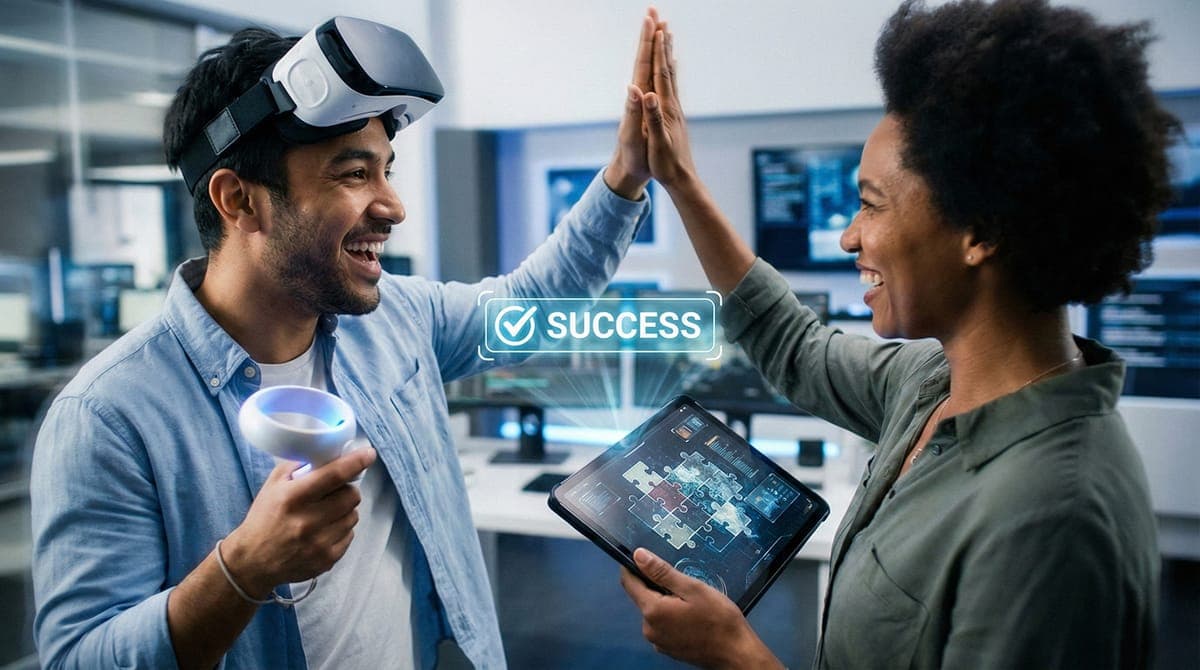
The 5 VR team building activities that work best for corporate groups are high-energy rhythm challenges like Beat Saber, social networking simulations like Walkabout Mini Golf, asymmetric multiplayer games like Acron: Attack of the Squirrels!, collaborative crisis management in Cook-Out, and low-stakes physics playgrounds like Job Simulator. These experiences prioritize accessibility, zero-nausea gameplay, and spectator engagement over complex gaming mechanics.
The Truth About Corporate Fun (From Someone Who Has Seen It All)
I’ve seen the terror in an HR Director’s eyes when a "fun" activity goes dead silent. You know the vibe: forty adults standing in a circle in a conference room, frantically avoiding eye contact while a facilitator tries to force enthusiasm out of a trust fall.
I’ve also seen the exact opposite. I’ve seen a reserved Senior Accountant from a Bay Street firm loosen his tie, put on a headset, and absolutely shred a guitar solo in VR while his entire department cheered him on. I’ve seen interns giving strategic orders to VPs during a virtual bomb defusal. I’ve cleaned 40 headsets at midnight after a 300-person gala at the Enercare Centre, exhausted but buzzing because I just watched a team of skeptics turn into a cohesive unit.
We’ve run over 200 events across the GTA, from small startups in Liberty Village to massive town halls in the Financial District. If there is one thing that data tells us, it's that corporate team building toronto planners are tired of forced fun. They want genuine engagement.
The secret isn't just "renting VR." It's curating the right activities that bridge the gap between gamers and non-gamers. Below is a deep dive into the five specific formats that actually deliver results, along with the operational math you need to plan your event.
1. The Icebreaker: High-Energy Rhythm Competitions
The Game: Beat Saber (1 Player VR + Spectators)
If you have ever been to one of our events, you know this is non-negotiable. It is the world’s most popular VR game for a reason. The mechanic is simple: you hold two lightsabers and slash blocks to the beat of the music. It requires zero explanation and about 10 seconds to learn.
- Best For: High-energy crowds, sales kick-offs, and competitive groups.
- Throughput: 15-20 players per hour, per station (playing 3-minute songs).
- Nausea Rating: 0/10 (Stationary).
Why It Works for Teams:
It destroys inhibition. There is something primal about slashing blocks to a heavy beat. It gets the heart rate up and immediately changes the energy in the room. Because we cast the gameplay to a TV screen, it becomes a spectator sport.
The Tournament Format:
We run this as a "High Score Challenge." We set up a physical whiteboard next to the station. Players pick from a curated list of 3 songs (usually classic rock or pop hits everyone knows). Top 3 scores go on the board. At the end of the night, the winner gets a prize. This creates a low-stakes, voluntary rivalry that permeates the room without forcing anyone to participate.
2. The Digital Water Cooler: Social Mini Golf
The Game: Walkabout Mini Golf (1-4 Players VR)
When clients ask for corporate social events that allow for networking, this is my default recommendation. Walkabout Mini Golf is the gold standard for social VR. The physics are perfect, but the magic is in the pacing. You are strolling through pirate coves or space stations, putting balls, and—most importantly—talking.
- Best For: C-Suite executives, networking hours, and "non-gamers."
- Throughput: 4 players per 20 minutes (Groups of 4).
- Nausea Rating: 1/10 (Teleportation movement eliminates motion sickness).
Why It Works for Teams:
It levels the playing field. Unlike shooter games where the 22-year-old marketing coordinator might destroy the 50-year-old executive, mini-golf is universally understood. It’s low intensity, which means it’s perfect for the "I don't do video games" crowd. We can link headsets so four colleagues are on the same virtual course, even if they are standing in different corners of the physical office.
3. The Inclusion Engine: Asymmetric Multiplayer
The Game: Acron: Attack of the Squirrels! (1 VR Player + 8 Mobile Phone Players)
This is the secret weapon for mobile vr team building. One of the biggest logistical challenges with VR is throughput—what do the other 20 people do while one person is in the headset? Acron solves this brilliantly by utilizing the devices everyone already has in their pockets.
- Best For: Large groups with limited space/budget.
- Throughput: ~50 players per hour (1 headset + 8 phones per round).
- Nausea Rating: 0/10.
How It Works:
The person in VR is a giant tree protecting golden acorns. Up to eight other colleagues join the same game using their own smartphones (iOS or Android) as squirrels. The squirrels have to work together—some build bridges, some use shields, some run fast—to steal the nuts. It turns a solitary VR station into a 9-person party game.
Real-World Scenario:
We ran an event at a law firm near King and Bay. The partners were hesitant to put on the headsets (worried about looking silly), but they were more than happy to pull out their phones to sabotage their associates. Once they saw how fun the "tree" role was, the headsets didn't stay empty for the rest of the night. It bridges the physical-digital divide better than any other activity.
4. The Pressure Cooker: Collaborative Communication
The Game: Cook-Out: A Sandwich Tale (Multiplayer VR)
If you want to test your team's communication skills without a boring seminar, put them in a magical kitchen. Cook-Out requires players to prepare increasingly complex sandwich orders for hungry fantasy creatures. You have to chop, grill, and assemble, but you can't do it alone—you have to ask your partner for the ketchup.
- Best For: specific team-bonding modules, small teams (4 people).
- Throughput: 12 players per hour (3-4 headsets linked).
- Nausea Rating: 0/10.
Why It Works for Teams:
It reveals leadership styles instantly. Who crumbles under pressure? Who starts delegating tasks? Who stays calm when the grill catches fire? "Even our executives who 'don't do games' were laughing and high-fiving in VR," an Executive Assistant from a major Toronto law firm told us after their holiday party. It forces collaboration in a way that feels organic, not mandated by HR.
5. The Zero-Stakes Playground: Physics Simulations
The Game: Job Simulator (1 Player VR)
Sometimes, the best VR team building packages aren't about competition or strategy—they are about shared laughter. Job Simulator takes mundane tasks (office work, cooking, auto repair) and turns them into slapstick comedy.
- Best For: The timid, the observers, and the comic relief.
- Throughput: 10-12 players per hour (longer dwell time).
- Nausea Rating: 0/10.
Why It Works for Teams:
It is pure comedy. The player in the headset might be "photocopying" their virtual face or throwing a stapler at a robot boss. The spectators watching on the TV are usually laughing harder than the player. It lowers the barrier to entry significantly. There is no "winning," only experimenting. For a shy team member, this is a safe, low-pressure way to participate and get a big laugh from the group.
The Math of Mobile VR: How Many Headsets Do You Need?
The most common mistake corporate planners make is underestimating the throughput. If you have 100 people and 1 headset, you will have 95 angry people. Here is the formula we use when planning events for Toronto clients:
The "Cocktail Hour" Ratio (Casual Play)
For a standard networking event where VR is an amenity (not the sole focus), you need 1 VR Station for every 20-25 guests.
- Example: 100 guests = 4 VR Stations.
- Result: Everyone who wants to play gets to play at least once.
The "Team Building" Ratio (Structured Play)
If the event is specifically about the activity (e.g., a team offsite), you need 1 VR Station for every 10-12 guests.
- Example: 50 guests = 4-5 VR Stations.
- Result: Teams can rotate through efficiently with minimal downtime.
Sample Agenda: The 2-Hour Corporate Social
How does this actually look in practice? Here is a typical run-of-show for a 50-person event at a client’s office:
16:00 - Setup & Safety Check
Our technicians arrive 60 minutes early. We map the safety zones (6.5 x 6.5 ft per station), sanitize the gear, and sync the casting TVs. We check for infrared interference (sunlight is the enemy of VR tracking).
17:00 - Event Start: The "Soft Open"
Activity: Job Simulator & Walkabout Mini Golf
As people grab drinks and food, we open the stations with low-pressure, casual games. This allows the early birds to get comfortable with the controllers without an audience watching them.
17:45 - The High Energy Shift
Activity: Beat Saber High Score Challenge
The energy in the room usually peaks here. We switch the stations to Beat Saber. The whiteboard comes out. We encourage departments to challenge each other. The music gets louder.
18:30 - The Multiplayer Finale
Activity: Acron (Mobile vs VR)
As things wind down, we switch to asymmetric games involving smartphones. This gets large groups involved simultaneously for a final shout-and-laugh session.
19:00 - Teardown
We pack up. No trace left behind.
The Operator’s Perspective: Why Logistics Make or Break the Event
You can pick the best games in the world, but if the logistics fail, the event fails. I cannot stress this enough: VR is 90% preparation.
When we arrive at a venue—whether it's the loading dock at the Sheraton Centre or a private room at Steam Whistle Brewing—we aren't just plugging in headsets. We are assessing three critical environmental factors:
- Lighting: VR headsets use cameras to see the world. Too dark? They lose tracking. Too much direct sunlight? The IR washes out. We bring our own bias lighting to correct this.
- Interference: In downtown Toronto offices, the WiFi bands are congested. We use dedicated Wi-Fi 6E routers for our multiplayer setups (like Cook-Out) to ensure zero latency. If the game lags, the player gets motion sick. We don't allow lag.
- Hygiene: This is a high-intensity activity. People will sweat. We use medical-grade silicone face covers that are replaced and sanitized between every single user, along with UV-C sanitization. We don't mess around with hygiene—especially when your CEO is the one putting the headset on next.
As one SaaS VP of People & Culture told us, "We've booked VRPlayin three times now. Each event, they bring something new and the team loves it." That consistency comes from operational discipline, not just flashy hardware.
Bringing It to Your Office
You don't need a massive convention hall to make these employee engagement activities work. We regularly set up in office cafeterias, boardrooms, and hotel suites. As long as you have a 6.5 x 6.5-foot clearing for standing players (or 3x3 for seated ones), we can turn the space into a virtual arcade.
If you are planning your next quarterly onsite or holiday party, consider skipping the bowling alley this year. VR offers a flexibility that traditional venues can't match—bringing the competition, the collaboration, and the comedy directly to your door.
Build a Better Team Event
Don't settle for another awkward happy hour. Let us curate a custom VR experience that gets your team talking, laughing, and collaborating.
VIEW TEAM BUILDING PACKAGES